SEO vs SEM: The Difference, and When Each One Wins
SEM now means paid search; SEO means the organic results. What each one really costs, how fast each works, and how to split a limited budget.
SEO and SEM are not two competing channels. SEM — search engine marketing — is the umbrella term, and in everyday industry use it has narrowed to mean paid search advertising, while SEO means the unpaid organic results below and around the ads. The real difference is how the position is obtained. With paid search you win an auction and pay per click, and the traffic stops the day the card stops working. With SEO you earn the position through crawlable, relevant, credible pages, and the traffic persists but takes months to arrive. Same results page, two entirely different cost structures.
The question worth asking is not which one is better. It is which one buys qualified traffic at an acceptable cost given the time and money actually available. That has a different answer at ₹20,000 a month than at ₹5,00,000 a month, and a different answer in month one than in month twelve.
What is the actual difference between SEO and SEM?
Search engine optimisation is the practice of earning organic positions in search results. Search engine marketing, as the term is used commercially today, is buying positions through Google Ads or Microsoft Advertising. The two appear on the same page and answer the same query, but almost nothing else about them matches.
| Dimension | SEO (organic) | SEM (paid search) |
|---|---|---|
| How the position is won | Relevance, quality and authority signals assessed by ranking systems | An auction, scored on bid and ad quality |
| What you pay for | Work — audits, content, development, links | Clicks, at a price the auction sets |
| Time to first result | Weeks for technical fixes, three to six months for meaningful traffic | Same day |
| If you stop spending | Traffic decays slowly over months or years | Traffic stops within hours |
| Control over position | Indirect. You influence, you do not decide | Direct. Raise the bid, move up |
| Cost behaviour as you scale | Cost per visit falls as traffic grows against a fixed fee | Cost per visit stays flat or rises with competition |
Because the cost curves move in opposite directions, the honest comparison is not a single number. Paid search is predictable and expensive. SEO is unpredictable early and cheap late.
Is SEM just another word for PPC?
In practice, yes — and it is worth saying so plainly rather than pretending the textbook definition still holds. When SEM entered common use in the early 2000s it covered everything a business did to be visible in search engines, organic work included. Over roughly two decades the usage drifted, and today a vendor selling “SEM services” is almost always selling Google Ads management.
The drift matters for one practical reason: check which definition a proposal is using. In the original umbrella sense, “SEO vs SEM” is a category error, because SEO sits inside SEM. In the modern sense it is organic versus paid, which is a real choice. The rest of this article uses the modern sense.
Which one costs less?
Paid search costs less to start and more to sustain. Organic search costs more to start and less to sustain. The crossover point is what actually decides the answer for your business.
Paid search cost is a per-click price multiplied by volume. It is set by an auction, so it rises when competitors bid harder and falls when they leave. Nothing you did last quarter reduces this quarter’s click price, other than improving ad relevance, which affects your cost through the quality component of the auction. That is the mechanic behind Google’s Quality Score — better ad and landing page relevance can lower what you pay for the same position, but it never makes clicks free.
SEO cost is a fixed monthly figure — a retainer, a salary, or your own time. PalV’s DM prices retainers at ₹5,000 a month for SEO Foundation, ₹10,000 for Growth and ₹15,000 for Ultimate, with standalone services from ₹500. Those numbers do not change whether the pages bring 200 visits a month or 20,000, which is the whole point: the effective cost per visit falls as the asset base grows.
The comparison that settles it is a per-visit one. Take your monthly SEO spend, divide by the organic sessions it produces on relevant queries, and compare that with the cost per click you are paying on the same keywords. Working out your break-even cost per click first is what turns this from an argument into arithmetic, and calculating SEO return honestly requires the same discipline.
Which one works faster?
Paid search works the same day. A campaign built this morning can be receiving clicks by this afternoon, which makes it the only sensible option when the deadline is measured in weeks.
Organic search does not work that way. Technical and indexation fixes can register within days. Pages already sitting at positions 8 to 20 often move with on-page work alone. But new pages competing for commercial terms typically take three to six months to produce meaningful traffic, and competitive head terms take the better part of a year. The month-by-month breakdown of an SEO timeline sets out what to expect at each stage, and any promise materially faster than that deserves scrutiny.
Speed is the single strongest argument for paid search and the single weakest for SEO. It is also the reason the two are so often run together rather than chosen between.
When does SEO win?
- When the budget is small and the horizon is long. Below roughly ₹25,000 a month, paid search on a competitive term buys too few clicks to learn anything, while the same money funds real organic work.
- When the query is informational. Nobody wants to click an ad to find out how something works. Research-stage queries convert badly on paid and build durable value organically.
- When cost per click in your category is punishing. Insurance, legal, finance and software categories have click prices that make paid acquisition unprofitable for small operators well before it becomes unprofitable for large ones.
- When you are building for AI answers too. Generative engines cite pages, not adverts. Optimising for AI search surfaces runs on the same content and credibility work as organic search, so the same spend serves two channels.
When does paid search win?
- Launches and deadlines. A product going live in six weeks cannot wait for organic to build.
- Testing demand before committing. A small campaign tells you within a fortnight whether a keyword produces enquiries. That is cheaper than finding out after commissioning twenty articles.
- Seasonal spikes. Festive-season peaks arrive and pass faster than organic can respond to them.
- Queries where the entire result page is commercial. If ads, shopping units and an AI answer occupy everything above the fold, the organic position that remains may not be worth the work.
How do SEO and paid search work together?
Running both is not a hedge; each channel produces something the other cannot buy. Four connections are worth building deliberately.
- Paid data prices your content plan. Search Terms reports show the exact queries that converted, with conversion counts attached. That is the closest thing to ground truth about commercial intent, and it beats any keyword tool estimate for deciding what to write next.
- Organic data cuts wasted paid spend. Where you already hold a strong organic position, the incremental value of also buying the click is lower. Attributing paid and organic properly is what keeps this from becoming guesswork.
- Landing pages get tested faster. Paid traffic reaches statistical usefulness in days rather than quarters, so headline and offer decisions can be made on paid traffic and applied to organic pages. The structural differences between paid and organic landing pages decide how far that transfers.
- Coverage while SEO matures. Paid holds the commercial terms during the months organic is still climbing, then scales back as positions land. Running SEO alongside an existing Ads account is the normal case, not the exception.
How should a limited budget be split?
There is no universal ratio, but there is a sequence that avoids the two common failures — spending on ads with nowhere to send the traffic, and spending on content nobody has confirmed anyone buys.
- Fix what blocks organic first. Indexation problems, broken canonicals and unusable mobile pages waste paid clicks as well as organic ones. This is the cheapest work available and it improves both channels.
- Buy a small amount of intent data. A limited campaign on your five most commercial keywords, run long enough to produce conversions, tells you which terms are worth a content programme.
- Move budget toward organic as evidence arrives. Once a term is proven to convert, the case for owning it permanently is strong. Setting a realistic SEO budget is the next decision.
- Keep paid on the terms organic cannot reach. Some head terms are not winnable at your authority level this year, and buying those clicks is rational.
- Measure both against the same denominator — cost per qualified enquiry, not cost per click and not rankings. Comparing organic and paid traffic on equal terms requires one shared definition of a good outcome.
The short version: paid search buys attention, SEO earns it, and the sensible order for most small businesses is to fix the technical basics, use a small paid budget to find out which keywords produce revenue, and then invest organic effort in owning exactly those. The direct Google Ads versus SEO comparison goes deeper on the auction mechanics, and the confirmed organic ranking factors set out what the organic side is actually competing on.
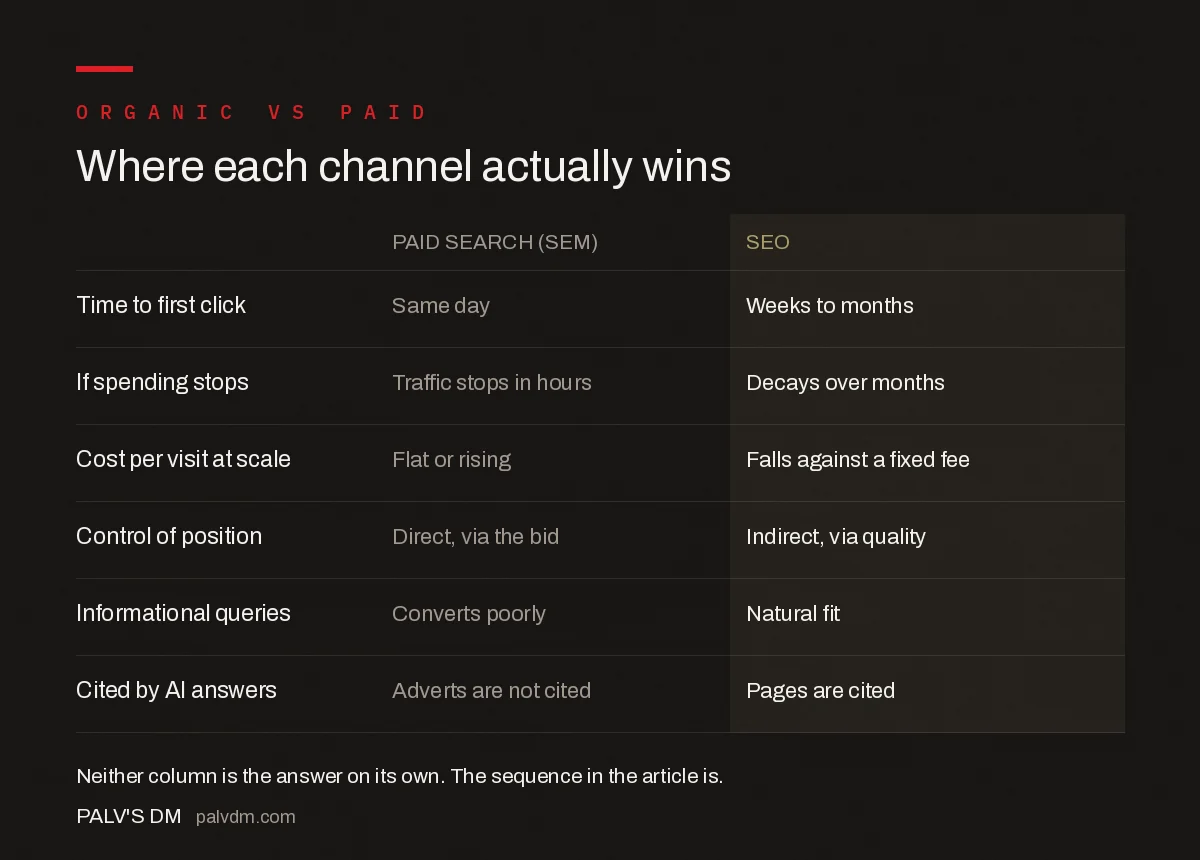
Where each channel actually wins
| Paid search (SEM) | SEO | |
|---|---|---|
| Time to first click | Same day | Weeks to months |
| If spending stops | Traffic stops in hours | Decays over months |
| Cost per visit at scale | Flat or rising | Falls against a fixed fee |
| Control of position | Direct, via the bid | Indirect, via quality |
| Informational queries | Converts poorly | Natural fit |
| Cited by AI answers | Adverts are not cited | Pages are cited |
Frequently asked questions
Is SEM the same as PPC?
In current industry usage, effectively yes. SEM originally covered everything done to gain visibility in search engines, organic work included. Today a vendor selling SEM services is almost always selling paid search management in Google Ads or Microsoft Advertising. Check which definition a proposal is using before comparing quotes, because the scope differs enormously.
Is SEO cheaper than paid search?
It is cheaper per visit once traffic accumulates, and more expensive per visit at the start. Paid search cost scales directly with clicks, so the price per visit stays flat or rises as competition increases. SEO cost is a fixed monthly figure, so the cost per visit falls as the number of ranking pages grows. Compare the two on cost per qualified enquiry, not cost per click.
Should a new business start with SEO or Google Ads?
Usually both, in a specific order: fix indexation and technical problems first because they waste paid clicks too, then run a small paid campaign on your most commercial keywords to find out which ones actually produce enquiries, then invest organic effort in owning exactly those terms. Paid search buys evidence quickly; SEO turns that evidence into an asset.
Does running Google Ads help organic rankings?
No. Google has stated repeatedly that Ads spend does not influence organic rankings, and the two systems are separate. What paid search does provide is data — Search Terms reports show the exact queries that converted, which is far more reliable than keyword tool estimates when deciding what content to commission next.
How long before SEO replaces paid search spend?
Rarely fully, and not quickly. Expect three to six months before organic produces meaningful traffic on mid-competition terms and closer to a year on competitive head terms. Most businesses reduce paid spend on terms where organic has landed rather than switching off entirely, keeping ads on head terms their authority cannot yet reach.
What is a reasonable split between SEO and paid budget?
There is no universal ratio, because it depends on urgency and click prices in your category. A practical rule for small budgets: if you need enquiries within eight weeks, weight paid; if you can wait two quarters and your category has high click prices, weight organic. Below roughly ₹25,000 a month total, splitting thinly across both usually underfunds each.
Sources
- Do you need an SEO? — Google Search Central
- About Quality Score for Search campaigns — Google Ads Help
- Creating helpful, reliable, people-first content — Google Search Central
Want this done on your site?
Every PalV’s DM engagement starts with a free audit of your actual website — a 12-point
crawl covering what is blocking indexation, on-page gaps against your primary keywords, speed
findings, and the three to five fixes worth making first. Delivered in two working days. No
payment details, and the findings are yours whether you hire us or not.