Why Google Ignores Your Sitemap Priority Values
Google confirms it ignores XML sitemap priority and changefreq values. What Google actually uses instead, and where sitemap effort is worth spending.

Google ignores the priority and changefreq values in your XML sitemap. This isn’t a suspicion or a workaround someone reverse-engineered; Google’s own Search Central documentation states it directly. The myth persists because the tags are still valid XML sitemap protocol fields, plugins still generate them by default, and it feels intuitive that telling Google “this page matters more” should do something. It doesn’t.
The confusion costs real time. Teams debate whether the homepage should be 1.0 and category pages 0.8, or argue about whether changefreq should say “daily” or “weekly” for a blog, when none of it changes what Google crawls or how often. That energy is better spent on the one sitemap field Google actually reads.
Does Google really ignore sitemap priority?
Yes. Google’s guide to building and submitting a sitemap is explicit that priority and changefreq don’t influence crawling behaviour. The values are self-declared by the site owner, and Google’s crawling systems have found self-reported importance scores to be an unreliable signal — nearly every site marks most of its pages as high priority, which makes the field meaningless as a ranking signal across the web. Google determines crawl priority using its own independent signals instead: internal link structure, page popularity, and how often content actually changes.
Where exactly has Google said this?
This is not an inference from crawl behaviour or a conclusion someone drew from a log file study. It is written into Google’s own documentation.
The Search Central page on building and submitting a sitemap states plainly that Google ignores <priority> and <changefreq> values, and that it uses <lastmod> only where the value is consistently and verifiably accurate — for instance, where it can be checked against the page’s actual last modification.
Gary Illyes of Google’s Search Relations team has been less diplomatic about it in public, describing the priority field as a bag of noise.
John Mueller made the same point as far back as a 2015 office-hours session, explaining that a direct timestamp is more useful than a self-assigned priority because Google can check a timestamp against its own crawl records.
That last clause is the whole story. Every field in a sitemap falls into one of two categories: things Google can verify independently, and things it has to take your word for. <loc> is verifiable — the URL either resolves or it does not. <lastmod> is verifiable, because Google has a copy of what the page looked like last time it crawled.
<priority> and <changefreq> are not verifiable by anything. They are a site owner’s opinion about their own content, submitted by the site owner, with no cost to inflating it. Predictably, almost every CMS that writes them defaults the homepage to 1.0 and most other things to 0.8, which tells a crawler precisely nothing.
Does anything still read them?
The sitemaps.org protocol still defines both fields, so they remain valid XML and will not cause errors. Some smaller crawlers and internal enterprise systems may still parse them.
Weigh that against the maintenance cost. Keeping accurate priority values across a few hundred URLs is real ongoing work, and the payoff is a hint that the crawler responsible for essentially all your organic traffic discards on read. Spend the effort on lastmod accuracy instead.
Myth: setting priority to 1.0 gets a page crawled first
The claim: Marking your most important pages priority=”1.0″ in the sitemap tells Google to crawl them before lower-priority URLs.
The reality: Priority values have no effect on crawl order or crawl frequency. A page declared priority 1.0 with no internal links pointing to it will still sit unclawled far longer than a priority 0.3 page linked from the homepage. Google’s crawlers assess importance through observed signals, not declared ones.
Why the confusion exists: The XML sitemap protocol itself, which predates Google’s current crawling infrastructure, defines priority as a legitimate field with defined semantics (“this value does not affect how your pages are compared to pages on other sites”). Early SEO advice treated it as a lever because it looked like one. WordPress SEO plugins auto-generate it, reinforcing the idea that it must matter if it’s there by default.
Myth: changefreq controls how often Google recrawls a page
The claim: Setting changefreq to “daily” on frequently updated pages makes Google recrawl them daily.
The reality: Google ignores changefreq for the same reason as priority: it’s a claim, not a measurement, and site owners routinely set it inaccurately, often defaulting every URL to “weekly” or “daily” regardless of actual update patterns. Google instead observes real change frequency by comparing crawled content and the lastmod timestamp over time.
Why the confusion exists: Changefreq conceptually overlaps with lastmod, and older SEO guidance from more than a decade ago treated both as crawl-scheduling tools before Google’s crawling infrastructure matured past taking self-reported claims at face value.
What does Google actually use from your sitemap?
| Sitemap field | Does Google use it? | What it’s for instead |
|---|---|---|
| loc (URL) | Yes — required | Tells Google the URL exists and should be considered for crawling |
| lastmod | Yes, if accurate | Signals when a page genuinely changed; helps prioritise recrawls |
| priority | No | Ignored; self-reported values aren’t trusted across the web |
| changefreq | No | Ignored; superseded by observed lastmod accuracy |
That leaves two fields worth any maintenance effort: the URL list itself, kept current and free of 404s or redirects, and lastmod, kept honest.
How do you make lastmod a signal Google trusts?
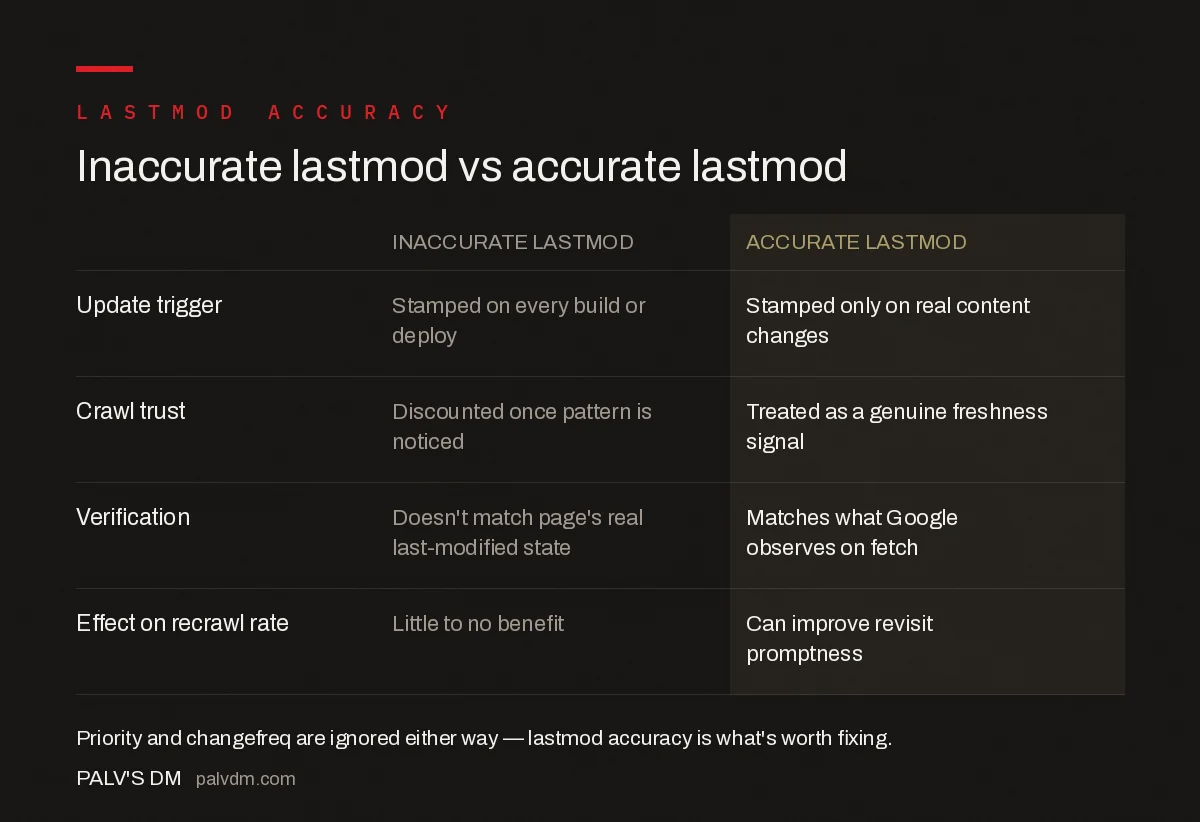
Inaccurate lastmod vs accurate lastmod
- Update trigger — Inaccurate: stamped on every build or deploy. Accurate: stamped only when page content meaningfully changes.
- Crawl trust — Inaccurate: discounted once Google notices the pattern. Accurate: treated as a genuine freshness signal.
- Verification — Inaccurate: doesn’t match the page’s real last-modified state. Accurate: matches what Google observes when it fetches the page.
- Effect on recrawl rate — Inaccurate: little to no benefit, sometimes actively ignored. Accurate: can improve how promptly changed pages get revisited.
The practical rule: only update a URL’s lastmod value in your sitemap when the page’s visible content actually changes, not on every deploy, template tweak, or unrelated site-wide update. Auto-generated sitemaps that touch lastmod on a nightly rebuild regardless of content changes are training Google to distrust the field.
What should you actually spend sitemap effort on?
- Keep the URL list accurate. Every URL in the sitemap should return a 200 status and be the canonical version of the page — no redirects, no noindexed URLs, no 404s.
- Split large sitemaps properly. Sites above roughly 50,000 URLs need a sitemap index file pointing to multiple child sitemaps, not one bloated file.
- Stamp lastmod honestly. Only touch it when content changes, and make sure the value is verifiable against the page’s actual state.
- Resubmit after major changes. Ping Google Search Console after a URL structure migration or large content update rather than waiting for a scheduled recrawl.
- Drop priority and changefreq if you want. Not required, but not worth debugging time either. Leave the default if your CMS generates them; don’t hand-tune them expecting an effect.
Frequently asked questions
Does setting sitemap priority to 1.0 make Google crawl a page first?
No. Google has stated it disregards the priority value entirely because it’s self-reported and unreliable across sites. A page marked 1.0 gets no crawl advantage over one marked 0.5; Google’s own signals, like internal links and popularity, decide crawl order instead.
Should I remove priority and changefreq from my sitemap?
You can leave them in without harm, since Google simply ignores them, but there’s no reason to spend time maintaining them. Removing them shrinks file size slightly on very large sitemaps and removes a source of confusion for anyone auditing the site later.
What sitemap field does Google actually use to prioritise crawling?
The lastmod tag, but only when it’s consistently accurate. Google cross-checks the declared lastmod date against the page’s actual last modification. Sitemaps that stamp every URL with today’s date regardless of real changes get that trust discounted or ignored.
What actually determines a page’s crawl priority if not the sitemap?
Internal link equity, page popularity, content freshness, and overall site crawl demand. A page linked from the homepage and updated regularly gets crawled more often than one buried five clicks deep, regardless of what any sitemap tag claims.
Sources
- Google Search Central — Build and Submit a Sitemap
- Build and Submit a Sitemap — Google Search Central
- Technical SEO: The Complete Working Guide
- XML Sitemaps: What to Include, What to Leave Out
- Conflicting Signals: When Canonical and Sitemap Disagree
- Why Your Page Isn’t Indexed: A Decision Tree
Want this done on your site?
Every PalV’s DM engagement starts with a free audit of your actual website — a 12-point
crawl covering what is blocking indexation, on-page gaps against your primary keywords, speed
findings, and the three to five fixes worth making first. Delivered in two working days. No
payment details, and the findings are yours whether you hire us or not.