WordPress Hosting in India: What to Actually Look For
A practical checklist for choosing WordPress hosting in India: data center location, renewal pricing, caching stack, and when shared hosting stops being enough.

The hosting decision that matters most for a WordPress site in India isn’t the brand name, it’s whether your visitors are actually served from somewhere close to them. A CDN with an Indian point of presence, real NVMe storage instead of spinning disk, and a renewal price you checked before signing up will do more for your site than any “best hosting” listicle ranking.
Most hosting comparison articles are written by affiliates ranking whoever pays the highest commission first. We don’t sell hosting, so there’s no incentive here to push one brand. What follows is what we actually check before recommending a host to a client, and where Indian hosting has quirks that generic “best WordPress hosting” guides written for a US audience don’t cover.
Does hosting location actually matter for an Indian audience?
Yes, though less than it did five years ago. Physical distance between your server and your visitor adds latency: a server in Mumbai reaching a visitor in Bangalore has a shorter round trip than one in Virginia or Frankfurt reaching that same visitor. That difference used to be the whole story. Today, a well-configured CDN with edge points of presence in Mumbai, Chennai or Delhi closes most of that gap even when your origin server sits overseas.
What that means practically: an Indian data center is a genuine advantage, not a requirement. If a host you’re evaluating has strong CDN coverage across Indian cities and reasonable core server response times, don’t rule it out just because the data center itself is in Singapore or the US.
Shared, VPS or managed WordPress: which one fits a business site?
This is the decision most businesses get wrong, usually by staying on shared hosting long after they’ve outgrown it, or by paying for managed hosting they didn’t need yet. We covered the general trade-offs in our shared vs VPS vs managed hosting comparison; here’s how it plays out specifically for Indian business sites.
| Hosting type | Good fit for | Where it breaks down |
|---|---|---|
| Shared hosting | Brochure sites, low-traffic blogs, sites under 1,000 monthly visitors | Shared server resources mean one noisy neighbor site can slow yours; no isolation during traffic spikes |
| VPS hosting | Growing sites, agencies hosting multiple client sites, WooCommerce stores with steady traffic | Requires more server knowledge unless it’s a managed VPS; misconfiguration is on you |
| Managed WordPress hosting | Lead-gen and ecommerce sites where downtime costs money, teams without a dedicated developer on call | Costs more per month; some plans restrict plugin choices for stability reasons |
What checklist should you actually run before choosing a host?
Skip the marketing page and check these directly.
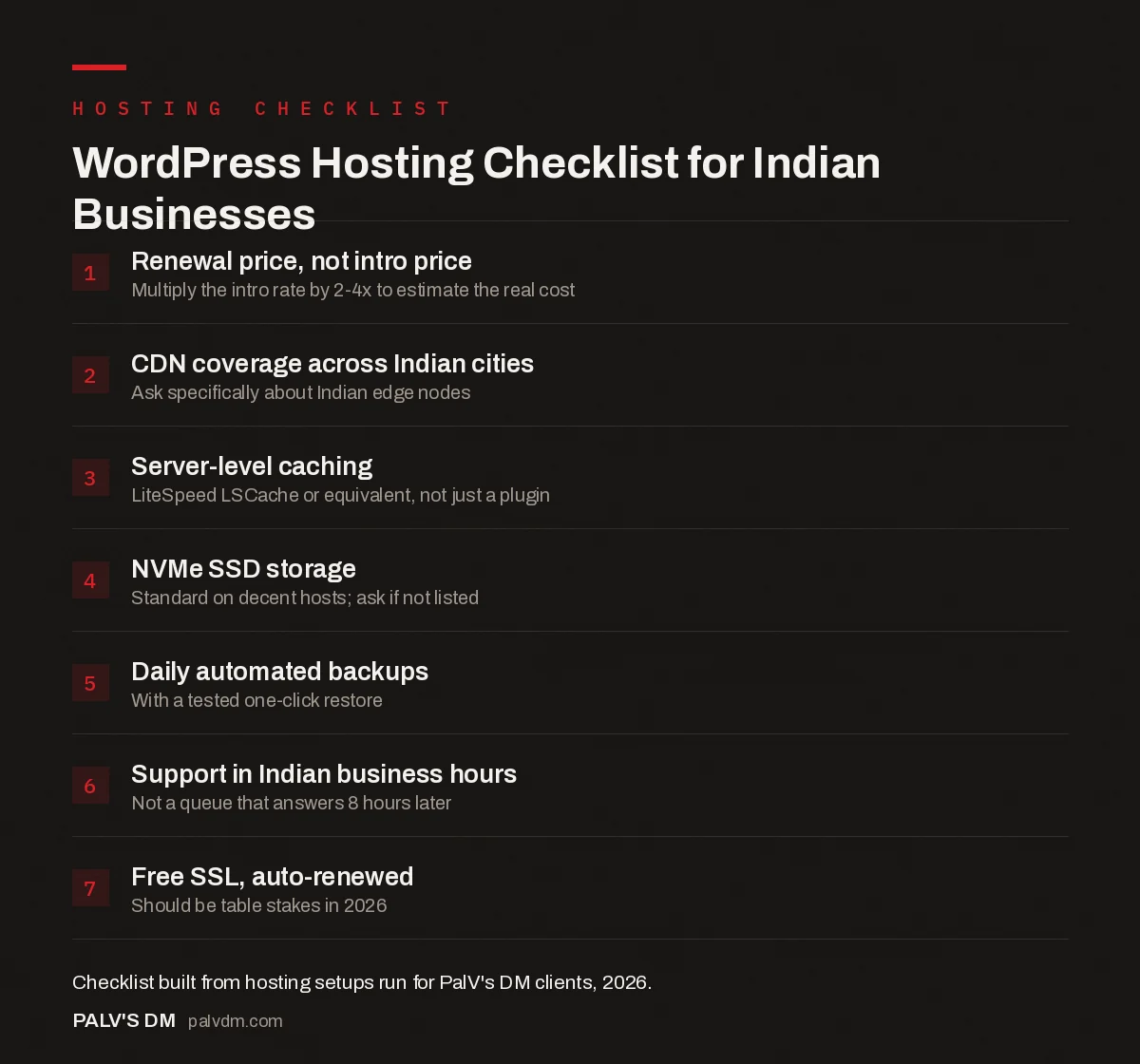
WordPress Hosting Checklist for Indian Businesses
- Renewal price, not intro price. Multiply the intro rate by two to four to estimate what you’ll actually pay after year one.
- CDN coverage across Indian cities. Ask specifically whether their CDN has Indian edge nodes, not just a generic “global CDN” answer.
- Server-level caching, not just a plugin. LiteSpeed with LSCache, or an equivalent server-side cache, outperforms a caching plugin running on generic Apache or Nginx.
- NVMe SSD storage. Standard on most decent hosts now; if a plan doesn’t mention it, ask.
- Backup frequency and restore process. Daily automated backups with a one-click restore, tested, not just claimed.
- Real support hours in your timezone. Chat support that’s actually staffed during Indian business hours, not routed to a queue that answers eight hours later.
- Free SSL and automatic renewal. Should be table stakes in 2026, but some budget hosts still charge for it separately.
How much does WordPress hosting actually cost in India?
Entry-level shared plans are frequently advertised under Rs 200 a month, almost always on a discounted multi-year term. Managed WordPress or business-tier plans built for a site that actually needs to stay up land more commonly in the roughly Rs 1,000 to Rs 5,000+ a month range, depending on resource allocation, number of sites, and support level. VPS pricing varies more widely based on RAM and CPU allocation, and can run higher for sites with heavy traffic or WooCommerce catalogs.
Treat every number in a hosting ad as a first-term teaser rate until you’ve confirmed the renewal price on the actual checkout page. This is the single most common way businesses end up paying far more than they expected in year two.
Is managed WordPress hosting worth paying extra for?
If the site generates leads or sales, generally yes. Managed hosting bundles things you’d otherwise assemble yourself: automatic core and plugin updates tested in a staging copy first, malware scanning, a real staging environment, and server-level caching tuned specifically for WordPress instead of generic web hosting. That bundle saves time even before counting the uptime benefit.
For a personal blog or a site where a few hours of downtime costs nothing, standard shared hosting from a reputable provider is genuinely enough. Don’t let a sales page convince you a hobby site needs enterprise infrastructure.
What about LiteSpeed specifically, since so many Indian hosts push it?
LiteSpeed Web Server, paired with the LSCache plugin, is a real performance advantage over standard Apache or Nginx setups when it’s configured correctly, and a lot of Indian hosting providers have adopted it because it’s genuinely fast on shared and VPS tiers. The catch: a badly configured LiteSpeed cache causes just as many “why is my site showing old content” support tickets as any other caching layer. If your host offers it, use it, but test the cache purge behavior on a staging copy before your first big content update, not during one.
Should you pick a local Indian host or an international brand?
Neither answer is automatically right. Local Indian providers often win on rupee pricing, GST invoicing that your accountant doesn’t have to convert from dollars, and phone support that understands Indian business hours without a handoff. International brands with an India presence, or strong Asia-Pacific CDN coverage, tend to win on infrastructure maturity: more mature staging tools, better documented APIs, and support teams that have handled a wider range of edge cases.
Our actual rule of thumb after setting up hosting for dozens of client sites: for a straightforward WordPress business site, the provider matters less than whether someone actually configures caching and a CDN correctly after signup. We’ve seen premium international hosting run slow because nobody touched the default settings, and budget local hosting run fast because someone spent twenty minutes tuning it properly. Don’t assume the brand name does that work for you automatically on any plan.
What about data protection and DPDP compliance?
India’s Digital Personal Data Protection Act changes what businesses need to think about regarding where customer data sits and how it’s handled, separate from raw hosting performance. This isn’t primarily a hosting decision, it’s a site configuration and cookie consent decision, and we cover the practical side of it in our guide to cookie banners under DPDP. Ask your host directly whether they offer any data residency guarantees if this is a specific concern for your business or clients.
Frequently asked questions
Does WordPress hosting need to be physically located in India?
Not strictly, but it helps. A Mumbai or Chennai data center cuts the physical distance data travels for Indian visitors, lowering latency by tens of milliseconds. A good CDN with an Indian edge point of presence closes most of that gap even on servers based elsewhere, so it matters less than it used to, but it still isn’t nothing.
Is shared hosting enough for a small business site in India?
For a brochure site with low traffic, a single-digit number of pages, and no ecommerce checkout, decent shared hosting from a reputable provider is genuinely fine. The moment you add WooCommerce, run paid traffic campaigns, or need guaranteed uptime for lead generation, the shared tier starts showing its limits under real load.
What is the renewal price trap in Indian WordPress hosting?
Many hosts advertise a steep introductory discount on a 3-year term, then renew at two to four times that rate once the term ends. The advertised price on the homepage is rarely the price you pay long-term. Always check the renewal price before committing, not just the first-term price.
Is managed WordPress hosting worth the extra cost in India?
For a business that depends on the site for leads or sales, yes. Managed hosting bundles server-level caching, automatic core updates, malware scanning and staging environments that would otherwise mean separate plugins or manual work. For a low-stakes hobby site, standard shared hosting is enough.
How much should WordPress hosting cost in India?
Entry-level shared hosting plans often start under Rs 200 a month on introductory multi-year pricing, though renewal rates are typically higher. Managed WordPress or VPS plans built for business traffic generally run from roughly Rs 1,000 to Rs 5,000+ a month depending on resources and support level.
Sources
- WordPress.org recommended hosting requirements
- Best WordPress Hosting for 2026, Forbes Advisor India
- WordPress SEO: The Complete Configuration Guide
- Shared vs VPS vs Managed Hosting: Choosing Honestly
- LiteSpeed Cache Configuration That Doesn’t Break Anything
- Cookie Banners Under DPDP: Doing It Without Wrecking UX
Want this done on your site?
Every PalV’s DM engagement starts with a free audit of your actual website — a 12-point
crawl covering what is blocking indexation, on-page gaps against your primary keywords, speed
findings, and the three to five fixes worth making first. Delivered in two working days. No
payment details, and the findings are yours whether you hire us or not.
Get your free SEO audit
See Web Development plans and prices