
How to Demonstrate First-Hand Experience on a Page
Experience shows through artefacts and specifics, not claims. The screenshots, sentence patterns and placement that make a page read as lived, not researched.

Experience is demonstrated on a page through artefacts and specifics, not through claims — a dated screenshot, a real number, a described failure and a named person do the work that “in my experience” cannot. Google’s guidance for writing high-quality reviews is the most explicit statement it has published on this: it asks creators to provide evidence such as visuals, audio or other links of their own experience with the product, to support expertise and reinforce authenticity. That is a documented instruction to put proof on the page, and the same principle applies far beyond product reviews.
The gap that matters is between having experience and rendering it visible. Plenty of genuinely experienced practitioners publish pages that read as researched, because they edited out every specific that made the work real. Demonstrating experience is a page-level craft problem with a short list of repeatable moves.
What does Google’s documentation actually ask for?
Three places in Google’s published guidance bear on this, and none of them describes a ranking factor.
The reviews guidance asks for evidence of first-hand use, specifically naming visuals, audio and links as forms of proof, and asks writers to describe what sets a product apart from competitors and to cover its shortcomings as well as its strengths.
The helpful content guidance asks whether content demonstrates first-hand expertise and a depth of knowledge — giving the examples of expertise that comes from actually having used a product or service, or having visited a place.
The core update self-assessment asks Who created the content, How it was created and Why it exists. The How question is where process evidence belongs, which is the case for publishing your methodology alongside the article.
None of that is measurable and there is no experience score, because E-E-A-T is a description of what Google is trying to reward rather than a system that assigns values. The instruction to put evidence on the page is nevertheless explicit, and most pages ignore it.
Which artefacts actually demonstrate experience?
| Artefact | What it proves | Cost to produce |
|---|---|---|
| Annotated screenshots of the real interface | You opened the tool and used it | Minutes, if captured during the work |
| Data exports with dates visible | You had access to the account | Minutes, plus redaction |
| Photographs you took | You were physically there | Minutes |
| Short screen recordings | You performed the sequence, in order | Under an hour |
| Quotes from a named practitioner | Somebody accountable stands behind the claim | One interview |
| Before-and-after states | You changed something and observed the result | Requires capture before the change |
Every row above shares one property: it is difficult to produce without having done the thing. That is the entire test. A stock photograph of a laptop proves nothing, which is the argument in why screenshots and original images beat stock photos.
Which sentence patterns demonstrate experience?
Artefacts carry the visual proof; sentences carry the rest. Five patterns do almost all of the work.
- The dated specific. “On a 40,000-URL crawl in June 2026, the export took about six hours.” Dates and quantities attach to real events and cannot be inferred from other people’s articles.
- The failure. “The first attempt broke because the staging subdomain was still returning 200s.” Nobody researching a topic knows which step fails.
- The number only a practitioner has. Setup times, error rates, how long approval actually takes, what the invoice came to.
- The trade-off. “We chose the slower method because the faster one loses the redirect history.” Real work forces choices between imperfect options; researched content presents one obvious path.
- The corrected assumption. “The documentation says this is optional. On three of four sites, leaving it out caused the report to come back empty.” Contradicting the consensus is only possible from experience, and it is the purest form of information gain.
The corresponding edit is to delete the opposite. Every “significantly”, “often”, “many businesses” and “in our experience” without a following specific is a place where a detail has been removed. Vague quantifiers are also one of the most reliable tells of AI-drafted content, because a model with no experience defaults to them.
Where on the page should the evidence go?
Early, and distributed — not consolidated into an author box at the bottom that most readers never reach.
Put one concrete, first-hand specific inside the opening 100 words, because that is the passage most likely to be extracted for a snippet or an AI answer, and answer-first openings are what get lifted. Then place at least one artefact or specific in each major section, so that a reader who lands on a single heading finds evidence there rather than three sections earlier. That requirement is the same one behind self-contained content sections — evidence that only appears once, at the top, is invisible to anyone arriving mid-page.
Keep the author credit visible at the top as well as the bottom, linked to an author page that carries verifiable credentials. A byline is the claim; the page it links to is the proof.
How do you show experience without breaching confidentiality?
Three techniques cover almost every case. Redact rather than omit — a screenshot with the domain blurred still shows the interface, the setting and the date, and it is far more convincing than no screenshot. Aggregate rather than itemise, reporting across a stated sample instead of naming a client; how to cite your own data covers doing this properly. And reconstruct on your own property, running the same process on your own site so the screenshots are yours to publish.
What does not work is publishing nothing and asserting a great deal. A page claiming deep experience with no evidence at all is weaker than one showing a single redacted screenshot with a date on it.
Is there any markup for experience?
No. There is no experience property, no E-E-A-T schema and nothing to declare. Anyone selling markup that signals expertise to Google is selling something that does not exist.
What does exist is markup that makes the surrounding facts machine-readable. Use Article schema with an author reference pointing at a Person entity that carries sameAs links to corroborating profiles, and set datePublished and dateModified honestly. Give original images descriptive filenames and alt text describing what is actually shown. None of that demonstrates experience by itself; all of it makes the evidence on the page easier to associate with a real, identifiable person.
Does experience evidence help with AI citations?
The evidence points that way, though indirectly. Peer-reviewed research on generative engine optimisation (Aggarwal et al., KDD 2024) tested content modifications against generative engine responses and found that adding statistics, quotations from named sources and citations to authoritative sources raised a source’s visibility in generated answers by up to around 40%, while keyword stuffing performed worse than making no change at all.
Pages written from genuine experience contain more of exactly those elements by default: real figures, dated observations, named people. There is also a supply argument. The consensus version of any topic is already represented thousands of times over on the open web, so a page that restates it offers a retrieval system no reason to prefer it. A page carrying an observation that exists nowhere else is the only available source when that specific point comes up in an answer.
The practical consequence is that the artefacts and sentence patterns above are doing two jobs at once, which is unusual. The same dated screenshot that convinces a sceptical reader also gives an extraction system something quotable and specific to attribute.
A page-level audit
Open one published article and work through it in order.
- Count the first-hand specifics. Dates, quantities, named tools, described failures. Fewer than five in a 1,500-word article means the page is researched, not lived.
- Check the opening 100 words. Is there one concrete detail that only somebody who did this would know?
- Check every H2 section for at least one piece of evidence that stands on its own.
- Look at every image. Did you make it? If not, it is decoration.
- Search the draft for vague quantifiers and replace each one with the real figure or delete the sentence.
- Confirm the byline is at the top and links to a page carrying checkable credentials.
- Ask where the experience came from. If the honest answer is nowhere, that is a sourcing problem, and the five honest routes to first-hand experience is the place to start.
What does not demonstrate experience
- Stock photography. A generic office image adds page weight and nothing else.
- The phrase “in my experience” with no following specific. It is a claim wearing the costume of evidence.
- A long author bio at the foot of a page with no first-hand detail in the body. Credentials at the bottom do not retroactively make the middle experiential.
- Invented anecdotes. Practitioners detect them through wrong terminology or impossible sequences, and one caught fabrication makes every other claim on the site suspect.
- Screenshots taken from someone else’s article. Reused images are traceable, and reusing them while implying first-hand use is the same fabrication with extra steps.
The summary worth keeping: experience is not a tone of voice. It is a set of details that could only have come from doing the work, placed where a reader — or a retrieval system quoting a single section — will actually encounter them.
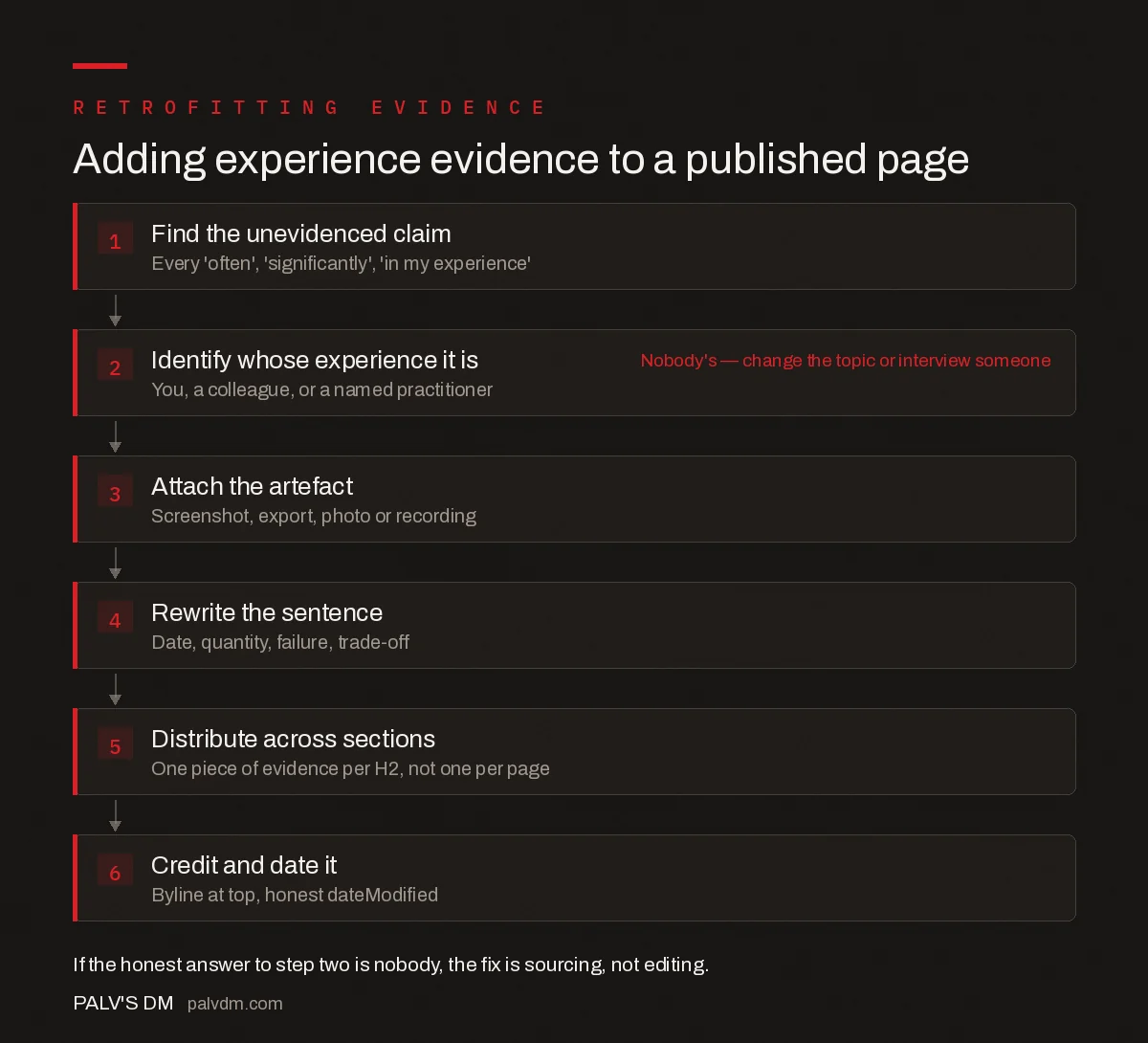
Adding experience evidence to a published page
- Find the unevidenced claim. Every ‘often’, ‘significantly’, ‘in my experience’.
- Identify whose experience it is. You, a colleague, or a named practitioner. Nobody’s — change the topic or interview someone
- Attach the artefact. Screenshot, export, photo or recording.
- Rewrite the sentence. Date, quantity, failure, trade-off.
- Distribute across sections. One piece of evidence per H2, not one per page.
- Credit and date it. Byline at top, honest dateModified.
Frequently asked questions
How do you demonstrate first-hand experience on a page?
Put artefacts and specifics in the body rather than claims in the bio. Annotated screenshots of the real interface, data exports with dates, photographs you took, short screen recordings, quotes from named practitioners, and before-and-after states. Add sentence-level specifics: dated events, described failures, real durations and costs, and trade-offs between imperfect options.
What does Google say about showing experience in content?
Google’s guidance on writing high-quality reviews asks creators to provide evidence such as visuals, audio or other links of their own experience with a product, to support expertise and reinforce authenticity. Its helpful content guidance asks whether content demonstrates first-hand expertise, giving the examples of having actually used a product or service, or visited a place.
Is there schema markup for E-E-A-T or experience?
No. There is no experience property, no E-E-A-T schema and nothing to declare. What exists is markup that makes the surrounding facts machine-readable: Article schema with an author reference to a Person entity carrying sameAs links to corroborating profiles, plus honest datePublished and dateModified values. Anyone selling E-E-A-T markup is selling something that does not exist.
Where should experience evidence appear on a page?
Early and distributed. Put one concrete first-hand specific inside the opening 100 words, because that passage is most likely to be extracted for a snippet or an AI answer, then place at least one artefact or specific in every major section. Evidence consolidated into an author box at the foot of the page is invisible to readers who land mid-article.
How can you show client work without breaking confidentiality?
Redact rather than omit — a screenshot with the domain blurred still shows the interface, settings and date. Aggregate rather than itemise, reporting across a stated sample instead of naming anyone. Or reconstruct the process on your own site so the screenshots are yours to publish. Showing one redacted, dated screenshot beats asserting deep experience with no evidence.
How many specifics should an article contain?
As a working threshold, fewer than five first-hand specifics in a 1,500-word article means the page was researched rather than lived. Count dates, quantities, named tools and versions, described failures, and real costs or durations. The related edit is to remove vague quantifiers such as significantly, often and many businesses, replacing each with the actual figure.
Sources
- Write high quality reviews — Google Search Central — asks for visuals, audio or links evidencing first-hand use
- Creating helpful, reliable, people-first content — Google Search Central
- Google core updates and your website — the Who, How and Why self-assessment questions
- GEO: Generative Engine Optimization (Aggarwal et al., KDD 2024)
Want this done on your site?
Every PalV’s DM engagement starts with a free audit of your actual website — a 12-point
crawl covering what is blocking indexation, on-page gaps against your primary keywords, speed
findings, and the three to five fixes worth making first. Delivered in two working days. No
payment details, and the findings are yours whether you hire us or not.