Google Removed &num=100: How It Broke Every Rank Tracker
In September 2025 Google stopped supporting the num=100 URL parameter. What broke, what Search Console data showed, and how to fix your reporting.

In September 2025 Google stopped serving the &num=100 URL parameter, which had let anyone pull 100 search results in a single page load instead of the standard ten. Rank-tracking tools had been built on that shortcut for years, so withdrawing it broke position tracking across the industry within days and stripped a large volume of scraper-generated impressions out of Google Search Console. Google’s only public comment was that “the use of this URL parameter is not something that we formally support”. No ranking system changed. No update was announced. The search results themselves were unaffected.
That is what makes the episode genuinely awkward. It was not an algorithm update, and yet for most sites it produced the single largest apparent shift in reported search data of 2025 — larger than any of the three confirmed core updates. Anyone running a year-on-year comparison that crosses September 2025 is comparing two different measurement regimes, not two years of performance.
What was the num=100 parameter and why did tools depend on it?
Appending &num=100 to a Google search URL returned 100 results on one page. Google removed the user-facing setting that controlled results per page back in 2018, but the URL parameter kept working unofficially for years afterwards, and the rank-tracking industry quietly standardised on it.
The economics explain the dependency. To find out where a site ranks across the top 100 positions for one keyword, a tool using &num=100 made a single request. Without it, the same check requires ten separate requests for ten pages of results. For a tool tracking hundreds of thousands of keywords daily, that is a tenfold increase in scraping volume, proxy cost and time. Every commercial rank tracker, every visibility index and a large number of in-house scripts were built on the cheap version.
When did Google remove it and what did Google actually say?
The parameter stopped working reliably around 12 September 2025. There was no announcement, no dashboard incident and no documentation change — practitioners noticed because their tools started returning nonsense.
When Search Engine Land asked, a Google spokesperson said only that “the use of this URL parameter is not something that we formally support”. That sentence is doing a lot of work. It is not a statement that the change is permanent, and it is not a statement that it was deliberate. It is a reminder that Google never promised the parameter would keep working, which is legally tidy and practically useless to anyone whose reporting depended on it.
This matters for how you classify the event. It never appeared on Google’s Search Status Dashboard, so it is not a confirmed update in the sense that the March 2025 core update was. It belongs in the same bucket as any other infrastructure change: real, consequential, and completely absent from the official record. The distinction between confirmed and unconfirmed changes is exactly the sort of thing that makes 2025 data hard to read.
Why did removing one parameter break the entire rank-tracking industry?
Because the tools did not degrade gracefully. They returned wrong data rather than no data.
Semrush and AccuRanker both publicly acknowledged disruption and began rebuilding their collection methods. In the interim, tracked positions for keywords that genuinely sat on pages two, three and beyond either vanished from reports or were reported inaccurately. Visibility scores built on top-100 coverage moved for reasons that had nothing to do with any site’s performance.
Three practical consequences followed for anyone reading a dashboard in late 2025:
- Deep-position data got thinner. Many tools now sample fewer pages, so the long tail of positions 21 to 100 is less complete than it was. Rank tracking after the num=100 change covers how to set expectations.
- Tool-to-tool disagreement widened. Different vendors rebuilt collection differently, so two trackers that once broadly agreed can now report materially different average positions for the same keyword set.
- Historic comparisons broke. A visibility chart that spans September 2025 has a methodology change baked into the middle of it, and no tool labels that on the graph.
What happened to Google Search Console data?
Search Console was affected for a different reason. Every one of those scraper page loads had been generating impressions. When a tool requested 100 results in one page view, every site appearing anywhere in those 100 positions was credited with an impression — for a page view no human ever saw.
Tyler Gargula, director of technical SEO at LOCOMOTIVE Agency, analysed 319 Search Console properties after the change. Search Engine Land reported the findings in September 2025:
| Metric | What the 319-property analysis found |
|---|---|
| Impressions | 87.7% of properties declined |
| Query count | 77.6% of properties lost unique ranking terms |
| Keyword length | Short-tail and mid-tail keywords took the biggest hit |
| Rank distribution | Fewer queries showing on page three and beyond; more surfacing in the top three and on page one |
The rank distribution row is the one that explains the confusion. Average position is an average across all reported impressions. Remove a large block of impressions that sat at positions 50 to 100, and the average of what remains improves — without a single page moving up. Sites saw impressions collapse and average position jump in the same week, which looks contradictory until you understand what was removed.
Was the old data wrong, or is the new data wrong?
The old data was wrong, and it had probably been wrong for years. Brodie Clark, who flagged the impression drops and inflated average positions early, argued that scrapers tied to num=100 may have distorted Search Console metrics over a long period.
That is the honest read. A large share of the “impressions but no clicks” long tail that SEOs have puzzled over — thousands of impressions at position 60 with a click-through rate of zero — was never human attention. It was tools looking at Google. Post-September 2025 Search Console is a smaller, more accurate picture of what people actually saw.
This is genuinely good news that arrives in a form nobody wants: a permanent step down in a chart you report to someone. Understanding what impressions, clicks and position each measure is what stops that step down being misread as a business problem.
Did the num=100 removal change anyone’s rankings?
No. This is the single most common misreading of the September 2025 change, and it costs people weeks of pointless work.
Google altered how many results a single request returns. It did not alter which pages rank, in what order, for any query. A page sitting at position seven before the change sat at position seven after it. What changed was how many of those positions a scraper could see in one go, and consequently how many impressions Search Console recorded for pages nobody visited.
The practical test is straightforward: look at clicks. Clicks come from humans choosing a result. If clicks held steady through September 2025 while impressions fell and average position rose, nothing happened to your rankings and no recovery work is required. If clicks fell too, you have a separate problem to diagnose — and the process for confirming what actually hit a site applies in the normal way, starting with whether a confirmed update was even running on those dates.
The reason this needs saying is that the change landed in the same autumn as the August 2025 spam update, which ran from 26 August to 22 September 2025. Two unrelated events overlapped almost exactly, one of them a genuine enforcement update and one of them a measurement artefact. Sites hit by the spam update saw real click losses. Sites that only saw impression losses were looking at scrapers disappearing.
What should you change in your reporting?
- Annotate September 2025 in every chart that crosses it. Every impression and average-position trend line spanning that month contains a methodology break. Label it once and you will stop re-explaining it every quarter.
- Stop reporting raw impressions as a headline metric. Clicks, conversions and revenue were never affected by this change. Impressions were. Lead with the numbers the change did not touch.
- Treat average position as a segment metric, not a site metric. A site-wide average position was always close to meaningless and is now discontinuous as well. How average position gets misread sets out the safer alternative.
- Reconcile tracker data against Search Console deliberately. The two sources disagree for structural reasons, and they disagree more since September 2025. Why Search Console and your rank tracker never match explains which to trust for which question.
- Rebaseline year-on-year comparisons. For any period comparison that straddles the change, compare clicks and conversions only, and say plainly why impressions have been excluded.
- Re-check what your tracker is actually collecting. Vendors rebuilt in different ways and at different times. Setting up rank tracking properly is worth revisiting rather than assuming your 2024 configuration still means what it meant.
What the num=100 removal should teach you about SEO measurement
The lesson is not “Google broke our tools”. It is that a large part of what the SEO industry treats as measurement is inference from a shared shortcut, and shortcuts are withdrawn without notice.
Practically, that argues for anchoring reporting on the metrics closest to the business — clicks, qualified leads, revenue — and treating impressions, visibility scores and average position as diagnostic aids rather than results. A site owner who reported clicks and enquiries through 2025 had a quiet autumn. A site owner who reported impressions and visibility index spent it explaining a cliff that never happened in reality.
It also argues for keeping a clear separation between changes Google confirms and changes Google merely makes. The 2025 update timeline contains four confirmed algorithm updates. The num=100 removal is not one of them, and yet it moved more numbers in most Search Console accounts than any of them did. When traffic or reporting moves, working through whether it was an update, a measurement change or you is the difference between a diagnosis and a guess — and the full traffic-drop checklist puts measurement artefacts near the top of the list for good reason.
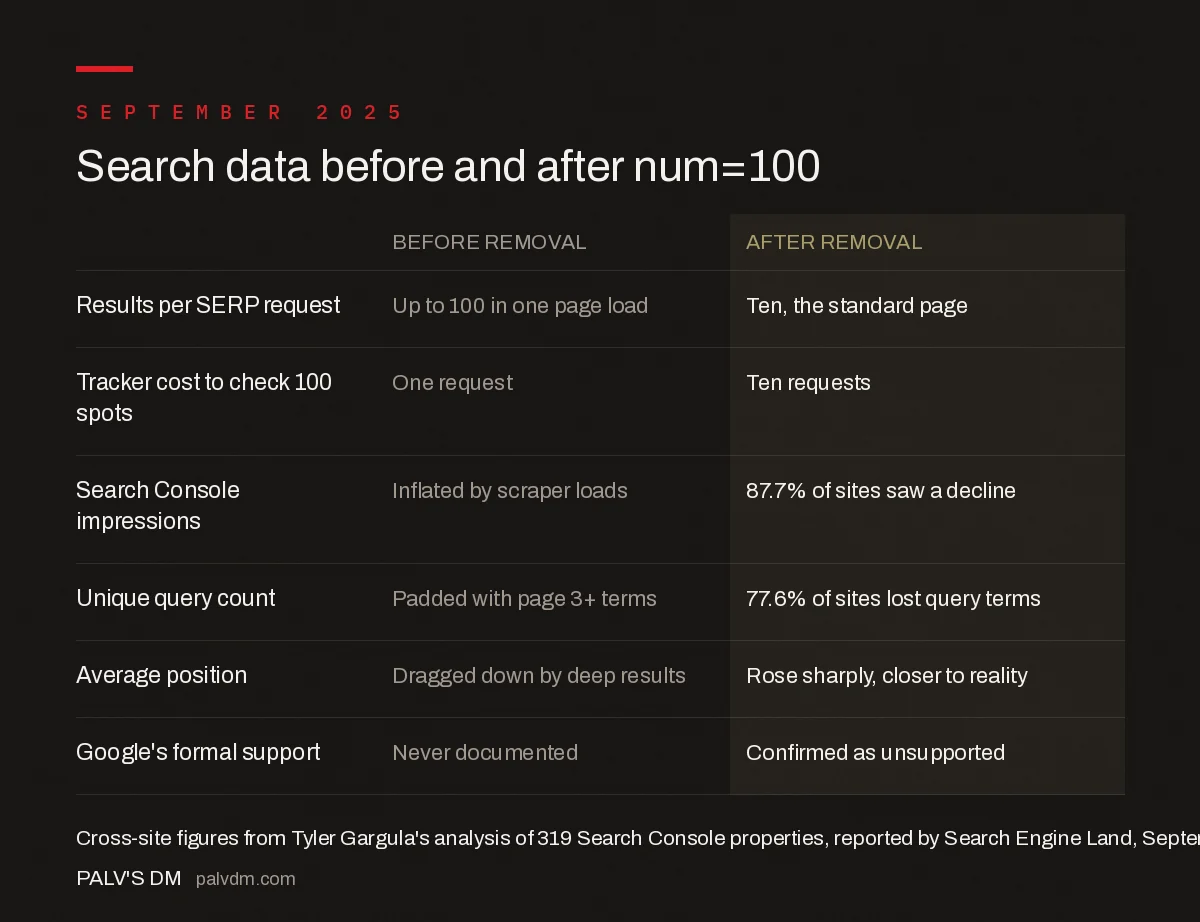
Search data before and after num=100
| Before removal | After removal | |
|---|---|---|
| Results per SERP request | Up to 100 in one page load | Ten, the standard page |
| Tracker cost to check 100 spots | One request | Ten requests |
| Search Console impressions | Inflated by scraper loads | 87.7% of sites saw a decline |
| Unique query count | Padded with page 3+ terms | 77.6% of sites lost query terms |
| Average position | Dragged down by deep results | Rose sharply, closer to reality |
| Google’s formal support | Never documented | Confirmed as unsupported |
Frequently asked questions
What was the num=100 parameter in Google Search?
The num=100 parameter was a URL setting that made Google return 100 search results on a single page instead of the standard ten. Google removed the user-facing control for results per page in 2018, but the URL parameter continued working unofficially until September 2025. Rank-tracking tools relied on it because it let them check the top 100 positions in one request rather than ten.
When did Google remove the num=100 parameter?
The parameter stopped working reliably around 12 September 2025. Google made no announcement and logged no incident on its Search Status Dashboard. Asked about it, a Google spokesperson said only that use of the URL parameter is not something Google formally supports, which stopped short of confirming whether the change was deliberate or permanent.
Why did my Search Console impressions drop in September 2025?
Rank-tracking tools requesting 100 results per page generated an impression for every site listed in those 100 positions, even though no person viewed the page. When Google stopped serving 100 results, those non-human impressions disappeared. In an analysis of 319 properties reported by Search Engine Land, 87.7% saw impressions decline and 77.6% lost unique ranking terms.
Why did my average position improve at the same time as impressions fell?
Average position is calculated across all reported impressions. The impressions removed were concentrated in deep positions that only appeared because scrapers were loading 100 results at a time. Removing a block of position 50 to 100 impressions raises the average of what remains, so average position rose without any page actually moving up in the results.
Was the num=100 removal a Google algorithm update?
No. It was an infrastructure change to how search result pages are served, not a change to ranking systems. It never appeared on Google’s Search Status Dashboard and Google announced no update alongside it. Rankings themselves were unaffected; what changed was how third-party tools collect data and how impressions are counted in Search Console.
How should I report on SEO performance after the num=100 change?
Lead with clicks, conversions and revenue, which the change did not affect, and annotate September 2025 on any impression or average-position chart that crosses it. Treat average position as a metric for specific query segments rather than the whole site, and expect rank-tracking tools to disagree with each other more than they used to.
Sources
- 77% of sites lost keyword visibility after Google removed num=100: Data — Search Engine Land
- Google Search confirms it does not support the results per page parameter — Search Engine Land
- Google Search rank and position tracking is a mess right now — Search Engine Land
- Search Console Performance report — Search Console Help
Want this done on your site?
Every PalV’s DM engagement starts with a free audit of your actual website — a 12-point
crawl covering what is blocking indexation, on-page gaps against your primary keywords, speed
findings, and the three to five fixes worth making first. Delivered in two working days. No
payment details, and the findings are yours whether you hire us or not.