How to Run an SEO Kickoff That Prevents Month-Three Surprises
Most SEO relationships fail over something knowable in week one. The access list, the agenda, the six questions, and what must exist in writing afterwards.

An SEO kickoff exists to convert a signed proposal into a written, agreed operating plan — access granted, targets defined, constraints declared and the first ninety days sequenced — before any work is billed. Almost every SEO relationship that collapses in month three collapses over something that was knowable in week one: nobody could deploy to the site, the target keywords were never realistic at the budget, or the client and the consultant were measuring different outcomes. A kickoff that does not surface those three things has not happened, whatever was in the calendar invite.
The distinction worth holding: a kickoff is not a strategy presentation. Strategy needs crawl data and Search Console history that nobody has yet. The kickoff’s job is to remove the unknowns that would otherwise be discovered slowly and expensively.
What should be done before the kickoff meeting?
Access is the bottleneck, and chasing it after the meeting costs the first two weeks. Everything below should be granted before the call, not discussed during it.
- Google Search Console, at owner or full user level. If nobody at the business can grant it, that is itself a finding — recovering lost analytics and Search Console access can take longer than the first sprint.
- Analytics, with a stated conversion definition. Not just the login. Which event counts as a lead, and has it ever been verified?
- CMS access at a level that can actually publish. Editor access that cannot touch titles, redirects or robots directives will block half the roadmap.
- Server or hosting contact. Named person, not a shared inbox. Technical fixes stall here more than anywhere else.
- Any previous audit, and the name of the previous agency. Past work explains present anomalies, especially link profiles.
- Twelve months of Search Console export. Data ages out at sixteen months, so exporting early protects the year-on-year comparison you will want later.
What does an SEO kickoff agenda actually cover?
Ninety minutes, in this order. The sequence matters because each item constrains the next.
- Commercial reality (15 min). What does the business sell, at what margin, to whom, and what is a customer worth? Everything downstream is prioritised against this and nothing else.
- What has already been tried (10 min). Previous agencies, previous tactics, any link building whose sources are unknown. This is where inherited risk gets declared rather than discovered during a spam update.
- Constraints (15 min). Who approves content, how long approval takes, who can deploy, what the release cycle looks like, and which pages are politically untouchable. This is the single most predictive section of the meeting.
- Targets and definitions (20 min). Which metric decides whether this worked. Agreeing the KPIs now prevents the month-six argument in which traffic doubled and the client is unhappy because enquiries did not.
- Sequence for the first ninety days (20 min). Not a full roadmap — the shape. Audit, then technical remediation, then the first content, with dates.
- Operating rhythm (10 min). Meeting cadence, reporting cadence, escalation route, and who owns the change log. Agreeing a weekly sprint rhythm here is much easier than imposing one in month two.
Which questions actually prevent month-three surprises?
Most kickoff agendas cover goals and skip the questions whose answers explain later failure. Six questions do disproportionate work.
“Who can push a change to the live site, and how long does a small change usually take?” If the answer is a quarterly release cycle through an external development vendor, the technical portion of the plan needs restructuring today, not in week seven.
“Has anyone bought links, ever, including before you owned the site?” Asked neutrally, this is usually answered honestly. Inherited link risk is far cheaper to assess in week one than to diagnose after a ranking drop.
“What happened at your last traffic drop?” A business that has been through one has a hypothesis worth testing. It also reveals whether anyone keeps a dated log of site changes, which determines whether future diagnosis is possible at all.
“Which keywords have you already promised internally?” Someone has told a director the site will rank for a term. Better to test it against difficulty and budget now, in the room, than to discover the expectation at a quarterly review.
“What does your sales team say about the leads you already get?” Frequently the fastest route to commercial impact is more of one existing lead type rather than more traffic overall, which reshapes how the keyword list is prioritised.
“What are we not allowed to change?” Brand rules, legal review requirements, a homepage nobody may touch. These constraints are real and workable — but only if declared before a roadmap is built on top of them.
What should exist in writing when the kickoff ends?
| Artefact | What it settles | Owner |
|---|---|---|
| Access register | Which accounts are granted, at what level, held by whom | Client |
| Success definition | The one metric that decides whether this worked, with a baseline | Both |
| Constraint list | Approval chain, deploy route, untouchable pages, review times | Client |
| Ninety-day sequence | Audit, remediation, first content, with dates | Consultant |
| Reporting agreement | What is reported, from which source, how often | Consultant |
| Change log location | Where every dated site change is recorded | Both |
Six short documents, not a deck. Each one is a decision that would otherwise be made implicitly, differently, by two parties who both believe they agreed something. A written reporting agreement alone eliminates most reporting disputes for the life of the engagement.
What does the first ninety days look like after the kickoff?
The kickoff should end with a sequence, not a promise. The shape below is what a normal engagement looks like on a site that starts with typical problems, and stating it out loud in the meeting is what makes month three boring in a good way.
Weeks 1-3: find out what is actually true. A full crawl, a Search Console history review, an index coverage comparison, and a look at what competitors rank for that you do not. Nothing here produces a chart that goes up. It produces the ranked backlog that everything afterwards is drawn from, and it is where technical SEO problems are identified rather than assumed.
Weeks 4-7: fix what blocks and improve what is close. Indexation faults, redirect chains, duplicate titles, canonical errors. In parallel, on-page work on pages already ranking in positions 8 to 20, because those move fastest and buy patience for the slower work. Impressions usually respond before clicks do.
Weeks 8-13: publish, link internally, and hold the first honest review. The first new pages ship against written briefs, internal links are added from existing pages, and the ninety-day review asks two separate questions: did the committed work ship, and did the leading indicators move. Those are different questions and conflating them is how good programmes get cancelled early.
What the review must not do is judge commercial outcomes. Three months is early for enquiries on anything competitive, and a ninety-day plan that promises revenue is setting a trap for both sides. Judge process at ninety days, leading indicators at ninety days, and commercial results at month six.
What goes wrong in SEO kickoffs?
Presenting a strategy before seeing the data. A consultant who arrives with a full keyword plan built from a proposal has not crawled the site. Real prioritisation comes after the audit, which is what separates an audit from a strategy.
Setting a timeline nobody has stress-tested. Agreeing “page one by month three” in a kickoff sets up a failure that has nothing to do with the work. The realistic shape — technical wins early, first movement around weeks six to ten, commercial results between months four and six — should be stated plainly, and how long SEO takes is a kickoff conversation, not a month-four defence.
Leaving scope undefined at the edges. Is on-page implementation included or advisory? Who writes the content? Who fixes the CMS bug found during the audit? Undefined edges become scope creep, and scope creep is where margin and goodwill both go.
No named client-side owner. An engagement without one person accountable for approvals and access on the client side stalls at the first dependency, every time.
Skipping the kickoff for a small retainer. A ₹5,000-a-month engagement needs the kickoff more than a large one, because there is no slack in the hours to absorb a fortnight of chasing access. The meeting can be forty-five minutes; it cannot be zero.
Run it this way and month three contains ordinary problems — a page that underperformed, a link that did not land — rather than structural ones. That is the entire test of a kickoff: whether the surprises that arrive later are about search results, or about things that were always knowable in week one. Everything after the kickoff belongs in the first month of work.
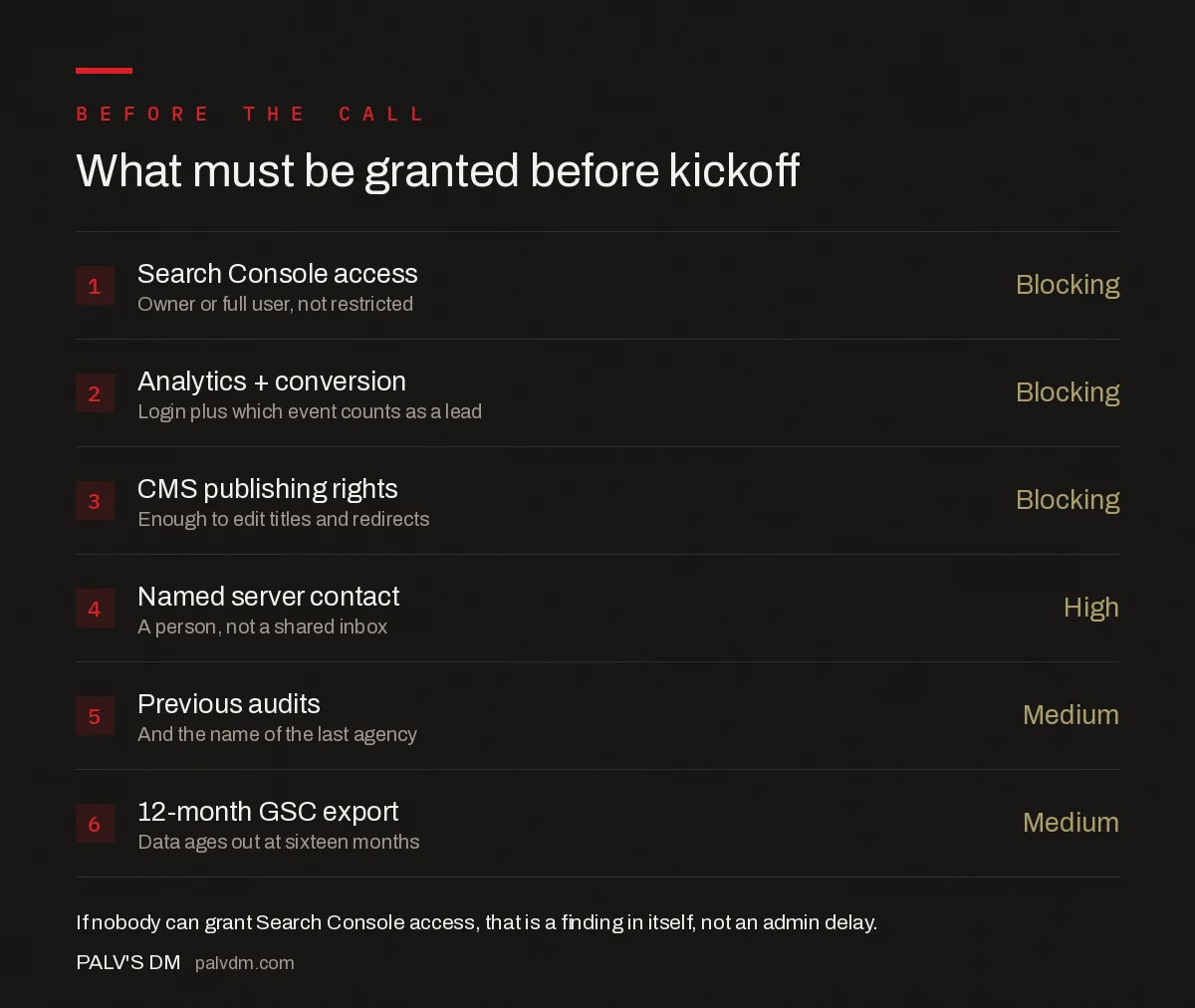
What must be granted before kickoff
- Search Console access — Blocking. Owner or full user, not restricted.
- Analytics + conversion — Blocking. Login plus which event counts as a lead.
- CMS publishing rights — Blocking. Enough to edit titles and redirects.
- Named server contact — High. A person, not a shared inbox.
- Previous audits — Medium. And the name of the last agency.
- 12-month GSC export — Medium. Data ages out at sixteen months.
Frequently asked questions
What should be covered in an SEO kickoff meeting?
Commercial reality first — what the business sells and what a customer is worth. Then what has already been tried, the constraints on approval and deployment, the metric that defines success, the sequence for the first ninety days, and the operating rhythm for meetings and reporting. Ninety minutes is enough if access was granted beforehand.
How long should an SEO kickoff take?
Around ninety minutes for a typical engagement, and no less than forty-five even for a small retainer. Small engagements need the kickoff more, not less, because there are no spare hours to absorb two weeks of chasing access. The meeting is short only when access, analytics and previous audit material were supplied in advance.
What access does an SEO consultant need at kickoff?
Google Search Console at owner or full user level, analytics with a stated conversion definition, CMS access sufficient to edit titles, redirects and robots directives, a named technical contact for server changes, any previous audits, and the identity of the previous agency. Editor access that cannot change technical elements will block a large part of any roadmap.
What questions should a client ask at an SEO kickoff?
Ask who will do the implementation and who merely advises, what happens when a fix requires developer time, which source the reporting will come from, what the consultant expects to be true at ninety days, and what would cause them to recommend stopping. A consultant who cannot describe a scenario where the work should stop is selling rather than advising.
Should the SEO strategy be presented at the kickoff?
No. A credible strategy requires crawl data and Search Console history that nobody has at kickoff. A consultant arriving with a complete keyword plan built only from the proposal has not examined the site. The kickoff sequences the audit; the strategy follows it, usually two to three weeks later, with evidence attached.
What should be documented after an SEO kickoff?
Six short artefacts: an access register, a written success definition with a baseline, a constraint list covering approvals and deployment, a ninety-day sequence with dates, a reporting agreement naming the data source, and the location of the change log. Documents, not a deck — each one settles a decision that would otherwise be assumed differently by both parties.
Sources
- Search Console Performance report — Search Console Help
- Debugging drops in Google Search traffic — Google Search Central
- Creating helpful, reliable, people-first content — Google Search Central
Want this done on your site?
Every PalV’s DM engagement starts with a free audit of your actual website — a 12-point
crawl covering what is blocking indexation, on-page gaps against your primary keywords, speed
findings, and the three to five fixes worth making first. Delivered in two working days. No
payment details, and the findings are yours whether you hire us or not.