Organization Schema: The Entity Foundation for Your Brand
Organization schema has no required fields, but the ones you skip decide your knowledge panel and AI citations. Here is what to include and why.
Organization schema is the JSON-LD block that tells Google, and increasingly AI systems, exactly who your brand is: its name, its official web presence, its verified profiles elsewhere, and how to reach it. Google lists no required properties for it, which is exactly why most sites implement it badly. “Nothing is required” gets read as “nothing matters,” when the honest reading is “include everything that’s true and relevant, because there’s no minimum bar stopping you.”
This one schema type sits underneath almost everything else on your site. Article schema references your Organization as publisher. Person schema references it as an author’s employer. A weak or missing Organization block doesn’t just cost you a knowledge panel, it leaves every other entity on your site pointing at nothing solid.
What does Organization schema actually do?
According to Google’s own structured data documentation, Organization markup helps Google understand your organization’s administrative details and disambiguate it from other organizations, sometimes literally other businesses with a similar name. Some properties work behind the scenes for disambiguation (like industry classification codes), while others directly influence what shows up visually in search, including which logo appears in your knowledge panel.
It’s not a ranking factor in the way title tags or backlinks are. Think of it differently: it’s the difference between Google guessing at who you are from scattered signals across your site, and Google reading a single, explicit statement of fact you’ve handed it directly.
Which properties should you actually include?
Google’s documentation lists roughly twenty recognized properties with no required subset, which is not the same as “pick a few and call it done.” Here’s what actually earns its place, based on which properties Google explicitly ties to visible search features or trust.
Organization Schema: Properties Worth Prioritising
| Property | What it does | Priority |
|---|---|---|
| name / alternateName | Your official and common brand name, should match your declared site name | Essential |
| url | Your website address; helps Google uniquely identify the organization | Essential |
| logo | Minimum 112x112px, crawlable URL; controls the logo shown in knowledge panels | Essential |
| sameAs | Links to verified profiles elsewhere (LinkedIn, Crunchbase, Wikipedia, review sites) | High |
| address | Physical or mailing PostalAddress; strengthens real-world presence signals | High |
| contactPoint / telephone / email | How a user (or a bot) reaches your business | High |
| description | A short, factual description of what the organization does | Medium |
| foundingDate, numberOfEmployees | Supplementary context; useful for larger or more established brands | Optional |
| vatID / taxID | A genuine trust signal; lets users verify your business in public registries | Optional but valuable |
The four marked “Essential” are the ones that show up incomplete most often when we audit a new client’s schema. Name and URL are trivial to get right and still get skipped constantly, usually because Organization schema gets bolted on by a plugin default and nobody goes back to fill in the specifics.
Where should this schema actually live on your site?
Google’s guidance is specific here: place it on your home page, or a single dedicated page that describes your organization, commonly an About page. You do not need to repeat the full block on every page of your site. What you do need is consistency: if your Organization schema declares one legal name and address, and your footer or About page text says something slightly different, that mismatch works against you rather than for you.
Where it does need to repeat, in reference form, is inside other schema types on the same site. Article schema’s “publisher” field and Person schema’s “worksFor” field should both point back to the same Organization @id rather than restating the details inline. That’s what actually connects your entities into one coherent graph instead of a pile of disconnected JSON blocks.
How does sameAs actually build entity authority?
sameAs is the property doing the most unappreciated work on this list. Each URL you list is Google’s own words “additional information about your organization” on another site, your official LinkedIn page, a Crunchbase profile, a Wikipedia entry if you have one, a G2 or Trustpilot listing. Individually, none of these prove much. Together, consistently pointing back to the same name, they form a corroborating pattern that’s much harder to fake than a single claim on your own site.
The mistake I see constantly: businesses list sameAs links to profiles they set up once in 2021 and never touched again. A dead LinkedIn page with three followers does close to nothing for entity confidence, and in some cases it actively signals inactivity. Audit your sameAs list the same way you’d audit backlinks. Keep what’s live and representative, drop what’s abandoned.
Organization schema implementation checklist
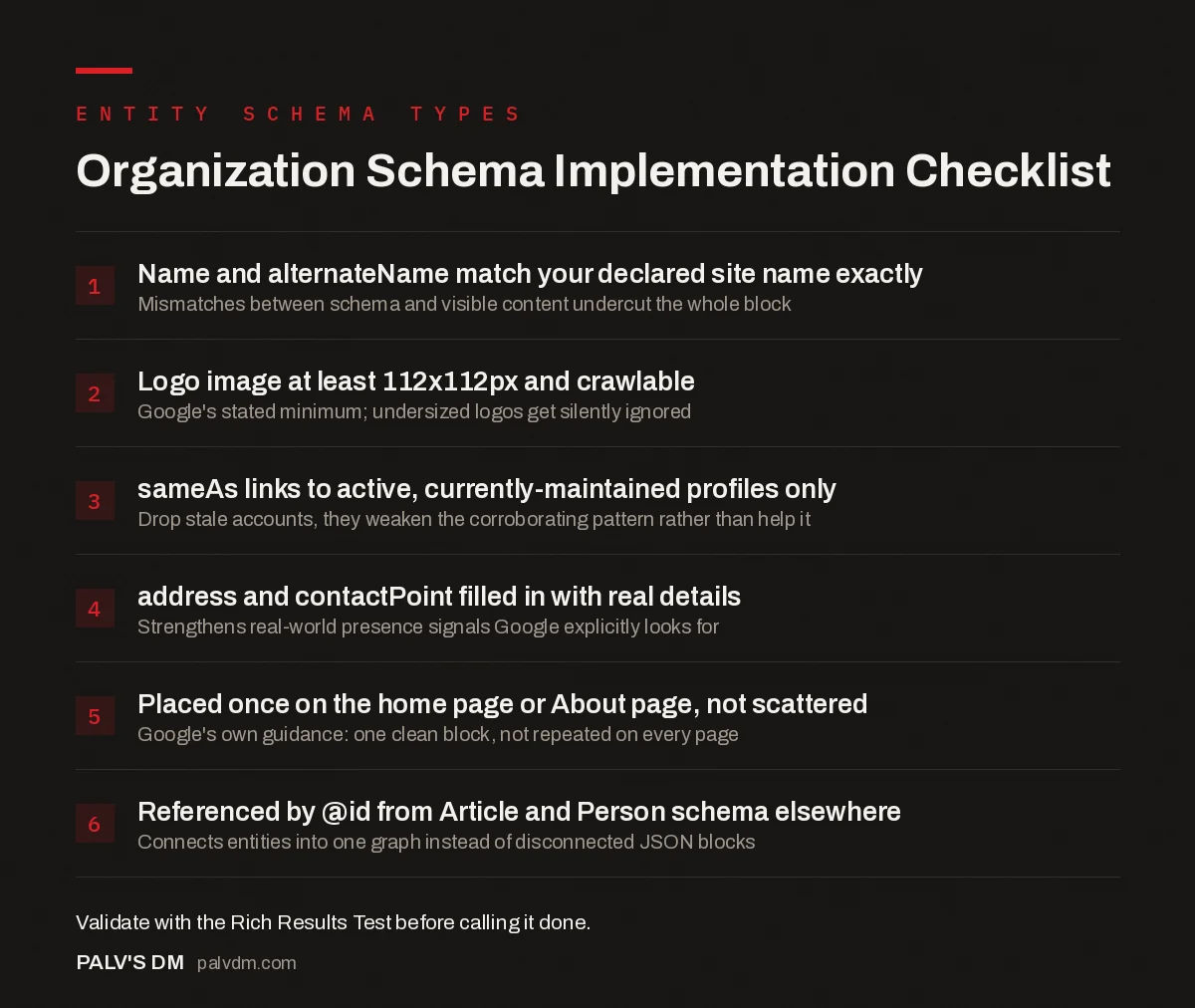
Organization Schema Implementation Checklist
- Name and alternateName match your declared site name exactly. Mismatches between schema and visible content undercut the whole block.
- Logo image at least 112x112px and crawlable. Google’s stated minimum; undersized logos get silently ignored.
- sameAs links to active, currently-maintained profiles only. Drop stale accounts, they weaken the corroborating pattern rather than help it.
- address and contactPoint filled in with real details. Strengthens real-world presence signals Google explicitly looks for.
- Placed once on the home page or About page, not scattered. Google’s own guidance: one clean block, not repeated on every page.
- Referenced by @id from Article and Person schema elsewhere. Connects entities into one graph instead of disconnected JSON blocks.
Does this change for a solo consultant or a small team?
Yes, and it’s the case we deal with constantly. A one-person consultancy or a small agency still benefits from a distinct Organization entity, separate from the Person schema for the founder, even when they’re effectively the same public face. The Organization holds the business-level facts: registered name, address, contact point, sameAs links to the company’s own profiles. The Person schema holds the individual’s facts: their own bio, credentials, personal social profiles, and a worksFor property pointing back to the Organization’s @id.
Skipping this distinction is the single most common thing we fix on new client sites. A founder-led business will often mark up only a Person, with no separate Organization entity at all, or the reverse: an Organization block with no connected Person, leaving authorship and expertise signals disconnected from the brand entirely. Both halves need to exist and reference each other. Neither one substitutes for the other, no matter how small the team is.
What commonly goes wrong with Organization schema?
- Using generic Organization when a more specific subtype fits. Google explicitly recommends the most specific subtype that applies, LocalBusiness for a physical storefront, OnlineStore for ecommerce, rather than the generic parent type.
- Logo images under the 112x112px minimum. Undersized or non-crawlable logo URLs get silently ignored rather than flagged as an error, so this one’s easy to miss without checking.
- Name mismatches between schema and visible content. If your schema says “Acme Corp” and your header says “Acme Corporation Pvt Ltd,” you’re handing Google conflicting signals about your own identity.
- One Organization block per legal entity, not per brand. Multi-brand companies sometimes try to cram several brands into one Organization object; each distinct legal or public-facing entity deserves its own.
- Forgetting to connect it via @id. Article and Person schema should reference the Organization’s @id, not restate the name as plain text. Disconnected schema blocks don’t build the entity graph Google (and AI systems) actually want.
How do you validate it once it’s live?
Run the page through Google’s Rich Results Test first and fix any critical errors it flags. Then use the URL Inspection tool in Search Console to confirm Google is actually reading the live page correctly, not just the code you think you deployed. Give it real time afterward. Google’s own documentation notes it can take several days after publishing for a page to be found and recrawled, so don’t judge success by checking your knowledge panel the same afternoon.
Frequently asked questions
Is Organization schema required for SEO?
No. Google’s own documentation states there are no required properties for Organization markup. It’s not a ranking requirement, but it does help Google disambiguate your brand and choose the right logo and details for a knowledge panel, which matters more as AI-generated answers rely on clearly identified entities.
Where should Organization schema be placed on a website?
Google recommends placing it on your home page, or a single page describing your organization, such as an About page. You don’t need to repeat it on every page. One clean, consistent block per site is what Google’s guidelines actually ask for.
What’s the difference between Organization and LocalBusiness schema?
LocalBusiness is a more specific subtype for a physical location, like a restaurant or clinic, and Google explicitly recommends using it instead of generic Organization when it applies. Organization fits a business without a single physical storefront, or as the parent entity referenced by other schema types on the site.
How many sameAs links should Organization schema include?
As many as are genuinely yours and actively maintained. Google lets you list multiple sameAs URLs, but a stale LinkedIn page you haven’t posted to in two years does less good than three profiles that are current and clearly represent the same entity.
Does Organization schema help with AI visibility, not just Google Search?
Indirectly, yes. AI systems retrieving information about a brand benefit from the same clearly structured entity signals Google uses: consistent name, verified sameAs links, and a stable address and contact point. It’s not a guarantee of citation, but it removes ambiguity that could cause a system to skip or misattribute your brand.
Sources
- Organization structured data, Google Search Central
- Organization, schema.org vocabulary
- Schema Markup: A Practical Guide With Copy-Paste JSON-LD
- Person Schema and Author Entity Signals
- Schema Nesting and @id: Connecting Your Entities Properly
- Service and Offer Schema for Agencies and Consultants
Want this done on your site?
Every PalV’s DM engagement starts with a free audit of your actual website — a 12-point
crawl covering what is blocking indexation, on-page gaps against your primary keywords, speed
findings, and the three to five fixes worth making first. Delivered in two working days. No
payment details, and the findings are yours whether you hire us or not.