How to Pause or Leave Without Losing Your Work
Thinking about how to cancel SEO service without losing rankings, content or access? Here's the ownership checklist and handover steps for a clean exit.

You can cancel an SEO service at any time, and if the agency did its job properly, you should walk away with everything: your Search Console and GA4 access, your Google Business Profile, your content, your backlink history, and your reporting archive. Nothing about SEO work is supposed to be locked inside someone else’s dashboard. If cancelling means losing rankings, content, or access, that was a structural problem with how the engagement was set up from day one — not a normal cost of leaving.
Key takeaway
- Nothing built during an SEO engagement — content, backlinks, rankings, reports — should be tied to the agency’s login. If it is, that’s a sign to fix before you pause, not after.
- Pausing and cancelling are different decisions with different consequences: pausing risks momentum, cancelling risks maintenance of what’s already built.
- A clean exit takes a written handover — access transfer, asset export, and a status snapshot — not just a goodbye email.
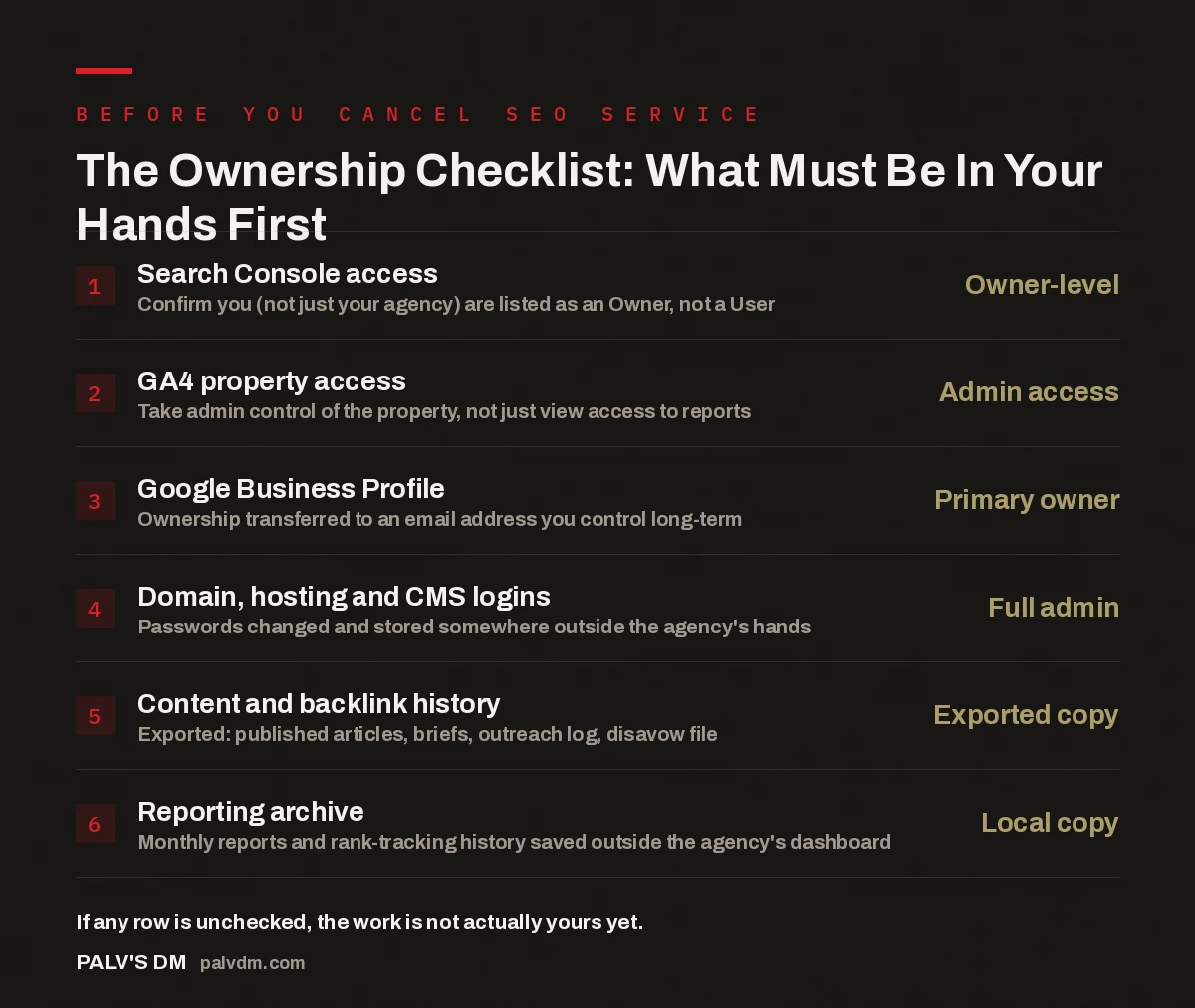
The Ownership Checklist: What Must Be In Your Hands First
- Search Console access — Owner-level. Confirm you (not just your agency) are listed as an Owner, not a User.
- GA4 property access — Admin access. Take admin control of the property, not just view access to reports.
- Google Business Profile — Primary owner. Ownership transferred to an email address you control long-term.
- Domain, hosting and CMS logins — Full admin. Passwords changed and stored somewhere outside the agency’s hands.
- Content and backlink history — Exported copy. Exported: published articles, briefs, outreach log, disavow file.
- Reporting archive — Local copy. Monthly reports and rank-tracking history saved outside the agency’s dashboard.
What actually happens when you cancel an SEO service?
Cancelling stops new work: no more content briefs, no more link outreach, no more technical fixes, no more monthly reporting calls. It does not undo what’s already live. Pages that were published stay published. Backlinks that were earned stay earned. Rankings you hold on the day you cancel don’t reset to zero — they simply stop being actively defended and improved. What tends to happen over the following months is a slow drift: competitors who are still investing pull ahead, technical issues that would have been caught in a routine audit go unnoticed, and content that needed a seasonal refresh doesn’t get one. None of that is instant. It’s attrition, not collapse.
The one scenario where cancelling causes real damage is when the agency structured the engagement so that assets live inside accounts you don’t control — a Search Console property under their email, a GA4 account they own, a CMS plugin only they have credentials for. In that setup, cancelling can mean losing visibility into your own data or, in the worst cases, losing the ability to edit your own site. That’s an ownership problem, not a natural consequence of ending SEO work, and it’s exactly what to check before you give notice.
How is pausing different from cancelling?
Pausing keeps the relationship and the accounts intact but stops active work for a defined or open-ended stretch — common around a cash-flow crunch, a website rebuild, a founder going heads-down on fundraising, or a seasonal business quiet period. Cancelling ends the engagement outright, with access and assets handed back. The practical difference shows up in what happens next: a pause can usually resume where it left off, with the same keyword priorities and content calendar picked back up. A cancellation means whoever takes over next — a new agency, an in-house hire, or nobody — starts by reconstructing context from whatever was handed over, which is why the handover quality matters so much more when you’re leaving for good.
| Question | Pause | Cancel |
|---|---|---|
| What stops | New content, outreach, reporting cadence | Everything, including the relationship itself |
| What continues | Existing rankings hold, no active decay | Existing rankings hold short-term, then drift without upkeep |
| Access | Usually stays as-is, no urgency to transfer | Must be fully transferred before you leave |
| Restart cost | Low — same team, same context, same plan | Higher — new team has to relearn the account from scratch |
| Best for | Temporary budget or team gaps you expect to close | Permanently moving in-house or to a different agency |
If there’s real uncertainty about whether the gap is three months or permanent, pausing is the lower-risk default — it costs nothing to convert a pause into a cancellation later, but converting a cancellation back into continuity means rebuilding relationships and context that a pause would have preserved.
What should you check before you pause or cancel your SEO service?
Before giving notice, go through the accounts and assets that any SEO engagement touches and confirm who actually holds them. This is the same list an incoming agency runs through when they’re rebuilding SEO after a bad agency experience — it’s far easier to check now than to reconstruct later.
- Log into Google Search Console and confirm your own email address (not a generic agency inbox) is listed as an Owner, with full permission — not a User with limited access.
- Do the same for GA4: check the property’s admin list, not just who can view reports.
- Confirm the Google Business Profile lists you as the primary owner, if the engagement included local SEO.
- Verify domain registrar, hosting panel, and CMS admin credentials are ones you hold directly, not credentials only the agency remembers.
- Ask for an export of everything produced: published content with source docs, the backlink or outreach log, and any disavow file that’s been submitted to Google.
- Ask for the reporting history — past monthly reports and rank-tracking data — saved somewhere outside the agency’s own dashboard, since that tool access usually ends with the contract.
None of this is unusual or adversarial to ask for. An agency that’s confident in its own work has no reason to make this list difficult to get through — it’s a description of why you should keep every account, login and asset from the start of the engagement, not just at the end of it.
The test of a good SEO engagement isn’t how it performs while you’re paying for it — it’s how easily you can leave. If handing back access takes more than a day, something was built wrong from the start.
Palash, Founder, PalV’s DM
How do you make sure you don’t lose rankings when you cancel?
Rankings don’t fall off a cliff the day an SEO service ends — they’re a function of accumulated signals (content depth, backlink profile, technical health, site authority) that don’t evaporate overnight. What puts rankings at genuine risk after cancellation is neglect over the following months rather than the cancellation itself. Three things are worth handling before or right at the point of leaving, regardless of whether a new team is taking over:
- Don’t let the site go untouched for long stretches. Even without active SEO work, someone should be checking Search Console periodically for crawl errors, manual actions, or indexing drops.
- Keep publishing something, even at a reduced pace. A site that goes fully silent on content for months sends a weaker freshness signal than one that keeps a slow, steady cadence.
- Watch for expiring technical dependencies. SSL certificates, CDN configurations, or plugins the previous agency set up can lapse quietly if nobody owns them after the handover.
If you’re moving to a new agency rather than going fully dormant, the transition is smoother when the outgoing team’s reporting history travels with you — it’s much of what’s covered in what’s in every monthly SEO update, and it’s the baseline a new team needs to avoid repeating diagnostic work that’s already been done.
What does a clean handover from an SEO agency look like?
A proper handover is a written document, not a farewell call. It should cover four things: a full access transfer confirmation (every login and property listed, with your ownership confirmed in writing); an asset export (content files, backlink logs, keyword research, disavow files); a status snapshot (where rankings, traffic, and technical health stood on the day the engagement ended, so any future comparison has a clean baseline); and open items (anything mid-progress — a content piece half-written, an outreach campaign in flight, a technical fix flagged but not yet shipped). Whether the engagement is being paused or ended for good, this same document is what makes the difference between a smooth restart and starting from zero.
When does it make sense to pause instead of cancel?
Pausing fits situations with a defined or reasonably foreseeable end point: a website migration where new content would be wasted effort until the new site is live, a temporary budget freeze tied to a specific quarter, a founder who needs the marketing function to go quiet for a few months during a fundraise or acquisition process, or a seasonal business where SEO spend genuinely doesn’t earn its keep in the off-season. In each of these cases, the underlying strategy — the keyword priorities, the content plan, the technical roadmap — is still sound; it’s the timing that’s off. Picking back up with the same team means none of that context has to be rebuilt.
Cancelling fits differently: a permanent move to an in-house team, a decision that you genuinely don’t need an SEO agency yet at the current stage, or dissatisfaction that a conversation hasn’t resolved. If results genuinely aren’t coming after a fair runway and honest troubleshooting, that’s also a legitimate cancel decision — but it’s worth having that conversation directly with the agency first, since a pattern of underperformance is sometimes fixable with a change in approach rather than a change in vendor.
What red flags mean you might have trouble leaving cleanly?
A few patterns are worth noticing well before you decide to cancel an SEO service, because they’re much easier to fix mid-engagement than to untangle on the way out:
- The agency has never sent you login credentials for any of the core accounts — Search Console, GA4, Business Profile — and reporting only ever happens through screen-shared calls.
- Content lives only inside the agency’s own content management tool rather than being published directly to your site’s CMS where you have full editing rights.
- A contract clause implies your rankings, content, or account access are contingent on continued payment — sometimes phrased as a “de-indexing” or “content removal” right on cancellation.
- Requests for account access or an asset export are met with delay, vague answers, or a request to “hop on a call” instead of a straightforward written confirmation.
None of these are guaranteed dealbreakers on their own, but together they’re a sign to ask directly, in writing, exactly what happens to access and assets on the day of cancellation — before that day arrives, not after.
Short version
You should be able to cancel or pause an SEO service the same way you’d cancel a software subscription — cleanly, with everything you’ve paid for still yours. If that’s not how your current setup works, it’s worth understanding why before you’re the one asking to leave.
See how PalV’s DM structures SEO engagements so you always own your work
Will my rankings drop immediately if I cancel my SEO service?
No. Rankings are built on accumulated signals — content, backlinks, technical health — that don’t disappear the moment work stops. What happens instead is a gradual drift over months as competitors who are still investing pull ahead and small technical issues go unaddressed. The bigger risk is losing account access, not losing rankings overnight.
How much notice should I give before cancelling an SEO service?
Check your contract for the notice period, but regardless of what it specifies, give enough time for a proper handover — access transfers, asset exports, and a status snapshot don’t need to happen overnight, and rushing them increases the odds something gets missed.
Can an SEO agency remove my content or de-index my site after I cancel?
Only if the content lives on infrastructure they control, or if your contract explicitly grants that right. This is exactly why account and content ownership matters before you sign up, not just when you’re leaving — read any cancellation clause carefully before the engagement starts.
Is it better to pause SEO or cancel it during a tight budget month?
If the budget gap is temporary — a quarter, a seasonal dip — pausing is usually the lower-friction option, since it preserves the team’s context and lets work resume without a restart cost. Cancelling makes more sense when the change is permanent, such as moving the function in-house.
What should I ask for when I cancel my SEO service?
Ask for confirmed owner-level access to Search Console, GA4, and Google Business Profile; admin credentials for your domain, hosting, and CMS; an export of all content, backlink, and outreach data; and a written status snapshot of rankings and traffic on the day work stops. This is the same list to check for early in any engagement, not just at the end.