Service Support — Content Writing
How We Handle Topics We Don’t Know Anything About
How we handle writing about unfamiliar industries: primary sources first, a subject-matter interview, then a technical review pass before anything ships.
Writing about unfamiliar industries comes down to one rule we don’t break: no claim goes into a draft until it’s traced back to a primary source or checked by someone who works in that industry. We don’t hire a new writer for every niche a client operates in — that’s not realistic at agency scale. Instead, every brief on a topic the writer hasn’t covered before runs through the same six-step process, from flagging unfamiliar terms on day one to a technical review pass before the draft reaches editing. The gap between “we don’t know this industry” and “this is publishable” gets closed by process, not by pretending the writer already knew it.
Key takeaway
- Unfamiliarity gets handled with primary-source research and a subject-matter interview, not by writing around the gaps in general terms.
- Every specific claim in an early draft is marked with where it came from, so a reviewer can check it without redoing the research.
- A claim that can’t be verified before publishing gets rewritten as qualitative or cut — it never goes out as a guess dressed up as fact.
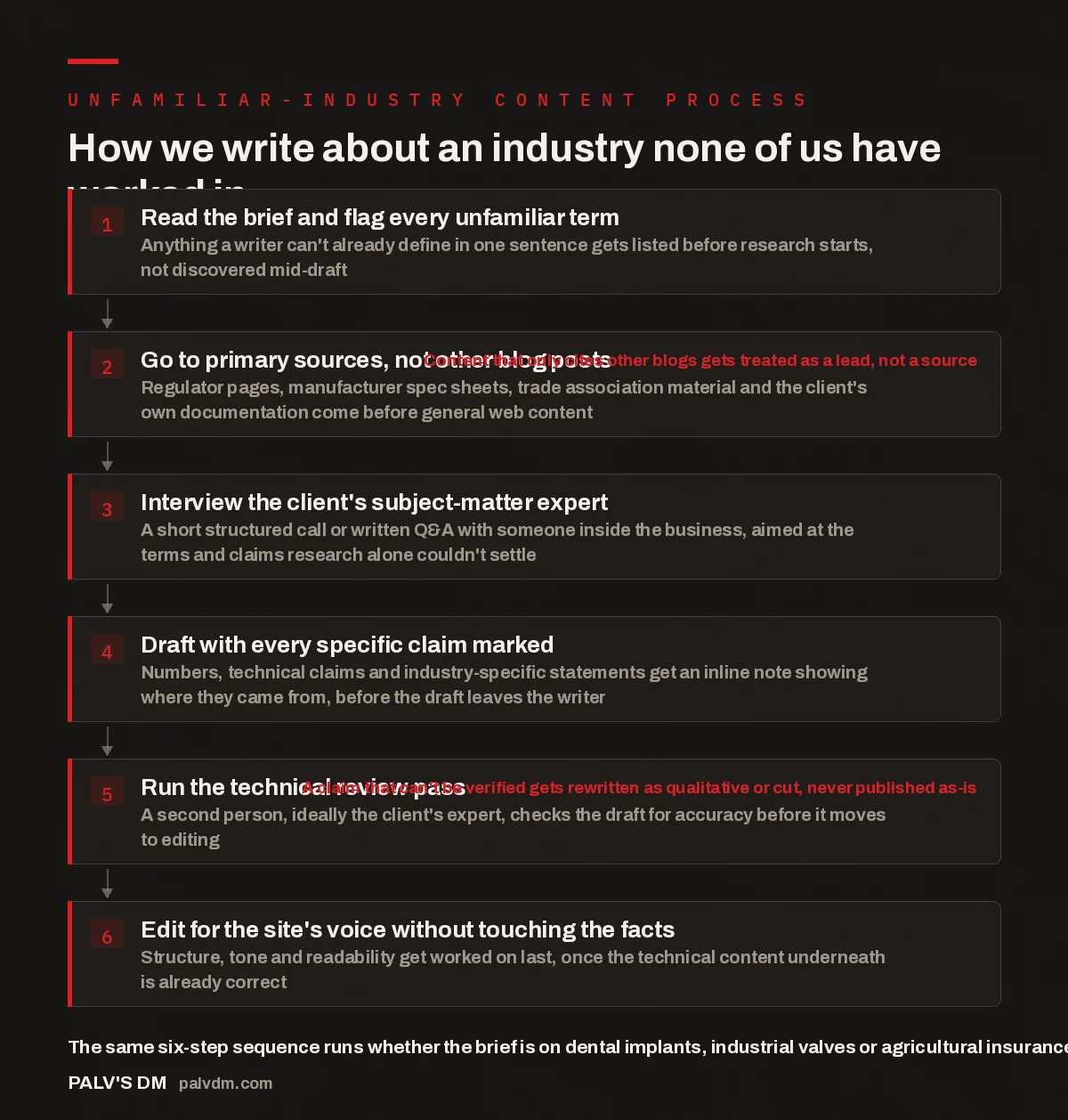
How we write about an industry none of us have worked in
- Read the brief and flag every unfamiliar term. Anything a writer can’t already define in one sentence gets listed before research starts, not discovered mid-draft.
- Go to primary sources, not other blog posts. Regulator pages, manufacturer spec sheets, trade association material and the client’s own documentation come before general web content. Content that only cites other blogs gets treated as a lead, not a source
- Interview the client’s subject-matter expert. A short structured call or written Q&A with someone inside the business, aimed at the terms and claims research alone couldn’t settle.
- Draft with every specific claim marked. Numbers, technical claims and industry-specific statements get an inline note showing where they came from, before the draft leaves the writer.
- Run the technical review pass. A second person, ideally the client’s expert, checks the draft for accuracy before it moves to editing. A claim that can’t be verified gets rewritten as qualitative or cut, never published as-is
- Edit for the site’s voice without touching the facts. Structure, tone and readability get worked on last, once the technical content underneath is already correct.
Why not just assign the brief to whoever’s free?
Because a writer without a process for closing an unfamiliarity gap will do one of two things: pad the draft with vague generalities that could apply to any business in the sector, or reach for a plausible-sounding specific that turns out to be wrong. Both are worse than admitting the gap up front — a vague draft doesn’t rank because it says nothing a competitor’s page doesn’t already say, and a wrong specific damages trust with exactly the readers a technical client most needs to convince. So a brief on an unfamiliar topic isn’t treated as a smaller version of a familiar one; it’s a research task first and a writing task second, with a fixed sequence in between.
Step 1: What does flagging unfamiliar terms actually look like?
Before research starts, the writer reads the brief once and lists every term, process or claim they couldn’t confidently define to a colleague in one sentence. Skipping this is exactly how a draft ends up half-researched — a writer who assumes they understand a term because it “sounds familiar” won’t go looking for a definition, and that’s the term most likely to end up wrong or vague in the finished piece.
This list becomes the research agenda. If a brief on industrial water treatment contains six terms the writer can’t define cleanly, those six get researched specifically, rather than the writer reading three general articles and hoping the gaps close on their own.
Step 2: Why do primary sources come before other blog content?
Most unfamiliar-industry research starts the same wrong way: search the term, read the top few results, synthesise. The problem is that those top results are often other agencies’ or brands’ content, written under the same time pressure, sometimes by writers who did exactly the same shallow pass. Errors and oversimplifications compound as they get repeated from site to site, and a writer working only from those pages inherits every one of them without knowing it.
Primary sources sit above that: a regulator’s own published guidance, a manufacturer’s technical spec sheet, a trade body’s standards documentation, or the client’s own internal material where it can be shared. These are slower to find and harder to read than a well-optimised blog post, which is exactly why they’re more reliable — nobody’s rewritten them for readability at the cost of accuracy. General web content still gets used, but to see how a topic is commonly discussed, not as the factual basis for a claim.
Step 3: What does the subject-matter interview cover that research can’t?
Research closes most of the gap on an unfamiliar topic, but not all of it. Some things — how a process runs day to day, which industry claims are technically true but misleading in practice — aren’t written down anywhere public. That’s what the subject-matter interview is for: a short, structured conversation built around the specific terms and questions flagged in step one, not a general “tell us about your industry” chat. Keeping it focused matters — a rambling call produces an hour of transcript and no clear answers, while a short list of specific questions produces an answer set the writer can actually use.
Step 4: How does marking claims in the draft work?
As the draft gets written, every specific claim — a number, a technical detail, an industry-specific statement — carries an inline note showing where it came from. This isn’t extra work bolted on at the end; it’s built into drafting, since it’s far faster to note a source while it’s fresh than to hunt for it again during review.
The upside shows up at the next step. A reviewer checking a marked draft can verify claims against their sources in minutes. A reviewer checking an unmarked draft has to redo the research from scratch — and under deadline pressure, that step gets skipped more often than anyone would like to admit, which is exactly how unverified claims slip through agencies that don’t mark sources as they go.
Not knowing an industry isn’t the problem. Writing as if you do, without a process to close that gap, is the problem. Every unfamiliar brief we take on assumes the writer doesn’t know the answer yet — and builds in the steps to find it before a word gets published.
Palash, Founder, PalV’s DM
Step 5: What happens in the technical review pass?
Before a draft on an unfamiliar topic moves to editing, a second person reviews it specifically for accuracy — not tone, not structure, just whether the claims hold up. Where possible, this reviewer is the client’s own subject-matter expert. Where a client reviewer isn’t available in time, a second researcher on our side cross-checks the marked claims against the sources noted in step four.
Anything that can’t be confirmed here gets one of two outcomes: it’s rewritten in qualitative terms — “commonly used in,” “typically requires,” rather than a precise figure — or it’s cut entirely. Neither is a failure of the process; both are the process working as intended. Publishing a claim nobody verified, because the deadline was close, is the outcome this step exists to prevent.
Step 6: Why does voice editing happen last, not first?
Once the technical review clears a draft, the last step is editing for readability, structure and voice. Doing this earlier — smoothing sentences before the facts underneath are confirmed — risks polishing a claim into something that reads more confidently than the evidence supports. A rough sentence that’s accurate is a five-minute edit. A polished sentence that’s wrong is much harder to catch, because it no longer reads like something that needs checking.
So structure and tone get worked on last, on a draft that’s already been through primary-source research, a subject-matter interview and a technical review. By the time an editor is shaping sentences, the underlying facts aren’t in question — the edit is purely about how well the piece reads.
Does this process slow down delivery on unfamiliar topics?
Somewhat, and we don’t pretend otherwise. A brief in a niche the writer already knows moves faster than one requiring primary-source research and a client interview. What this avoids is the more expensive version of slow: a published error a client’s customer catches, followed by a correction and a rewrite that takes longer than doing the research properly the first time. The interview step tends to worry clients before their first unfamiliar-topic brief, but in practice it’s usually a short written exchange or a fifteen-minute call — and it’s the single biggest factor in how quickly the brief clears review without rewrites.
How does this fit into the wider content process?
This isn’t a separate process bolted on for hard topics — it’s the same content pipeline from brief to published we run on every article, with the unfamiliar-topic steps inserted where the writer’s own knowledge runs out. The claim-marking habit in step four is the same discipline behind how we add evidence, statistics and quotes, and the technical review in step five is one application of a rule we apply everywhere: we refuse to publish without verifying numbers. Regulated industries push this hardest, which is why writing for a regulated industry usually adds a compliance check on top of the standard review.
Want content on a niche topic done properly?
If your industry is specific enough that most agencies write around it instead of into it, this is the research-first process we run on every unfamiliar brief.
FAQ: writing about unfamiliar industries
Do you only take on content briefs in industries you already know?
No. Most agencies work across enough industries that some unfamiliarity is normal on almost every new client. What matters is a fixed process — primary-source research, a subject-matter interview, a technical review — for closing that gap before anything publishes, rather than assigning the brief and hoping.
What counts as a primary source when writing about an unfamiliar industry?
Regulator guidance, manufacturer spec sheets, trade association documentation, and the client’s own internal material where it can be shared. General web articles get used to see how a topic is commonly discussed, not as the factual basis for a specific claim.
How long does the client’s subject-matter interview usually take?
Usually a short written exchange or a call under twenty minutes, built around specific questions from the writer’s research gaps. It’s kept deliberately focused, since a rambling open-ended session produces more transcript than usable answers.
What happens to a claim that can’t be verified before publishing?
It’s rewritten in qualitative terms rather than stated as a precise fact, or removed from the draft entirely. A claim that can’t be traced back to a source or confirmed by the client’s expert doesn’t get published as if it were settled.
Does writing about an unfamiliar industry take longer than familiar topics?
Yes, primary-source research and a subject-matter interview add time compared with a familiar niche. That extra time up front is usually shorter than the time lost to a factual error caught after publishing, which needs a correction and rewrite.
Short version: writing about unfamiliar industries at PalV’s DM runs on a fixed six-step process — flag unfamiliar terms, research primary sources before general web content, interview the client’s subject-matter expert, mark every specific claim, run a dedicated technical review, and only then edit for voice. Nothing gets published on an unfamiliar topic without a source or an expert behind every specific claim in it.