Service Support — Content Writing
Content Writing for a Regulated Industry
YMYL content writing for regulated industries needs a named reviewer, sources traced to regulators, and a compliance sign-off gate before it publishes.
YMYL content writing for a regulated industry — finance, healthcare, legal, insurance — needs three things ordinary blog content doesn’t: a named, credentialed author or reviewer on the page, every factual claim traced to a primary source (the regulator, the statute, the official guidance), and a sign-off from someone who understands the subject before the article goes live. Skip any one and you get content that gets penalised in search, ignored by AI engines that weigh trust signals heavily, or worse, creates real liability for the client. This is a process problem before it’s a writing problem.
Key takeaway
- Regulated-industry content needs a named author or reviewer, sourced claims, and a compliance sign-off gate — not just good writing.
- Disclaimers only work when they’re scoped to the specific claim they’re protecting, not pasted once at the bottom of every page.
- Guidance in regulated categories changes; the article needs a visible update trail, not a one-and-done publish date.
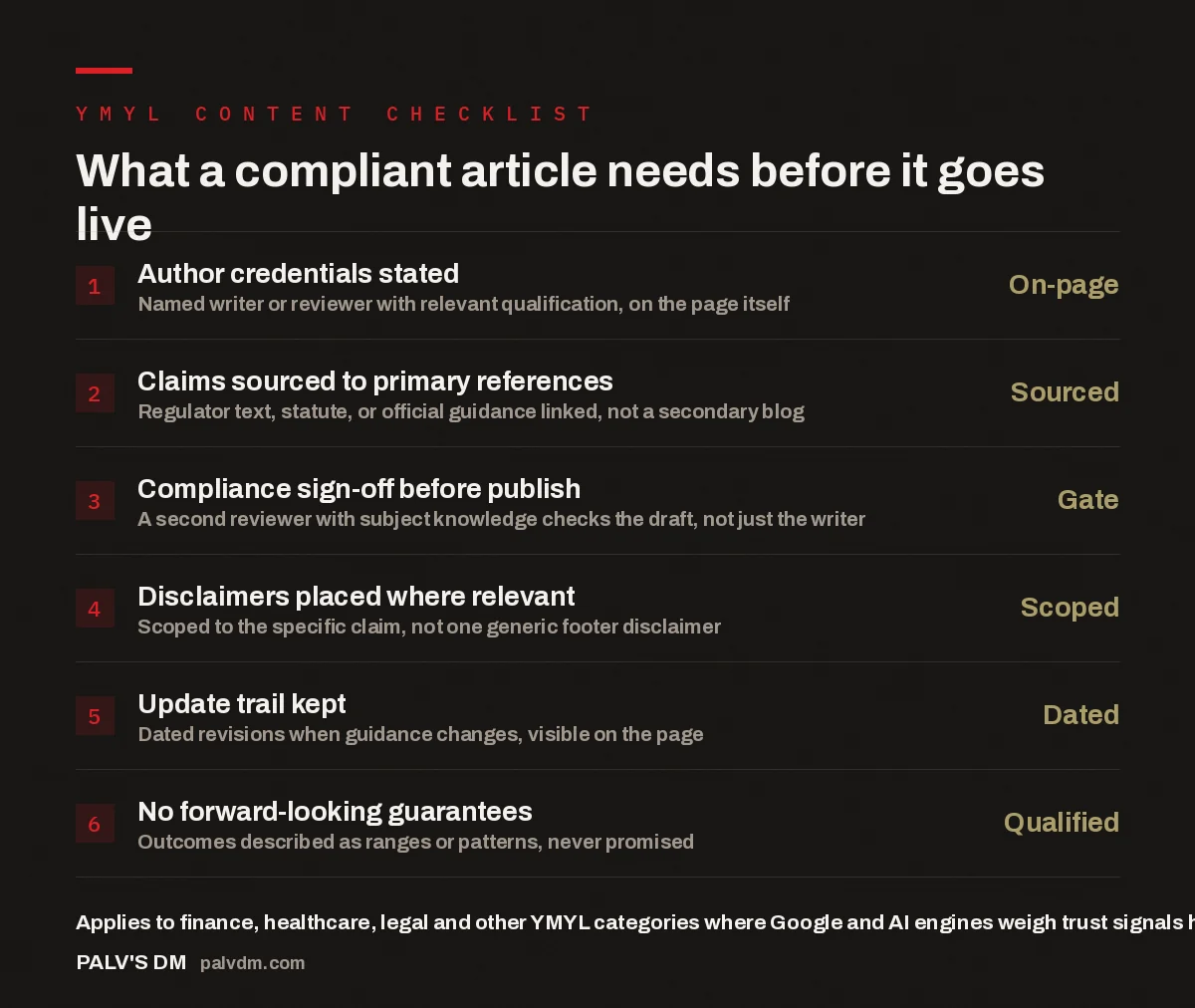
What a compliant article needs before it goes live
- Author credentials stated — On-page. Named writer or reviewer with relevant qualification, on the page itself.
- Claims sourced to primary references — Sourced. Regulator text, statute, or official guidance linked, not a secondary blog.
- Compliance sign-off before publish — Gate. A second reviewer with subject knowledge checks the draft, not just the writer.
- Disclaimers placed where relevant — Scoped. Scoped to the specific claim, not one generic footer disclaimer.
- Update trail kept — Dated. Dated revisions when guidance changes, visible on the page.
- No forward-looking guarantees — Qualified. Outcomes described as ranges or patterns, never promised.
What Makes an Industry “Regulated” for Content Purposes?
An industry counts as regulated, for content purposes, when a mistake in an article could change what a reader does with their money, their health, or their legal standing — and when there’s a body that can hold the publisher accountable for getting it wrong. That covers the obvious categories: banking, insurance, investment advice, pharmaceuticals, clinical services, tax, and law. It also covers categories people underestimate, like HR software that touches payroll compliance, or a fintech app that walks users through loan eligibility. The practical test: could a wrong statement in this piece cause a reader to lose money, delay treatment, or misunderstand a legal obligation? If yes, treat it as regulated content, regardless of what industry the client’s website is nominally in.
What Does YMYL Actually Mean for Your Content?
YMYL — Your Money or Your Life — is Google’s own label for content that can affect a reader’s health, financial stability, safety, or legal rights. It isn’t a formal ranking factor you can tick off; it’s a lens that search quality raters and, increasingly, AI answer engines apply to decide how much trust a page has earned. A YMYL page gets judged harder on the same three questions as everything else — does the author know what they’re talking about, is the site a credible source for this topic, and can the specific claims be trusted — but the bar sits noticeably higher because the cost of being wrong is higher.
In practice this shows up as generic explainer content getting outranked by pages with a named expert, a clear “reviewed by” line, and citations to primary sources, even when the generic page reads more smoothly. AI engines summarising this kind of question behave the same way — in the accounts we work on, pages with weak sourcing rarely get pulled into AI-generated answers on regulated topics, while pages with clear attribution and sourcing do. The pattern holds consistently enough that we now build sourcing and attribution into the brief from the start, rather than adding it after a draft is written.
How Do You Source Claims Without a Compliance Team on Staff?
Most clients in regulated industries don’t have an in-house compliance team dedicated to content review, and that’s fine — the sourcing discipline just has to live in the writing process instead. The rule we apply: every factual claim traces back to a primary source, not a summary of a summary. For a finance client, that’s the RBI or SEBI circular itself, not a news article describing it. For a healthcare client, that’s the clinical guideline itself, not a wellness blog’s paraphrase of it.
- Pull the claim from the regulator’s, association’s, or standards body’s own published document, and link to it directly.
- Date-stamp anything that references a rule, rate, or threshold, since these change and a static claim ages badly.
- Where the client has internal expertise — a compliance officer, a licensed advisor, a pharmacist — get their read on the draft before it goes anywhere near publish, not just a general proofread.
- Flag anywhere the writer had to infer or generalise rather than quote a source directly, so the reviewer knows exactly where to look harder.
This is slower than writing a standard blog post, and it should be. An article that took three source-checking passes is doing its job; one that took twenty minutes to write and zero to check rarely survives a compliance review intact.
The clients who get this right treat the compliance reviewer as part of the writing team, not as a gate the content has to survive at the end. Bring them in at the brief stage and the article gets written correctly the first time.
Palash, Founder, PalV’s DM
Who Should Review Regulated Content Before It Publishes?
Two people need to look at a regulated article before it’s live, and they’re not the same person. First, an editor checks that the piece is accurate to its sources, well structured, and answers the question it’s targeting — standard editorial review, the kind every article on the site goes through. Second, someone with genuine subject knowledge of the regulated area — the client’s compliance lead, a licensed professional on staff, or an external reviewer the client trusts — checks it for anything that could mislead, overstate, or create liability. That second gate is the one that’s easy to skip under deadline pressure, and the one that matters most for regulated content specifically.
If the client doesn’t have anyone in-house who can play that second role, that’s worth raising before the article is written, not after. Some bring in an outside consultant for a fixed review fee per article; others accept a narrower content scope, staying away from anything that needs a licensed sign-off. Both are reasonable. What isn’t reasonable is publishing regulated content with only a single editorial pass.
How Should Disclaimers Be Written So They Actually Hold Up?
A single disclaimer sentence in the footer of every page (“This content is for informational purposes only”) does almost nothing, legally or for the reader. It reads as boilerplate because it is boilerplate, and it doesn’t tell a reader where the general information stops and their specific situation needs a professional. Disclaimers that hold up are scoped to the exact claim they’re qualifying — placed next to the number, the recommendation, or the eligibility statement it applies to, not bundled into one line at the end.
An article on loan eligibility criteria should note, right where it lists the criteria, that individual eligibility depends on the lender’s current underwriting policy and the reader’s own financial profile — not just carry a generic “not financial advice” line below the fold. The same logic applies to healthcare content: a symptom description should note, at the point it’s made, that it isn’t a diagnosis, rather than relying on readers to scroll to a disclaimer they may never see.
What Happens When Guidance Changes After You’ve Published?
Regulated categories change their guidance more often than most other content topics — tax slabs, insurance rules, clinical recommendations, data protection requirements. An article that was accurate at publish and goes stale silently is a liability, not just an SEO problem, because readers land on it via search or an AI answer with no idea it’s out of date. The fix is a visible update trail: a “last reviewed” date on the page itself, and a brief note of what changed when a material fact is revised, not a silent edit.
This means regulated content needs a review cadence built into the plan, not a publish-and-forget schedule. A quarterly check against the regulator’s current published guidance catches most drift before it becomes a problem. For fast-moving areas — anything tied to an annual budget announcement or an active regulatory consultation — that check needs to happen closer to the relevant date, not on a fixed calendar.
Common Mistakes We See in Regulated-Industry Content
The most common failure isn’t factual error — it’s tone. Content written to sound authoritative often ends up guaranteeing an outcome (“you will qualify,” “this treatment works”) when the honest, defensible version is a qualified statement about eligibility or typical patterns. The second most common failure is treating disclaimer and compliance review as the last step before publish rather than an input to how the article is structured — content patched afterward almost always reads as patched.
The third pattern: a generic freelance writer with no brief on the regulatory context produces fluent, well-structured content that happens to state something the regulator would flag. This isn’t a writing skill problem. It’s a briefing and review process problem, and it’s why regulated-industry content needs a different workflow than the rest of a content calendar, not just more careful writers.
Related: how we add evidence, statistics, and sources to an article, why we refuse to publish without verifying numbers, the two approval gates every article goes through, and how we handle topics we don’t already know well — all of which feed into how a regulated-industry brief gets built.
Key takeaway
If your site publishes in finance, healthcare, legal, or another YMYL category, the content process needs a subject-matter reviewer and a sourcing standard built in from the brief stage — not added on afterward.
FAQ
What is YMYL content writing?
YMYL stands for “Your Money or Your Life” — Google’s term for content that could affect a reader’s health, financial stability, safety, or legal rights. YMYL content writing means producing that content to a higher standard of sourcing, author credibility, and accuracy, because both search engines and readers judge it more strictly.
Which industries count as regulated for content purposes?
Finance, insurance, healthcare, pharmaceuticals, law, and tax are the obvious ones. It also extends to any business whose content touches a regulated decision — a fintech app describing loan eligibility, or HR software explaining payroll compliance. The test: could a wrong statement change a reader’s money, health, or legal position?
Do we need an in-house compliance team to publish this kind of content?
No, but someone with genuine subject knowledge needs to review each article before it publishes — a compliance lead, a licensed professional, or an external reviewer. If nobody fills that role, narrow the content scope to topics that don’t need a licensed sign-off rather than publish without review.
How often should regulated content be updated?
A quarterly check against current regulator guidance catches most drift for most topics. Fast-moving areas tied to an annual budget announcement or an active regulatory consultation need checking closer to the relevant date rather than on a fixed calendar, since the underlying guidance can shift with little notice.
Are generic disclaimers enough for regulated content?
A single footer disclaimer rarely does the job. Disclaimers work best placed next to the specific claim they qualify — an eligibility statement, a dosage note, a rate — so the reader sees the caveat exactly where it applies, rather than needing to find a general statement elsewhere on the page.
Short version: content for a regulated industry needs a named author or reviewer, claims sourced to primary references, a subject-matter sign-off before publish, disclaimers scoped to the specific claim, and a visible update trail as guidance changes. Build those into the brief, not the edit pass, and the content survives both a compliance review and an AI engine’s trust filters.