May 2026 Core Update: A Volatile Twelve Days
The May 2026 core update ran 21 May to 2 June with three distinct volatility spikes. Why mid-rollout readings misled almost everyone who took them.
The May 2026 core update began on 21 May 2026 and completed on 2 June 2026, roughly 12 days. It was Google’s second core update of 2026 and, by broad practitioner consensus, considerably heavier than March’s. What makes it worth studying is not the outcome but the shape: the rollout produced at least three distinct waves of movement, and the ranking positions visible on day three were not the positions that survived to completion.
That shape is the practical lesson. Anyone who assessed damage in the first week, and acted on it, was optimising against a state that changed twice more before Google marked the update done.
What Google confirmed
| Detail | Confirmed |
|---|---|
| Start | 21 May 2026 (Thursday afternoon) |
| Completion | 2 June 2026 |
| Total rollout | ~12 days |
| Google’s estimate | “May take up to 2 weeks to complete” |
| Stated purpose | “A regular update designed to better surface relevant, satisfying content for searchers from all types of sites” |
| New guidance issued | None |
Google posted the announcement to its Search Status Dashboard and to LinkedIn, using the same standard language it applied to the March 2026 core update. As with March, no companion blog post and no new advice for creators.
The three waves
This is what separated May from March in practice.
Wave one — Saturday 23 May. The update was announced on Thursday afternoon and was already producing large ranking movement by Saturday. That is fast for a core update, and it caught sites that had not yet started monitoring.
Wave two — Saturday 30 May. After a relatively quieter middle period, a second round of large movements landed a week later. Sites that had concluded on 26 May that they were unaffected discovered otherwise.
Wave three — 1 to 2 June. Further significant volatility in the final twenty-four hours, immediately before Google marked the rollout complete.
Three separate readings of “how did we do” taken on 24 May, 27 May and 3 June would have produced three different answers. Only the last one is worth anything.
Why mid-rollout readings mislead
Google rolls core updates out progressively rather than flipping a switch. During that period, results genuinely move around as the new assessment propagates. A page can drop, partially recover, and then settle somewhere else entirely.
This creates a specific and expensive failure mode. A site owner sees a drop on day three, panics, and starts rewriting pages, deleting content or changing internal linking. By the time the rollout completes, three things have happened: the rankings have changed for reasons unrelated to the edits, the edits themselves are now confounding variables, and the ability to attribute anything to anything has been permanently destroyed.
The discipline is uncomfortable but simple. During a rollout, you observe and you log. You do not restructure. If a change was already planned and scheduled before the update, ship it and note the date. Otherwise wait.
How to assess the May 2026 update now
The rollout finished on 2 June, so current data is stable and any analysis you run today is on solid ground.
- Compare 8–20 May against 3–15 June. Equal-length windows, both entirely outside the rollout. Never let a comparison window straddle 21 May to 2 June — see choosing the right comparison window.
- Split positions, impressions and clicks. These three tell different stories and an average of them tells none. Falling positions is a ranking change; falling clicks at steady positions is usually an AI Overview or a title problem.
- Isolate Search from Discover and News in Search Console’s search type filter. They move independently.
- Segment by page template and query cluster. Core updates are rarely uniform. The pattern is the diagnosis.
- Check your own deployment log for the window. If you shipped anything between 21 May and 2 June, it is now entangled with the update and you should say so in your reporting rather than pretending otherwise.
- Confirm it was actually this update. The 2026 update timeline lists every confirmed rollout, and was it an update or was it you walks the alternatives.
What it appeared to reward
With the usual caveat that Google published no guidance and this is inference rather than fact: the May update was widely read as continuing the same direction as March rather than changing course. Sites publishing large volumes of undifferentiated content fared worst. Pages offering something the rest of the results did not — original data, documented first-hand testing, named expertise — fared better.
That is consistent enough across the 2026 rollouts to be worth planning around, and it is covered properly in what the 2026 updates have in common. It also maps onto Google’s own published self-assessment questions, which ask who produced the content, how it was produced, and why it exists — questions that anonymous, volume-produced content struggles to answer. Why anonymous content is losing ground goes into that specifically.
What not to conclude
- Do not treat it as a penalty. A core update is a reassessment, not enforcement. There is no violation to undo and no reconsideration request to file. The distinction changes what you do about it.
- Do not read a heavier update as a bigger warning. “Heavier” describes how much movement occurred across the index, not how badly Google thinks of your site.
- Do not expect recovery before the next core update. Google states plainly that the largest changes tend to arrive with a subsequent core update rather than between them.
- Do not confuse it with the June spam update. The June 2026 spam update ran 24 to 26 June, three weeks after the core update completed, and enforces entirely different systems.
As of 17 August 2026, the May core update remains the most recent core update Google has confirmed. If your site lost ground in it, the interval before the next one is the working window — and the 30-day recovery plan is how to use it.
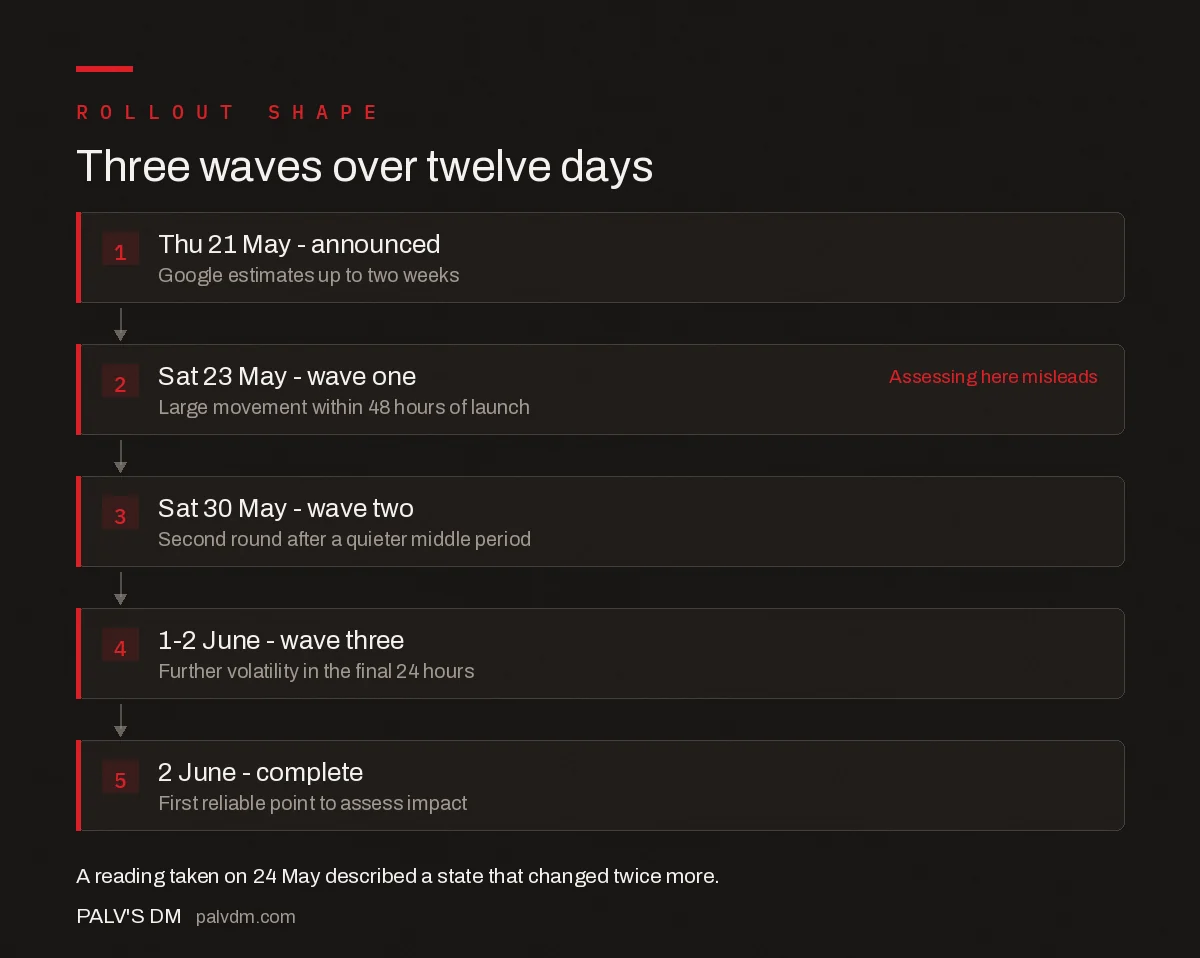
Three waves over twelve days
- Thu 21 May – announced. Google estimates up to two weeks.
- Sat 23 May – wave one. Large movement within 48 hours of launch. Assessing here misleads
- Sat 30 May – wave two. Second round after a quieter middle period.
- 1-2 June – wave three. Further volatility in the final 24 hours.
- 2 June – complete. First reliable point to assess impact.
Frequently asked questions
When did the May 2026 core update roll out?
It started on 21 May 2026, a Thursday afternoon, and Google confirmed it was complete on 2 June 2026 — roughly 12 days. It was Google’s second core update of 2026, following the March core update which ran 27 March to 8 April.
Was the May 2026 core update bigger than March?
By practitioner consensus, yes. It produced noticeably more ranking volatility, with three distinct waves of movement: large shifts on Saturday 23 May, another significant round on Saturday 30 May, and further volatility in the final 24 hours before completion. Google itself made no statement about relative size, and does not publish that kind of comparison.
Why did my rankings change during the May 2026 rollout and then change again?
Core updates roll out progressively rather than all at once, so results genuinely move as the new assessment propagates. The May 2026 update showed at least three separate waves. A position on day three was frequently not the position that survived to completion, which is why assessments made mid-rollout are unreliable and changes made mid-rollout destroy your ability to attribute cause afterwards.
What comparison window should I use to measure the May 2026 impact?
Use two equal-length periods that both sit entirely outside 21 May to 2 June — for example 8 to 20 May against 3 to 15 June. A window that straddles the rollout blends the before and after states into a single average that describes neither, which is the most common measurement error after a core update.
Did Google give any advice for the May 2026 core update?
No new guidance. Google used its standard framing, describing it as a regular update designed to better surface relevant, satisfying content from all types of sites, and pointed site owners to its existing core update and helpful content documentation. Its standing advice applies: there are no specific recovery actions, a drop does not necessarily mean something is wrong, and the biggest changes tend to follow a later core update.
Sources
- Google May 2026 core update rollout is now complete — Search Engine Land
- Google Search Status Dashboard
- Google core updates and your website
Want this done on your site?
Every PalV’s DM engagement starts with a free audit of your actual website — a 12-point
crawl covering what is blocking indexation, on-page gaps against your primary keywords, speed
findings, and the three to five fixes worth making first. Delivered in two working days. No
payment details, and the findings are yours whether you hire us or not.