Service Support — Consulting & Audit
Consulting After a Traffic Collapse
Considering an SEO consultant after a traffic drop? Learn when to call one, what they diagnose first, and how to prepare so the review moves fast.

Hire an SEO consultant after a traffic drop when you can’t confidently explain the cause, when the pages that fell drive revenue, or when your current agency might be the reason it happened. A consultant’s first job isn’t to fix anything — it’s to diagnose the drop independently and tell you within days whether you’re looking at an algorithm update, a technical break, a manual action, or something that was never really SEO in the first place. If the drop is small, explainable, and already being addressed by a team you trust, it can usually wait. If it’s steep, unexplained, or hitting money pages, waiting is the expensive option.
Key takeaway
- An SEO consultant’s first job after a traffic drop is diagnosis, not action — confirming what actually happened before anyone touches the site.
- Sudden, steep, or revenue-hitting drops justify an outside consultant fast; small dips within normal fluctuation usually don’t.
- If the drop happened on your current agency’s watch, an independent read avoids the conflict of them investigating their own work.
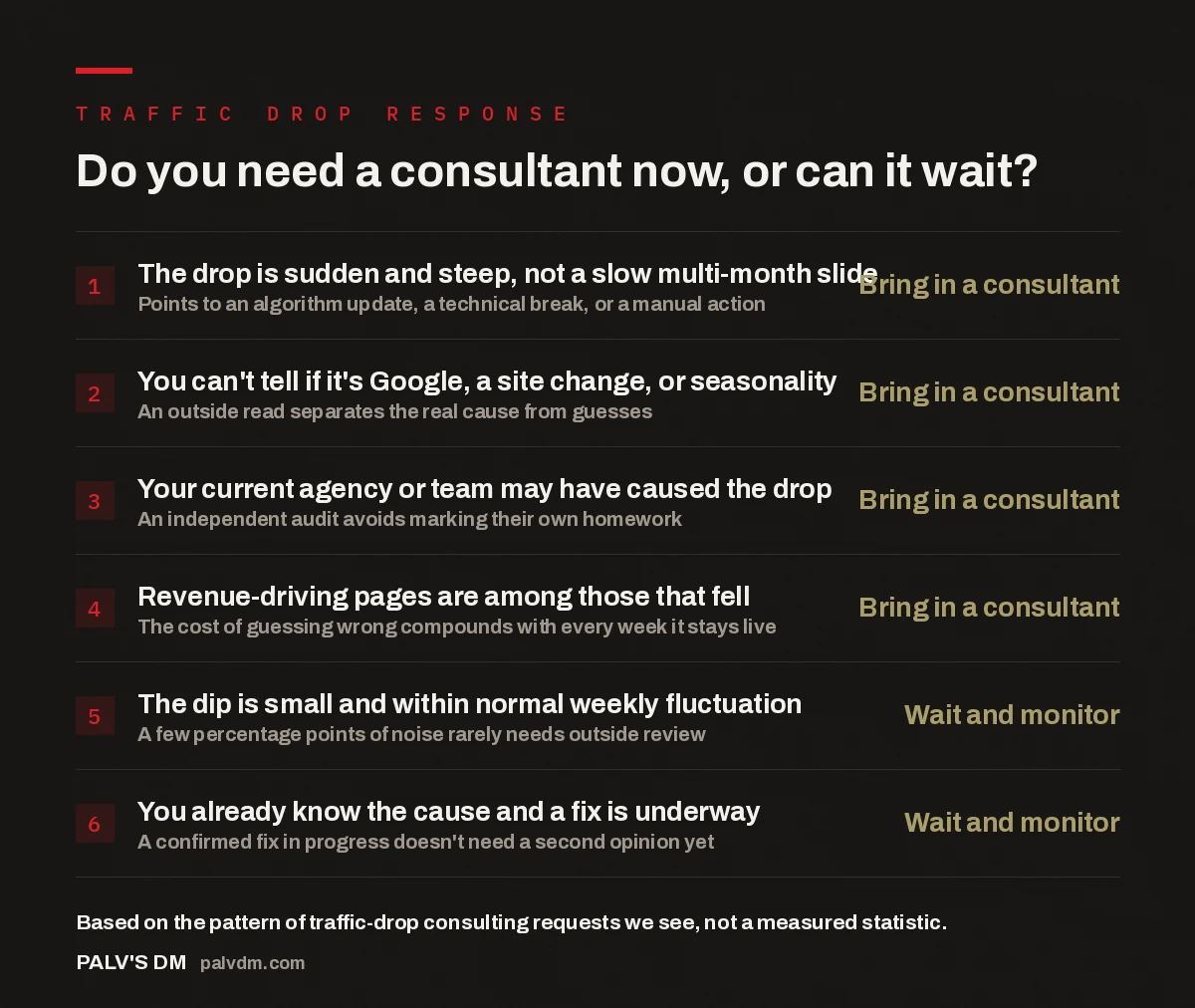
Do you need a consultant now, or can it wait?
- The drop is sudden and steep, not a slow multi-month slide — Bring in a consultant. Points to an algorithm update, a technical break, or a manual action.
- You can’t tell if it’s Google, a site change, or seasonality — Bring in a consultant. An outside read separates the real cause from guesses.
- Your current agency or team may have caused the drop — Bring in a consultant. An independent audit avoids marking their own homework.
- Revenue-driving pages are among those that fell — Bring in a consultant. The cost of guessing wrong compounds with every week it stays live.
- The dip is small and within normal weekly fluctuation — Wait and monitor. A few percentage points of noise rarely needs outside review.
- You already know the cause and a fix is underway — Wait and monitor. A confirmed fix in progress doesn’t need a second opinion yet.
How fast should you bring in a consultant after a drop starts?
Speed matters here more than in most SEO decisions, because an uninvestigated drop tends to compound. A technical issue left live for three extra weeks means three extra weeks of pages dropping out of the index. A manual action left unaddressed means the recovery clock only starts once you’ve filed a reconsideration request. The pattern that shows up repeatedly: teams that get an outside SEO consultant to review a traffic drop within the first week or two recover faster than teams that spend a month debating internally whether the drop is “real.”
That doesn’t mean every dip needs an emergency call. A small pullback over a week, especially in a category with known seasonal swings, is often nothing. The signal to move quickly is size and shape together: a drop that’s steep, starts on a specific date, and isn’t explained by anything you changed on purpose. When those three line up, waiting another two weeks to “see if it recovers” usually costs more than getting a second opinion now.
What does a consultant actually do in the first week?
The first week is almost entirely diagnostic, and a competent consultant resists the pressure to recommend fixes before that diagnosis is done. The work starts with pulling the exact date and shape of the drop from Search Console and analytics, then checking that date against confirmed Google algorithm updates, any changes your team or agency made around that time, and whether the drop is site-wide or concentrated in specific templates or sections. What a consultant looks at in the first thirty minutes of any audit is largely the same regardless of whether the engagement started with a drop or a routine review — a drop just gives you a specific date to work backward from, which narrows things considerably.
From there, the consultant rules causes in or out rather than guessing: was there a redesign, migration, or URL change in the weeks before? Did crawl stats spike or crash around the same date? Is Search Console showing a manual action? Did rankings fall for specific keyword clusters, or across the board? Each answer eliminates possibilities. By week’s end, a good consultant should be able to tell you, in plain language, which cause is most likely — even if the full fix takes longer.
In-house diagnosis vs bringing in a consultant: what’s actually different?
| Question | Diagnosing it in-house | Bringing in a consultant |
|---|---|---|
| Who’s investigating? | The team that may have caused it, or one without prior update-pattern exposure | Someone with no stake in the outcome and broader pattern recognition |
| How fast is the read? | Depends on internal bandwidth and competing priorities | Usually a focused diagnosis within the first week |
| Risk of a biased conclusion? | Higher, especially if the drop coincided with recent agency changes | Lower — no reason to protect anyone’s prior work |
| Cost | No direct fee, but slower diagnosis has its own cost in lost traffic | A defined fee, usually recovered quickly if it shortens recovery |
| Best fit for | Small, explainable dips your team already understands | Steep, unexplained, or agency-caused drops hitting revenue pages |
Neither column is automatically right — it depends on the situation in the checklist above. But one case deserves caution: when the drop happened on your current agency’s watch, they’re rarely the right party to investigate whether they caused it. That’s not an accusation of dishonesty, it’s a structural conflict, the same way a contractor shouldn’t inspect their own work. Getting a second opinion on agency work covers how to request that review without souring the relationship.
The clients who come to us calmest after a traffic drop are almost never the ones with the smallest drop — they’re the ones who already have a clear timeline of what changed and when. Half our first call is usually just reconstructing that timeline from scratch, and that’s the part that costs the most time to wait on.
Palash, Founder, PalV’s DM
What actually causes most sudden traffic drops?
There isn’t one universal cause, but a handful of categories account for most drops in the accounts we work on, and they’re usually distinguishable fairly quickly. A broad algorithm update tends to hit a category or content type across many sites at once — the broader pattern of how search algorithms and ranking behaviour have been shifting is useful context for judging whether a drop is isolated to your site or part of something wider. A technical break — a botched robots.txt change, a canonical pointing the wrong way, a migration that lost redirects — tends to hit specific templates or sections and correlates tightly with a deploy date your dev team can confirm. A manual action shows up explicitly in Search Console. And a slow structural decline that looks sudden only because nobody was watching closely enough is its own category, distinguishable mainly by the fact that, zoomed out, it wasn’t sudden at all.
Knowing the category matters because the fix looks different for each. Algorithm-update drops are addressed by improving underlying content and site quality over time — there’s no single lever to pull. Technical breaks are addressed by reverting or fixing the specific change, often within days. Manual actions require a formal fix-and-request-review cycle. Treating one kind of drop like another is the single most common way teams waste weeks chasing the wrong fix — the three findings that show up in almost every audit often surface exactly this kind of misdiagnosis.
Should you go straight to a consultant or try your existing team first?
If you have an internal SEO person or an agency you trust, and the drop isn’t tied to anything they recently touched, it’s reasonable to ask them for an initial read first. Give them a short deadline — days, not weeks — to identify the likely cause. If they come back with a clear, evidence-backed explanation and a credible fix, a consultant isn’t necessary.
Bring in an outside consultant sooner in three situations: the internal team comes back unsure or with a vague explanation that doesn’t match the data; the drop coincides with changes that same team made; or the affected pages generate leads or revenue, where extra weeks of guessing shows up directly in lost business. None of this requires assuming bad faith — a consultant working alongside your existing team, rather than replacing them, is a normal way to get a faster, more objective read.
What should you bring to the first consulting call?
The single biggest accelerant for a fast diagnosis is arriving with data already assembled:
- Search Console performance data covering at least eight weeks before and after the drop, so the shape and exact start date are visible.
- Analytics data for the same window, split by landing page or section if possible, to show whether the drop is site-wide or concentrated.
- A rough timeline of anything that changed around the drop date — deploys, redesigns, content changes, migrations, even unrelated site work.
- Access (read-only is fine to start) to Search Console and analytics, so the consultant can verify details rather than relying on screenshots.
Walking in with that assembled can turn a week-long diagnosis into two or three days, since the consultant isn’t spending the first call requesting access and waiting on exports. What to bring to a consulting call to make it worth it covers this preparation for any first consulting engagement, not just a traffic drop.
Key takeaway
- A drop that’s sudden, steep, unexplained, or hitting revenue pages is worth an outside consultant’s time within the first week or two.
- Diagnosis always comes before action — a consultant’s first output is a clear answer on cause, not an immediate list of fixes.
- Arriving with Search Console data, analytics, and a change timeline already assembled is what turns a week-long diagnosis into a two-day one.
FAQ
How do I know if my traffic drop is a Google algorithm update or something on my own site?
Compare the exact start date of your drop against confirmed algorithm update rollout windows, which Google documents publicly. If it lines up closely and the decline hits a specific content type rather than the whole site, that points toward an update. If not, the more likely cause is something changed on the site itself.
Should I pause paid ads or other marketing while investigating an organic traffic drop?
Not automatically. An organic drop doesn’t necessarily mean other channels are affected, and pausing paid spend can create a second problem — lost leads — while you’re still diagnosing the first. Check whether other channels show a correlated dip before making changes there, but don’t tie the two decisions together by default.
Can a consultant diagnose a traffic drop without full access to my website?
Read-only access to Search Console and analytics is usually enough for the diagnosis phase — a consultant doesn’t need CMS or hosting access just to identify the likely cause. Broader access typically only becomes necessary once you move from diagnosis into implementing the fix.
How long does it typically take to recover from a traffic drop once the cause is fixed?
It depends on the cause. Technical breaks that get fixed quickly often show partial recovery within days to a couple of weeks, once pages are recrawled. Algorithm-related drops tend to take longer, since they depend on sustained improvement rather than a single fix, and manual actions only start their recovery clock once a reconsideration request is filed and reviewed.
Is it worth hiring a consultant if the drop is only affecting one section of the site?
Often yes, especially if that section drives meaningful traffic or revenue, because a localized drop is usually easier and faster to diagnose than a site-wide one — there are fewer variables to rule out. A focused outside review of a high-value section tends to pay for itself quickly.