Service Support — Content Writing
Content for a Brand With No Existing Blog
How do you start a business blog with zero traffic history? Plan your first ten topics, a publishing cadence, and basic schema before writing post one.

If you want to start a business blog for a brand that has never published a single article, the biggest risk isn’t a bad first post — it’s publishing without a plan and stopping after four. A new blog with no domain history needs three things before the first draft is written: a fixed set of topics tied to what the business actually sells, a cadence the team can sustain for at least three months, and basic technical setup (schema, author bios, internal linking) done from post one instead of retrofitted later. Everything else — tone, length, keyword research depth — matters less than whether the blog still exists and is still being updated six months from now.
Key takeaway
- A brand-new blog should launch with a topic list already written for the first 8-10 posts, not one post and a “we’ll figure out the rest” plan.
- Consistency beats volume in the first three months — a modest, sustainable cadence outperforms a burst of posts followed by silence.
- Technical basics (schema, author pages, internal links between posts) are cheaper to set up before post one than to retrofit across fifty posts later.
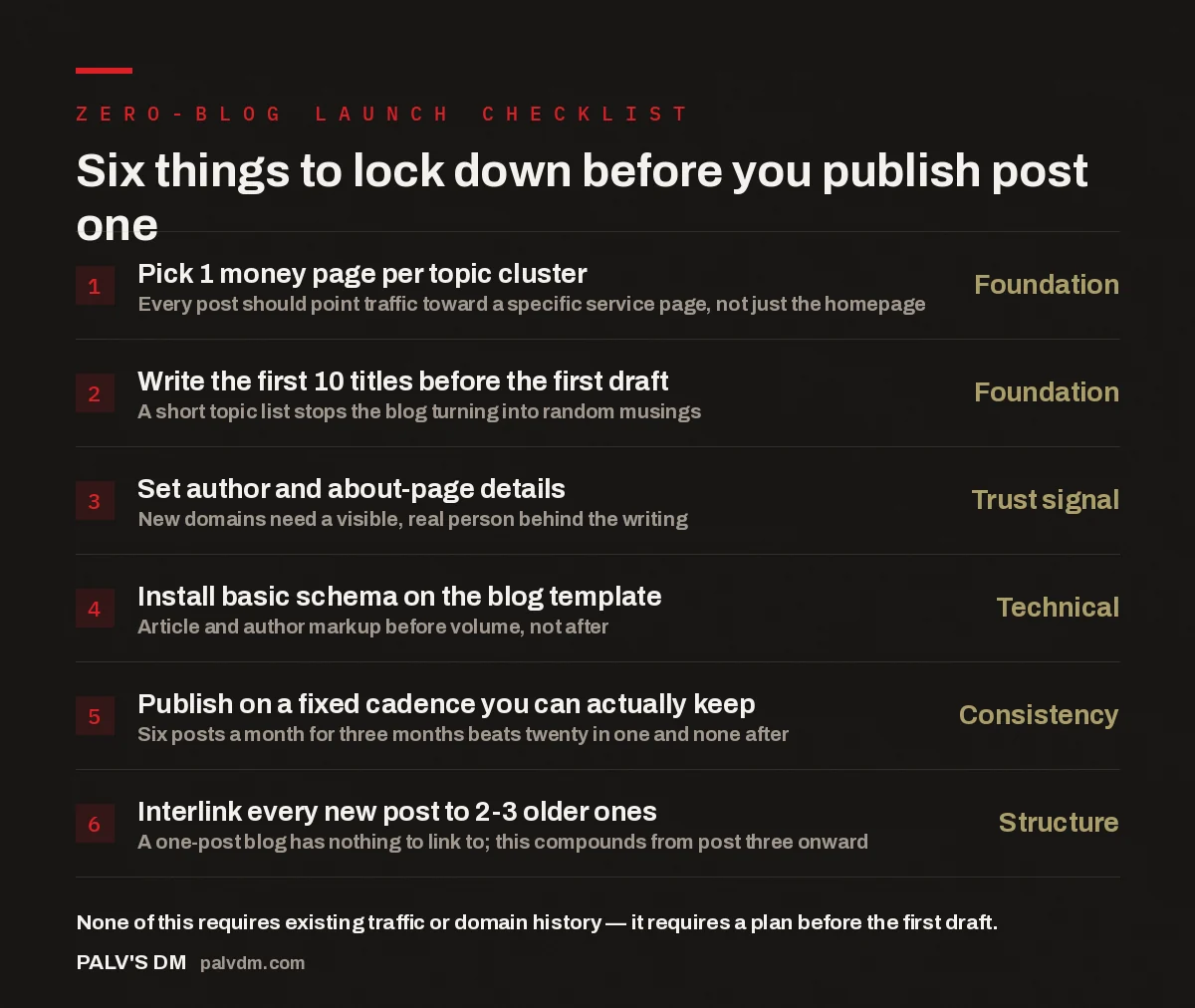
Six things to lock down before you publish post one
- Pick 1 money page per topic cluster — Foundation. Every post should point traffic toward a specific service page, not just the homepage.
- Write the first 10 titles before the first draft — Foundation. A short topic list stops the blog turning into random musings.
- Set author and about-page details — Trust signal. New domains need a visible, real person behind the writing.
- Install basic schema on the blog template — Technical. Article and author markup before volume, not after.
- Publish on a fixed cadence you can actually keep — Consistency. Six posts a month for three months beats twenty in one and none after.
- Interlink every new post to 2-3 older ones — Structure. A one-post blog has nothing to link to; this compounds from post three onward.
What actually happens when you start a business blog with zero history?
A brand-new domain doesn’t rank for anything competitive in the first few months, no matter how good the writing is. That’s not a punishment, it’s just how search engines and AI answer engines work — they weight some amount of established signal (age, consistency, other sites linking in) alongside the content itself, and a blog that launched last week has none of that yet. What a new blog can do immediately is answer very specific, lower-competition questions that its target customers are actually typing or asking — the kind of query with three competitors instead of three hundred. Those posts start getting a trickle of traffic well before the domain has “authority” in any broader sense, and they give you something to link new posts back to.
The pattern that shows up repeatedly with new business blogs we’ve worked on: the first 5-8 posts get almost no traffic on their own, but they become the internal-linking backbone for posts 15 through 30, which is where the visible movement starts. Treating the early posts as throwaway content is a mistake — they’re infrastructure, not filler.
How many articles do you need before a new blog does anything?
There’s no fixed number that applies to every industry, but the honest answer is: more than most brands expect, and spread over more time than most brands expect. A handful of posts is not a blog — it’s a placeholder that search engines and readers alike will treat as abandoned if it doesn’t grow. What tends to move things is sustained publishing against a real topic map, not a single viral post or a content sprint that stops the moment the founder gets busy again.
If you want a working rule of thumb rather than a guess: plan your first quarter around covering every core service or product the business offers from at least two angles — a direct “what is / how does it work” angle and a “how do I choose / what should I watch for” angle. That alone is usually 15-20 topics before you’ve written a single opinion piece or trend article. Once that base layer exists, later posts have somewhere to link to, and the blog starts looking like a resource instead of a diary.
What should the first 10 posts actually be about?
Resist the urge to open with a thought-leadership piece or a company-news post — neither answers a question anyone is searching for, and a brand-new domain needs every early post to be pulling its own weight. The first 10 should map directly to what the business sells and what a prospective customer would need to know before buying it:
- One clear “what is [service/product]” explainer per core offering
- One “how much does [service] cost” or “how to choose a [service provider]” post — high commercial intent, low competition for a new domain
- Two or three posts answering the objections your sales team hears most often
- One “how we work” or process post that builds trust with a reader who has never heard of the brand
- Two or three posts targeting a specific situation or customer segment rather than the topic in general
Notice what’s missing from that list: industry news commentary, listicles with no product connection, and anything written mainly to sound impressive rather than to answer a real question. Those formats can work later, once the blog has an audience worth impressing. In month one, they’re a distraction.
Do you need a writer, a strategist, or both to launch a blog from scratch?
A common myth is that a blog just needs “good writers” and the rest sorts itself out. In practice, a brand with no existing blog needs the strategy decisions made first — which topics, in what order, pointing at which page — because a writer working without that map will default to whatever seems interesting that week. Good writing on the wrong topic, in the wrong order, with no internal links, still under-performs mediocre writing that follows a deliberate plan. If you only have budget for one role at launch, it should be someone who can map the first quarter of topics against your actual services, even if that means the first few posts are written more plainly than you’d like.
The founders who ask us “how do we start a business blog” almost never need better sentences first. They need someone to tell them which ten topics to write about and in what order — the writing quality is rarely the reason a new blog goes nowhere.
Palash, Founder, PalV’s DM
What technical basics does a brand-new blog need on day one?
Retrofitting technical setup across dozens of posts later is far more expensive than doing it once, correctly, before publishing the first one. For a brand-new blog, that means: a blog template with proper heading structure and Article schema built in, a real author name and short bio rather than “Admin,” a consistent URL and category structure you won’t need to restructure at post 30, and an internal-linking habit that starts with the very first post — even if there’s nothing to link to yet, leave the placeholder pattern in the template so it’s not forgotten later.
None of this requires a large budget or a developer on retainer. It requires deciding the pattern once and applying it consistently, which is exactly the kind of thing that gets skipped when a blog launches in a hurry and gets fixed properly the second time around, at real cost, after the first thirty posts are already live.
How long before a new business blog is worth the effort?
Directionally, the accounts we work on that stick with a consistent publishing cadence start seeing the first meaningful, non-branded traffic in the range of a few months in — not from one post going viral, but from the accumulated effect of enough posts existing, linking to each other, and each answering a real question well. The accounts that stall out are almost always the ones that published in bursts: a flurry of posts in month one, then nothing for two months, then a different person picks it up with a different tone and no memory of the original topic map. A blog that publishes six modest posts a month for three straight months will, in our experience, consistently outperform one that publishes twenty in one month and then goes quiet.
Ready to start?
If you’re deciding how to start a business blog with no existing content, no author history, and no time to figure out the topic map yourself, we build the first quarter’s plan and the posts that go with it.
Frequently asked questions
How many blog posts should I publish before expecting any traffic?
There’s no universal number, but a base layer of 15-20 posts covering your core services from two or three angles each is a reasonable minimum before you can judge whether the approach is working. Fewer than that and you don’t yet have enough internal linking or topic coverage to tell signal from noise.
Should our first blog post be an announcement about the blog itself?
No. A “welcome to our blog” post answers no one’s search query and wastes a slot that could go to a real explainer or FAQ post. Save the announcement, if you want one, for a newsletter or social post instead of the blog itself.
Can I start a business blog without an in-house writer?
Yes — most brands with no existing blog don’t have an in-house writer and don’t need one to start. What you do need before the first draft is written is the topic map: which pages you’re supporting, in what order, and who the reader is for each post.
Does a new blog need its own separate subdomain?
Generally no. Publishing under a folder path on your main domain (like /blog/) lets the blog’s content and links contribute to the same domain as your service pages, rather than building authority on a separate subdomain that doesn’t directly help the pages you’re trying to grow.
What’s the biggest mistake brands make when they start a business blog?
Publishing in a burst and then stopping. A flurry of ten posts in the first month followed by silence for the next two signals inactivity to both readers and search engines, and the momentum from the burst is largely wasted. A steady, sustainable cadence from day one performs more reliably than an unsustainable sprint.
Short version: to start a business blog that actually works, write the first 8-10 topics before the first draft, get schema and author basics right in the template from post one, and commit to a publishing cadence you can hold for three straight months. Related reading on our content process: how we move a post from brief to published, whether you need a writer or a strategist first, how many articles it typically takes before traffic moves, and what SEO content should cost per article in India when you’re budgeting a launch.