December 2025 Core Update: The Eighteen-Day Rollout
The December 2025 core update ran 18 days across the holiday period. What Google confirmed, why the three-week estimate was unusual, and how to diagnose it.
The December 2025 core update started on 11 December 2025 and Google marked it complete on 29 December 2025 — 18 days and 2 hours. It was the longest core update rollout of 2025, the only one to run across the holiday period, and the only recent core update for which Google estimated three weeks rather than the usual two. It was also the last core update before Google’s 2026 rollouts came in noticeably shorter, at 12 days 4 hours in March and 11 days 21 hours in May.
The timing is what made it difficult rather than the length. An 18-day rollout landing between 11 and 29 December sits on top of the sharpest seasonality in the calendar for retail, travel and publishing, with most teams away for part of it. Diagnosing ranking damage in that window is genuinely harder than in any other month, and a large number of December 2025 “core update hits” were seasonal traffic patterns misread.
What did Google confirm about the December 2025 core update?
| Detail | Confirmed |
|---|---|
| Announced | 11 December 2025, 09:25 PST |
| Completed | 29 December 2025, 11:00 PST |
| Duration | 18 days, 2 hours |
| Google’s stated estimate | “The rollout may take up to 3 weeks to complete” |
| New guidance issued | None |
| Category | Filed under Ranking on the Search Status Dashboard |
Google’s notice pointed to its standing core updates documentation rather than to anything new, which has been the pattern for every core update since. The Search Status Dashboard holds the entry with the exact timestamps, and every 2025 date sits in the 2025 update timeline.
Why was the three-week estimate unusual?
Google’s standard core update wording is “the rollout may take up to 2 weeks to complete”. That is what it said for the March 2026 and May 2026 core updates, and for the February 2026 Discover core update. For December 2025 it said three weeks.
Google has never explained why the estimate changed, so the only defensible reading is the narrow one: Google expected this rollout to run longer than a typical one, and it did — 18 days, past the two-week mark, though still inside the three weeks Google had allowed for.
What the estimate does not tell you is anything about scope or severity. Rollout duration and update impact have no demonstrated relationship: the March 2024 core update ran 45 days and the December 2024 core update ran 6 days and 4 hours, and both were broad reassessments of the same kind. The full rollout-duration record sets out every logged duration since November 2021.
What made an 18-day holiday rollout so hard to read?
Three problems compound, and they are worth separating because each has a different workaround.
Seasonality swamps the signal. Between 11 and 29 December, search demand in most commercial verticals rises steeply, peaks, and then collapses over Christmas. A traffic chart in that window moves violently for reasons that have nothing to do with ranking. Clicks are the worst metric to judge a December core update by, because clicks are exactly what seasonality moves.
Your comparison windows are contaminated. A standard 28-day comparison ending in early January compares a rollout period against a pre-Christmas run-up. A year-on-year comparison runs into the December 2024 core update, which ran 12 to 18 December 2024. Both Decembers contain a core update, which is an unusual piece of bad luck for anyone reaching for the obvious baseline.
Nobody is at their desk. The rollout crossed Christmas and ran to 29 December. Deployments freeze, monitoring lapses, and by the time teams reconvene in January the movement has already happened and the daily data is two to three weeks old.
The compounding effect is what catches people out. Any one of those three problems is manageable in isolation. Together they produce a chart that looks like a catastrophe in the first week of January regardless of what the update did, which is why December core updates generate more false diagnoses than any other month. For sites with strong December seasonality, the safest position through the whole rollout was to record the dates and change nothing until a clean comparison was possible in mid-January. Planning SEO around seasonality is what makes that restraint affordable rather than nerve-racking.
How do you diagnose a holiday-period core update?
- Judge positions before clicks. Average position and impressions for a fixed query set are far less seasonal than clicks. If positions held and clicks fell over Christmas, you had a seasonal traffic pattern, not a ranking change.
- Compare 1–10 December against 30 December to 8 January. Both windows sit fully outside the 11–29 December rollout. A window straddling the rollout blends two states and answers nothing. Choosing the comparison window correctly matters more here than in any other month.
- Use same-weekday year-on-year comparisons, not same-date. December traffic is heavily weekday-shaped, and 24 December falls on a different day each year.
- Segment by query cluster and page type before looking at totals. Core update damage shows up as a pattern — one content type or one query cluster losing while others hold. Seasonality moves everything together.
- Isolate Discover and News from Search. They move independently and have their own seasonal shapes.
- Check what you shipped in the freeze. December deployments are rushed before the freeze and rarely reviewed after it. Establishing whether it was an update or you resolves a large share of December drops.
Confirming update impact properly covers the full method once the windows are set.
Where does the December 2025 rollout sit in the record?
It was the longest of the three 2025 core updates and the end of a lengthening sequence, which then reversed in 2026.
| Core update | Started | Duration |
|---|---|---|
| March 2025 | 13 Mar 2025 | 13 days, 21 hours |
| June 2025 | 30 Jun 2025 | 16 days, 18 hours |
| December 2025 | 11 Dec 2025 | 18 days, 2 hours |
| March 2026 | 27 Mar 2026 | 12 days, 4 hours |
| May 2026 | 21 May 2026 | 11 days, 21 hours |
Three lengthening rollouts across 2025, then two of the shortest of the modern era in 2026. It is a real pattern in the data and it means nothing until Google explains it, which Google has never done for any rollout duration. The full update history puts the sequence alongside what each update was actually for.
What did it set up for 2026?
December 2025 was the last core update before a dense run of 2026 activity: the February Discover core update, the March spam update, the March 2026 core update, the May core update and the June spam update. Sites still carrying December 2025 damage had two further core updates within six months in which to recover.
That matters because of Google’s standing guidance, restated after each 2026 core update: there are no specific actions that guarantee recovery, a drop does not necessarily mean anything is wrong with your pages, and the biggest recoveries tend to arrive with a subsequent core update rather than between them. On the 2026 cadence, a site damaged in December 2025 had its realistic recovery point in late March or early June 2026, not in January.
What if you are still carrying December 2025 damage?
Start by confirming it was the update at all, using the comparison windows above. A surprising share of December 2025 diagnoses collapse under a positions-versus-clicks split.
If the damage is real, the response is the same as for any core update: identify the specific URLs and query clusters that lost, compare them honestly against the pages that gained, and close the gap in substance rather than formatting. Google’s self-assessment questions are built around who produced the content, how it was produced and why it exists — and a page with no named author, produced at volume to fill a keyword gap, cannot answer two of the three. What a core update actually is explains why there is no violation to undo, and the 30-day recovery plan sequences the work so that it lands before the next reassessment rather than after it. Every subsequent confirmed date is in the 2026 update timeline.
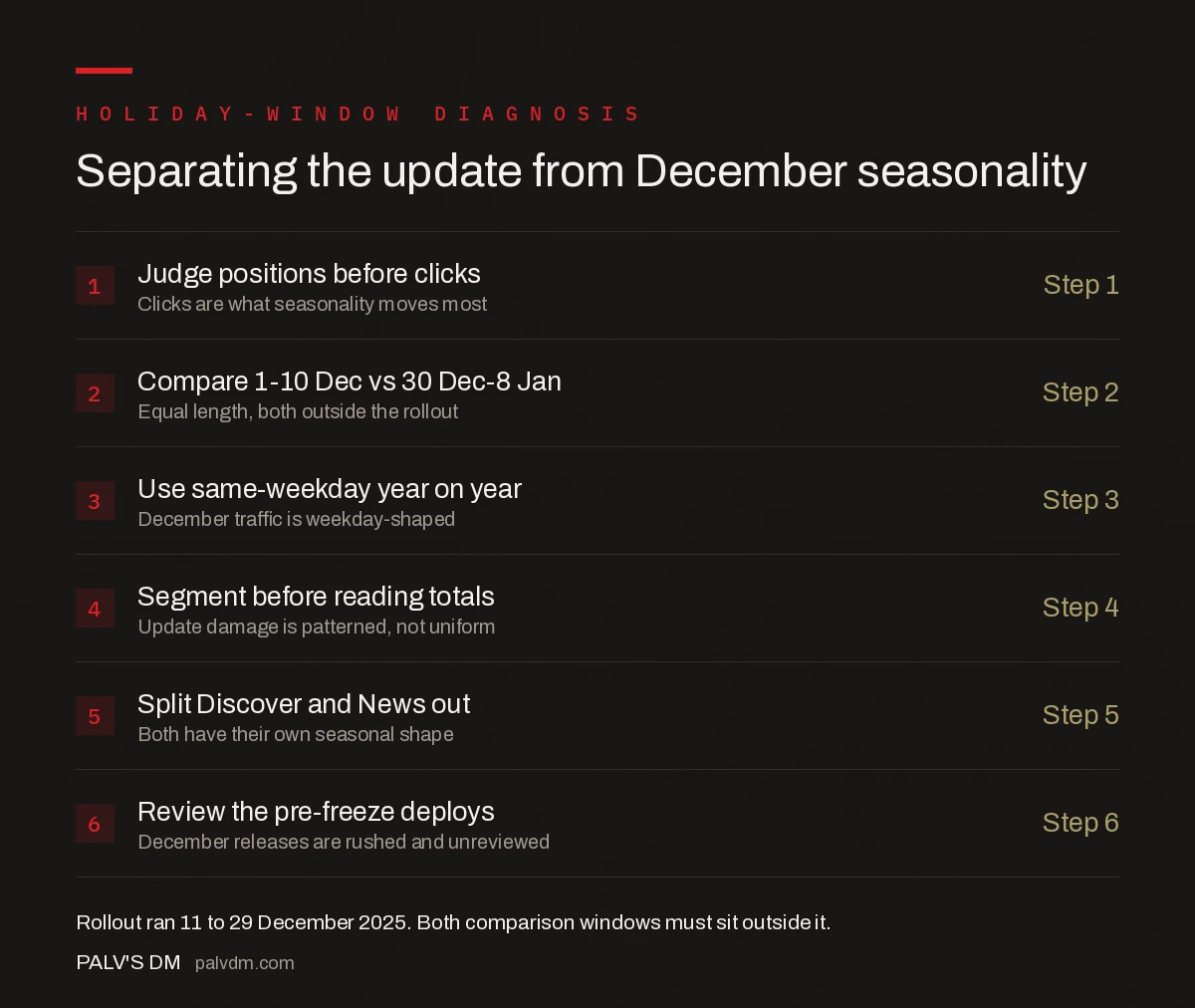
Separating the update from December seasonality
- Judge positions before clicks — Step 1. Clicks are what seasonality moves most.
- Compare 1-10 Dec vs 30 Dec-8 Jan — Step 2. Equal length, both outside the rollout.
- Use same-weekday year on year — Step 3. December traffic is weekday-shaped.
- Segment before reading totals — Step 4. Update damage is patterned, not uniform.
- Split Discover and News out — Step 5. Both have their own seasonal shape.
- Review the pre-freeze deploys — Step 6. December releases are rushed and unreviewed.
Frequently asked questions
When was the December 2025 core update?
Google released the December 2025 core update on 11 December 2025 at 09:25 Pacific time and marked the rollout complete on 29 December 2025 at 11:00 Pacific time, a total of 18 days and 2 hours. It was filed under Ranking on the Google Search Status Dashboard, and Google issued no new guidance with either the launch or the completion notice.
How long did the December 2025 core update take?
18 days and 2 hours. It was the longest of the three core updates Google ran in 2025, following March 2025 at 13 days 21 hours and June 2025 at 16 days 18 hours. Unusually, Google estimated up to three weeks for this rollout rather than its standard two, and the rollout finished inside that three-week allowance.
Why is a December core update harder to diagnose?
Because seasonality moves traffic violently in the same window. Search demand in most commercial verticals rises, peaks and collapses across December, so clicks are the worst metric to judge the update by. Standard 28-day comparisons are contaminated, deployment freezes hide self-inflicted changes, and the previous December also contained a core update.
Which comparison windows should I use for the December 2025 core update?
Compare 1 to 10 December 2025 against 30 December 2025 to 8 January 2026. Both sit entirely outside the 11 to 29 December rollout, and both are equal length. Judge average position and impressions for a fixed query set before clicks, because clicks are the metric December seasonality distorts most.
Was the December 2025 core update bigger than the 2026 ones?
There is no evidence either way, because rollout duration carries no information about impact. The December 2025 rollout ran 18 days and 2 hours, the March 2026 core update 12 days and 4 hours, and the May 2026 core update 11 days and 21 hours. Google has never explained why rollout lengths vary.
Can I still recover from the December 2025 core update?
Yes, but recovery tends to arrive with a subsequent core update rather than between them, which is Google’s own standing guidance. A site damaged in December 2025 had its realistic recovery points at the March 2026 and May 2026 core updates. The work is to close the substance gap against the pages that gained.
Sources
- Google Search Status Dashboard — Ranking incident history
- Google core updates and your website — Search Central
- Creating helpful, reliable, people-first content — Search Central
- Performance report (Search results) — Search Console Help
Want this done on your site?
Every PalV’s DM engagement starts with a free audit of your actual website — a 12-point
crawl covering what is blocking indexation, on-page gaps against your primary keywords, speed
findings, and the three to five fixes worth making first. Delivered in two working days. No
payment details, and the findings are yours whether you hire us or not.