
BERT and Natural Language Understanding in Search
BERT changed how Google reads the words in a query in relation to each other. What it does, what it changed in 2019, and why you cannot optimise for it.
BERT is a natural language understanding technique Google applied to Search in October 2019 to read the words in a query in relation to each other rather than as a bag of keywords. It affected one in ten English searches in the United States at launch, and by October 2020 Google said it was involved in almost every English query. BERT is not something you can optimise for. It changed how Google interprets language, not what it rewards, and Google has never published a BERT checklist because there is nothing in it to configure.
The reason it still matters in 2026 is not the update itself but what it established: small function words carry meaning, and pages that answer the actual question asked outperform pages that match the keywords in it. Everything Google has shipped in language understanding since builds on that.
What is BERT?
BERT stands for Bidirectional Encoder Representations from Transformers. It is a neural network technique for natural language pre-training, published by Google Research in 2018 and released as open source, which is why BERT and its descendants appear far outside Google.
The bidirectional part is the substance. Earlier language models read text in one direction, predicting each word from the words before it. BERT considers the words on both sides of a term at once, so the meaning of a word is derived from its full context rather than from what preceded it. In a search query, where every word is doing work in a nine-word sentence, that difference is decisive.
Google added BERT to its published list of ranking systems, alongside other long-running systems that operate on language and relevance rather than on quality judgements.
What did BERT change in Google Search?
Google announced BERT for Search on 25 October 2019. At launch it applied to about one in ten searches in English in the United States, and it was also used to improve featured snippets in the two dozen countries where that feature was available. Google expanded BERT to more than 70 languages by December 2019, and said at its Search On event in October 2020 that BERT was being used in almost every English query.
Google’s own launch example remains the clearest. For the query “2019 brazil traveler to usa need a visa”, the word “to” defines the direction of travel. Before BERT, Google’s results treated the query as being about US citizens travelling to Brazil. With BERT, the relationship between “brazil traveler” and “to usa” is read correctly, and the results describe a Brazilian travelling to the United States.
That is the entire shift in one example. The keywords were identical. The meaning was the opposite.
How is BERT different from RankBrain, neural matching and MUM?
| System | Introduced | What it does |
|---|---|---|
| Hummingbird | 2013 | Rebuilt the ranking engine around the meaning of a whole query rather than individual keywords |
| RankBrain | 2015 | Helped Google interpret queries it had never seen before by relating them to known concepts |
| Neural matching | 2018 | Connected queries to pages by broad concept rather than by literal term matching |
| BERT | 2019 | Read the relationships between words within a query and a passage, including function words |
| MUM | 2021 | Multitask, multilingual and multimodal understanding across languages and formats |
The systems overlap and none replaced its predecessor. Treating them as a sequence of updates to react to is a category error: they are components of how Search interprets language, and they run continuously rather than rolling out and completing the way core updates do. RankBrain and Hummingbird are worth understanding for the same reason — as background architecture, not as events. The history of Google’s algorithm updates separates the two kinds properly.
Can you optimise for BERT?
No, and Google has said so directly. There is nothing to optimise for, because BERT is a comprehension mechanism rather than a set of criteria. No markup enables it, no formatting triggers it, and no agency can tune a page for it.
What BERT changed is which pages win when comprehension improves. Three consequences are real and worth acting on.
- Writing naturally beats writing for term matching. Prepositions, negations and word order carry meaning that BERT reads. Stripping them to hit a keyword pattern removes the signal that makes the page match the question.
- Conversational and long-tail queries became viable targets. Queries phrased as full questions are interpreted rather than approximated, which is what makes keyword research built around real phrasing more productive than research built around head terms alone.
- Passage-level clarity matters. A page that answers a specific question in a specific, self-contained paragraph is easier to match than one that circles the subject for 400 words first. That is the case for answering first and for writing readably rather than exhaustively.
What does BERT not do?
BERT is routinely blamed for things it has no involvement in, usually because it is the most recognisable name available when a ranking drop needs an explanation.
- It does not judge quality. BERT interprets language. Whether content is helpful, original or trustworthy is assessed by entirely separate systems, which is what E-E-A-T and Google’s helpful content guidance describe.
- It does not roll out and complete. Language understanding systems run continuously. There is no BERT rollout window to wait out, no completion notice, and no dashboard entry, unlike a core update.
- It does not rescue a page with nothing to say. Better comprehension means Google reads your page more accurately, which helps only if the page answers something. A clearly written restatement of the existing results is still a restatement.
- It is not why your rankings moved last week. If positions changed on a specific date, check Google’s Search Status Dashboard and your own release log before reaching for a system that has been running since 2019.
Does BERT still matter in 2026?
It matters as foundation rather than as news. Language understanding is now assumed everywhere in Search, which is precisely why keyword-density thinking stopped working: the system is not counting your terms, it is reading your sentences.
It also explains why writing for AI-driven surfaces is less of a break with SEO than it is often presented to be. Generative engines and Google’s AI features work on the same premise BERT established — that meaning lives in the relationships between words, and that a passage answering a question directly is more usable than a page merely containing the right nouns. SEO for AI search covers where the practices diverge, and how AI search engines choose citations covers what they select at the passage level.
The practical takeaway has not changed since 2019. Write the sentence a person would actually say, answer the question that was actually asked, and stop editing prepositions out to make room for a keyword. BERT rewards that not because it is a ranking trick but because it is finally able to tell the difference. The ranking factors that genuinely have evidence behind them are all downstream of the same shift.
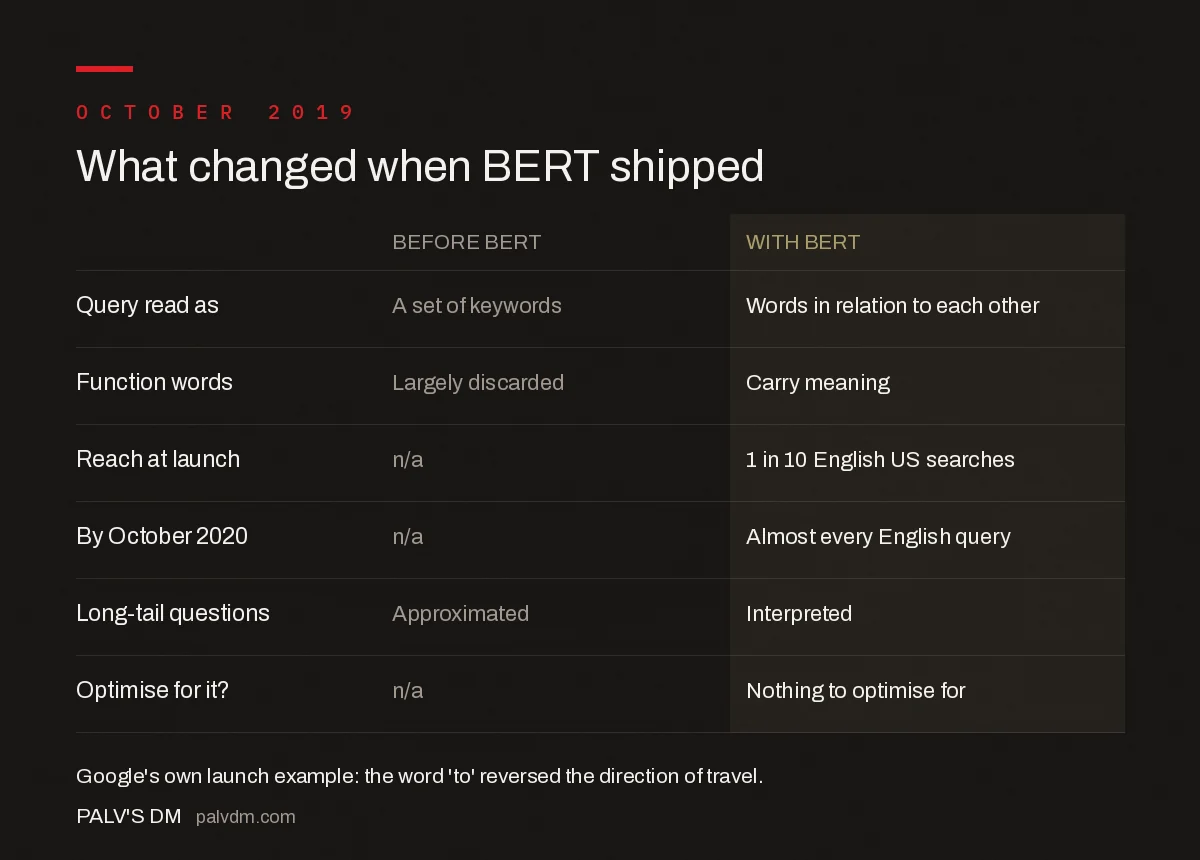
What changed when BERT shipped
| Before BERT | With BERT | |
|---|---|---|
| Query read as | A set of keywords | Words in relation to each other |
| Function words | Largely discarded | Carry meaning |
| Reach at launch | n/a | 1 in 10 English US searches |
| By October 2020 | n/a | Almost every English query |
| Long-tail questions | Approximated | Interpreted |
| Optimise for it? | n/a | Nothing to optimise for |
Frequently asked questions
What is Google BERT?
BERT stands for Bidirectional Encoder Representations from Transformers. It is a natural language technique published by Google Research in 2018 and applied to Google Search in October 2019. It reads the words in a query in relation to each other, including small function words such as prepositions, rather than treating a query as a set of independent keywords.
When did Google launch BERT in Search?
Google announced BERT for Search on 25 October 2019. At launch it applied to about one in ten searches in English in the United States and was also used to improve featured snippets in the two dozen countries where that feature was available. Google expanded it to more than 70 languages by December 2019 and said in October 2020 that it was used in almost every English query.
Can you optimise a page for BERT?
No. Google has stated there is nothing to optimise for with BERT, because it is a language comprehension mechanism rather than a set of ranking criteria. No markup enables it and no formatting triggers it. What changes in practice is that pages answering the question actually asked outperform pages that merely contain the query’s keywords.
What is the difference between BERT and RankBrain?
RankBrain, introduced in 2015, helped Google interpret queries it had never seen before by relating them to concepts it already understood. BERT, applied to Search in 2019, reads the relationships between words inside a query and a passage, including function words that change meaning. Neither replaced the other; both remain components of how Search interprets language.
Is BERT a ranking factor?
BERT appears in Google’s published list of ranking systems, but it is a language understanding system rather than a quality judgement. It affects which pages Google considers relevant to a query by improving how the query and the page are interpreted. There is no BERT score to raise and no configuration a site owner can change.
Does BERT still matter for SEO in 2026?
It matters as foundation rather than as an event. Language understanding is now assumed throughout Search, which is why keyword-density approaches stopped working: the system reads sentences rather than counting terms. The same premise underpins how generative AI surfaces select passages, so writing clear, direct answers serves both.
Sources
- Understanding searches better than ever before — The Keyword
- BERT: Pre-training of Deep Bidirectional Transformers for Language Understanding
- A guide to Google Search ranking systems
- Creating helpful, reliable, people-first content — Search Central
Want this done on your site?
Every PalV’s DM engagement starts with a free audit of your actual website — a 12-point
crawl covering what is blocking indexation, on-page gaps against your primary keywords, speed
findings, and the three to five fixes worth making first. Delivered in two working days. No
payment details, and the findings are yours whether you hire us or not.


