Hummingbird and the Shift to Meaning
Google Hummingbird rebuilt ranking around query meaning in August 2013. What it changed, why nobody could measure it, and what it still means for content.
Hummingbird was a rebuild of Google’s ranking engine, announced on 26 September 2013, that shifted Search from matching the words in a query to interpreting the meaning behind it. Google’s ranking systems documentation describes it in one line: “a major improvement to our overall ranking systems made in August 2013”. It was not a filter, not a penalty and not a demotion of anything. It changed the machinery that produces results, which is why almost nobody could point to a site that Hummingbird had visibly hit.
That invisibility is the reason Hummingbird is under-discussed and over-mythologised at the same time. Every language-understanding system Google has shipped since — RankBrain, neural matching, BERT, MUM — sits on the foundation Hummingbird laid, and the tactics it made obsolete are still being sold.
What was the Google Hummingbird update?
Google announced Hummingbird at a press event on 26 September 2013, held to mark the company’s fifteenth anniversary. Two details from that announcement define the update.
First, Hummingbird had already been live for roughly a month before Google mentioned it. Google’s own documentation dates the change to August 2013, a month before the announcement. Second, Amit Singhal, then head of Google’s ranking team, told reporters the change affected around 90% of searches worldwide, and characterised it as the most substantial rewrite of the algorithm in over a decade.
Those two facts together are unusual. A change touching the overwhelming majority of searches ran for a month without the SEO industry noticing it. That happened because Hummingbird did not demote a class of sites; it changed how queries were interpreted, and most results for most queries stayed broadly sensible. It is a useful corrective to the assumption that every significant Google change produces a visible tracker spike — the reverse is also true, and the difference between confirmed and unconfirmed updates still trips people up.
What did Hummingbird actually change?
Before Hummingbird, Google’s ranking systems leaned heavily on matching query terms against document terms, with refinements layered on top. Hummingbird restructured that process around the query as a whole.
Three shifts came out of it:
- Conversational and long queries became answerable. A search phrased as a full question could be interpreted as a question rather than as a bag of words, which mattered enormously as voice input and mobile search grew.
- Entities moved to the centre. Google’s public framing at the time was “things, not strings”, building on the Knowledge Graph launched in 2012. Search began resolving a query to a subject rather than to a phrase, which is the basis of entity-based SEO and of semantic SEO as a discipline.
- Synonyms and paraphrase stopped being a workaround. If Google understands that two differently-worded questions mean the same thing, publishing a separate page for each wording produces near-duplicates instead of coverage.
The entity shift deserves more attention than it usually gets. Resolving a query to a subject means Google needs to identify the subject of your page with confidence, and it does that from the whole page rather than from a title tag. A page that names the thing it is about, defines it, distinguishes it from adjacent things and covers its practical attributes gives that resolution something to lock onto. A page assembled from paraphrases of competitor articles gives it very little, which is one reason thin comparison content struggles even when it is technically well optimised.
The last point is the one with the largest practical cost. A great deal of content built between 2010 and 2015 — one page per keyword variation, distinguished only by phrasing — became structurally redundant the moment Hummingbird shipped, and much of it is still live.
How does Hummingbird relate to RankBrain, BERT and MUM?
Hummingbird is the ancestor, not a competitor. Google has built successive language-understanding systems on the same premise since 2013, each one narrower and more capable than the last.
| System | Year | What it added |
|---|---|---|
| Hummingbird | 2013 | A rebuilt ranking engine organised around query meaning rather than term matching |
| RankBrain | 2015 | Machine learning that relates words to concepts, so pages rank without exact-word matches |
| Neural matching | 2018 | Matching representations of concepts in queries against representations in pages |
| BERT | 2019 | Understanding how combinations of words express meaning and intent, including word order |
| MUM | 2021 | Understanding and generating language, though Google says it is not used for general ranking |
Read as a sequence, this is a decade of Google getting better at one thing: working out what a person actually wants. RankBrain, BERT and MUM are each worth understanding individually, but none of them reversed Hummingbird’s direction. They accelerated it.
Is Hummingbird still running?
Not as a distinct, named system. Google’s guide to Search ranking systems lists Hummingbird under “Retired systems”, alongside Panda, Penguin and the helpful content system, with the note that Google’s ranking systems “have continued to evolve since then, just as they had been evolving before”.
That phrasing is deliberately deflationary and worth taking at face value. Hummingbird was not switched off; it was superseded by continuous evolution of the same machinery. There is no Hummingbird refresh, no Hummingbird recovery, and no Hummingbird diagnostic. When rankings move today, the mechanism to investigate is a broad core update, not a system Google retired more than a decade ago.
Why was Hummingbird invisible when core updates are not?
Hummingbird ran for about a month without the SEO industry identifying it, while a modern core update produces visible volatility within forty-eight hours. The difference is not that Google got noisier — it is that the two kinds of change do different work.
An infrastructure change to how queries are interpreted improves matching across the board. Most results for most queries remain reasonable, so the aggregate movement is diffuse rather than concentrated. A broad core update, by contrast, reassesses which pages best satisfy each query, so gains and losses cluster: specific sites move a long way in one direction, and volatility trackers register that immediately.
Two lessons carry forward. First, absence of tracker movement is not evidence that nothing changed — Google shipped its biggest ranking rewrite of the decade without a spike anyone could name. Second, the presence of tracker movement is not confirmation that Google changed anything either; only Google’s Search Status Dashboard confirms an update. Working through the 2026 update record and then confirming whether an update actually hit your site beats reasoning backwards from a volatility chart in either direction.
What Hummingbird means for how you write now
Hummingbird’s practical guidance has aged unusually well, because the direction it set has never reversed.
- Build one strong page per topic, not one page per phrasing. If two queries mean the same thing, Google treats them as the same thing. Splitting them across two pages splits your own signals and creates cannibalisation.
- Define the subject explicitly. Name the entity, state what it is, and cover its attributes and relationships. A system resolving queries to subjects needs your page to be unambiguously about one.
- Answer the question as asked. Conversational queries carry a specific intent, and analysing that intent before writing prevents the common failure of ranking for a phrase while answering something else.
- Cover the topic completely enough to be the last click. Meaning-based retrieval rewards depth over repetition, which is the mechanical case for building topical authority rather than publishing scattered posts.
- Write in the vocabulary of your readers. Not synonym padding — genuine terminology, including the way people phrase things when they are unsure what the correct term is.
None of that is a checklist you can complete once. Meaning-based retrieval rewards pages that stay accurate and stay complete, which makes maintenance part of the work rather than an afterthought. A page that was the best answer in 2023 and has not been touched since is competing against pages written with three more years of context, and no amount of structural tidiness compensates for that.
What Hummingbird was not
- Not a penalty. No site was demoted for violating anything. There was no notice, no recovery process and nothing to appeal.
- Not the same as Caffeine. Caffeine, in 2010, rebuilt Google’s indexing infrastructure. Hummingbird rebuilt ranking. The two are routinely confused, and they solved unrelated problems.
- Not “the end of keywords”. Keyword research still tells you what people want and how much demand exists. What ended was the idea that a page must contain the exact string to rank for it.
- Not measurable after the fact. Because it ran for a month before announcement, no credible before-and-after analysis of Hummingbird exists. Any article claiming precise Hummingbird winners and losers is reconstructing them.
The most useful thing Hummingbird leaves behind is a test you can apply to any page. Read it and ask what subject it is about, in one sentence, without using the target keyword. If you cannot answer, neither can a system built to resolve queries to meaning — and that has been true of every retrieval system Google and its competitors have shipped since, right through to the generative engines citing sources today.
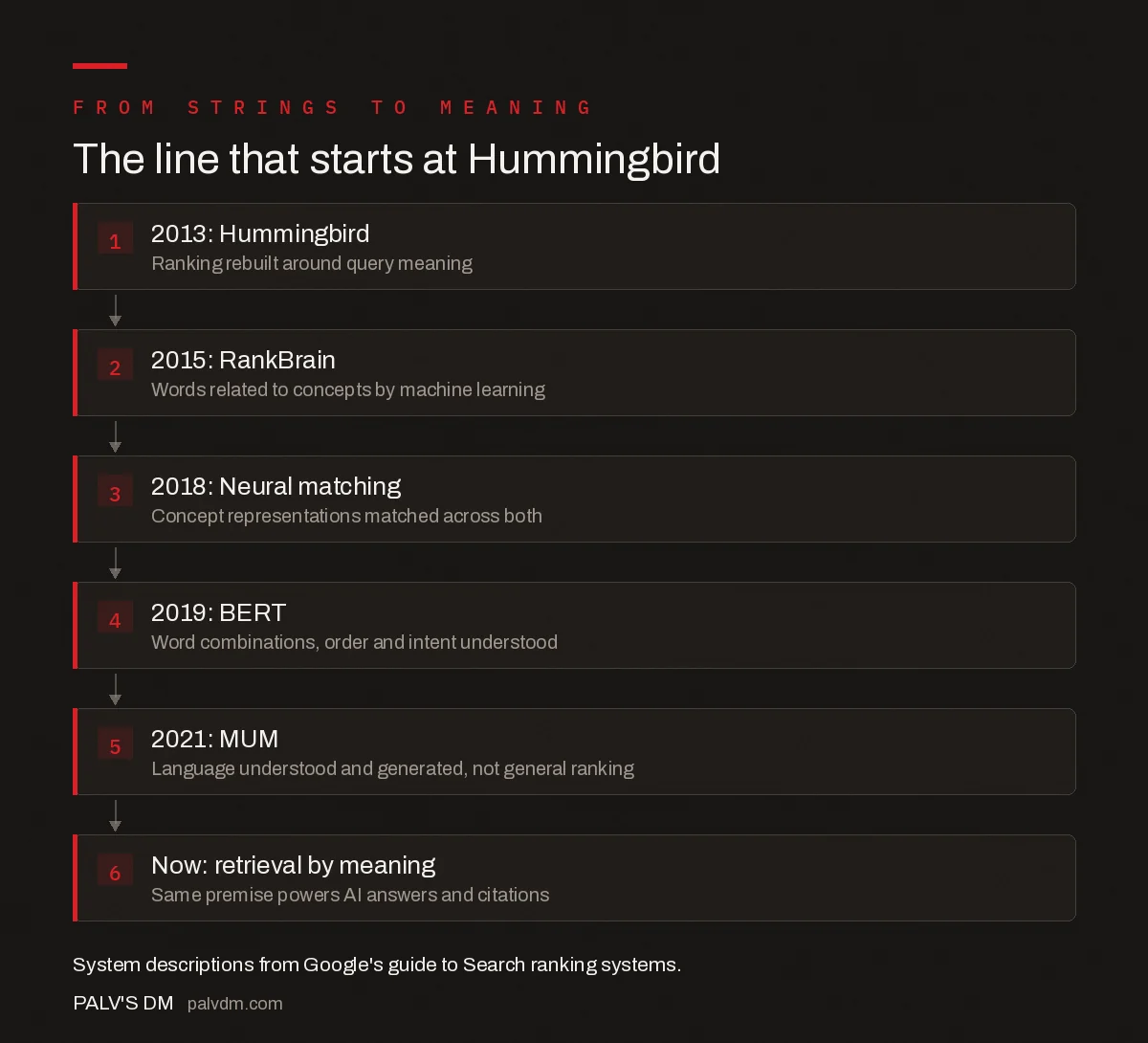
The line that starts at Hummingbird
- 2013: Hummingbird. Ranking rebuilt around query meaning.
- 2015: RankBrain. Words related to concepts by machine learning.
- 2018: Neural matching. Concept representations matched across both.
- 2019: BERT. Word combinations, order and intent understood.
- 2021: MUM. Language understood and generated, not general ranking.
- Now: retrieval by meaning. Same premise powers AI answers and citations.
Frequently asked questions
What was the Google Hummingbird update?
Hummingbird was a rebuild of Google’s ranking engine announced on 26 September 2013. Google’s documentation dates the change itself to August 2013 and describes it as a major improvement to its overall ranking systems. It shifted Search from matching the words in a query to interpreting the meaning behind the whole query, and it was not a penalty or a filter.
How many searches did Hummingbird affect?
Amit Singhal, then head of Google’s ranking team, told reporters at the September 2013 announcement that the change affected around 90% of searches worldwide. Because the update had already been running for roughly a month before Google mentioned it, no reliable before-and-after measurement of its effect on individual sites was ever possible.
Is Hummingbird still part of Google's algorithm?
Not as a named system. Google’s guide to Search ranking systems lists Hummingbird under retired systems, alongside Panda, Penguin and the helpful content system, noting that its ranking systems have continued to evolve since 2013. The change was superseded by continuous development rather than switched off, so there is no Hummingbird refresh or recovery process.
What is the difference between Hummingbird and Caffeine?
Caffeine, released in 2010, rebuilt Google’s indexing infrastructure so content could be crawled and indexed far faster. Hummingbird, in 2013, rebuilt the ranking side so queries were interpreted by meaning rather than by term matching. They addressed unrelated problems at different stages of the pipeline and are frequently confused with each other.
Did Hummingbird make keywords irrelevant?
No. Keyword research still shows what people search for and how much demand exists behind each topic. What Hummingbird ended was the requirement that a page contain the exact phrase to rank for it, and with it the value of publishing separate pages for near-identical wordings of the same question.
How do you optimise for Hummingbird?
There is no Hummingbird-specific optimisation, and Google has never published any. The durable response is to build one thorough page per topic rather than one per phrasing, state clearly what subject the page covers, answer the question as it is actually asked, and cover the topic deeply enough that a reader does not need another result.
Sources
- A guide to Google Search ranking systems — Lists Hummingbird as retired, dated August 2013
- How AI powers great search results — The Keyword
- How Google Search works — Search Central
- Creating helpful, reliable, people-first content
Want this done on your site?
Every PalV’s DM engagement starts with a free audit of your actual website — a 12-point
crawl covering what is blocking indexation, on-page gaps against your primary keywords, speed
findings, and the three to five fixes worth making first. Delivered in two working days. No
payment details, and the findings are yours whether you hire us or not.