Manual Action vs Algorithmic Suppression: How to Tell Them Apart
A manual action is a human decision you are told about. Algorithmic suppression is silent. How to tell which one you have and what each recovery needs.

A manual action is a person at Google reviewing your site, deciding it breaks a published policy, and applying a penalty that always appears as a notice in Search Console. Algorithmic suppression is Google’s systems demoting pages without any human review and without any notification at all. The practical difference is that one of them tells you what is wrong and gives you an appeal, and the other does neither. Checking which you have takes thirty seconds in Search Console under Security & Manual Actions, and it should always be the first thing you do.
The reason this matters more than it sounds: the two have almost opposite recovery paths. A manual action ends when a human accepts your fix. Algorithmic suppression ends when Google’s systems recrawl and reassess, on their own schedule, with no confirmation that they ever did.
The difference at a glance
| Manual action | Algorithmic suppression | |
|---|---|---|
| Who applied it | A human reviewer at Google | An automated ranking or spam system |
| Are you notified? | Yes — a Search Console notice naming the violation | No, ever |
| Do you know the cause? | Yes, Google names it | No — you have to infer it |
| Scope | Stated: site-wide or specific URLs | Unstated; can be a page type, a section or the whole site |
| Appeal | Reconsideration request, reviewed by a person | None exists |
| Typical recovery | Weeks, once the fix is accepted | Months, after recrawl and reassessment |
What is a manual action?
A manual action is Google’s rarest and most explicit enforcement mechanism. A reviewer looks at the site, matches what they see against a published policy, and applies a demotion or removal. Because a person made the decision, a person can also reverse it.
The notice lives in Search Console under Security & Manual Actions → Manual actions. It names the violation and states whether the action covers the whole site or a list of affected URLs. Action types Google lists include unnatural links to your site, unnatural links from your site, thin content with little or no added value, pure spam, cloaking and sneaky redirects, user-generated spam, and site reputation abuse.
The route out is defined: fix exactly what the notice names, document what you changed and why, then file a reconsideration request. Do not file until the problem is genuinely gone. A rejected request costs weeks and reviewers see your history.
What is algorithmic suppression?
Algorithmic suppression covers everything Google’s systems do automatically to reduce a site’s visibility. It splits into two quite different things that get merged constantly.
Algorithmic spam enforcement is a system detecting a match against Google’s published spam policies — link spam, scraped content, doorway pages, cloaking, expired domain abuse, scaled content abuse. It behaves like a penalty: something specific triggered it and removing that thing is the route out. Google announces spam updates globally but never identifies affected sites.
Core update reassessment is not enforcement at all. Google reassesses how relevance and quality are judged across the index, and positions move. No policy was broken. Core updates are not penalties, and treating one as suppression sends you looking for a violation that does not exist.
Both are invisible in the sense that matters: nothing appears in Search Console, no message arrives, and no support channel will confirm anything. The comparison of core updates, spam updates and manual actions separates the three mechanisms properly.
How do you tell which one you have?
- Open Security & Manual Actions. A notice means manual action and the diagnosis is over. An empty report means it is not a manual action — there is no hidden version.
- Date the drop to the day. Use the daily view in Search Console’s Performance report. Manual actions and spam enforcement usually produce an abrupt cliff. Core update movement often arrives in waves across a rollout.
- Compare the date against Google’s Search Status Dashboard. A drop that starts on a confirmed core update date is a reassessment. One that starts on a spam update date deserves a spam policy audit. A drop on a date with no dashboard entry is most often self-inflicted — see confirmed versus unconfirmed updates.
- Look at the scope. Spam enforcement tends to hit either the specific offending pages or the entire site at once. Core update movement is patterned — one template, one content type or one query cluster loses while the rest holds. Segmenting the damage is how you see which shape you have.
- Audit honestly against the spam policies. Bought links, pages generated at volume to fill keyword gaps, a subfolder rented to a third party. If one describes your site, the trackers are irrelevant.
- Rule yourself out. Deployments, robots.txt edits, canonical changes and migrations cause more drops than Google does. Update or self-inflicted walks the sequence.
How does recovery differ?
Manual action. Fix the named issue completely, then file the reconsideration request with a plain account of what was wrong, what you changed, and what will stop it recurring. A human reviews it, usually within a few weeks, and tells you the outcome. It is the only Google enforcement with a confirmed ending.
Algorithmic spam enforcement. Remove the violating practice, then wait. Google’s systems have to recrawl the affected URLs and reassess them, and there is no notification when that happens. Expect months. Removing a page does not instantly remove its effect on the site’s assessment.
Core update movement. Google states there are no specific actions that guarantee recovery, that a drop does not necessarily mean anything is wrong, and that the largest changes tend to arrive with a subsequent core update rather than between them. Both 2026 core updates ran twelve days, which sets the realistic rhythm for reassessment. The 30-day recovery plan and realistic recovery timing both work from that constraint.
Where people go wrong
- Filing reconsideration requests with no manual action. There is nothing to reconsider. The request is not read and the weeks spent waiting are wasted.
- Blanket disavowing after an algorithmic drop. Disavowing links belongs with a manual action naming unnatural links, or where links were knowingly bought. Used as a reflex it removes signals that were working.
- Assuming silence means suppression. Most drops with no Search Console notice and no confirmed update are technical or measurement problems, not Google acting on your site.
- Never opening the Manual Actions report. It is empty for almost every site almost always, so nobody checks it — which is exactly why the rare real notice sits unread for months. Full context sits in how to tell if you actually have a Google penalty.
The short version: if Google told you, it is a manual action and you have a defined path. If Google did not tell you, no amount of asking will produce a diagnosis, and the work is to audit your own site against published policy and against the pages that outranked you.
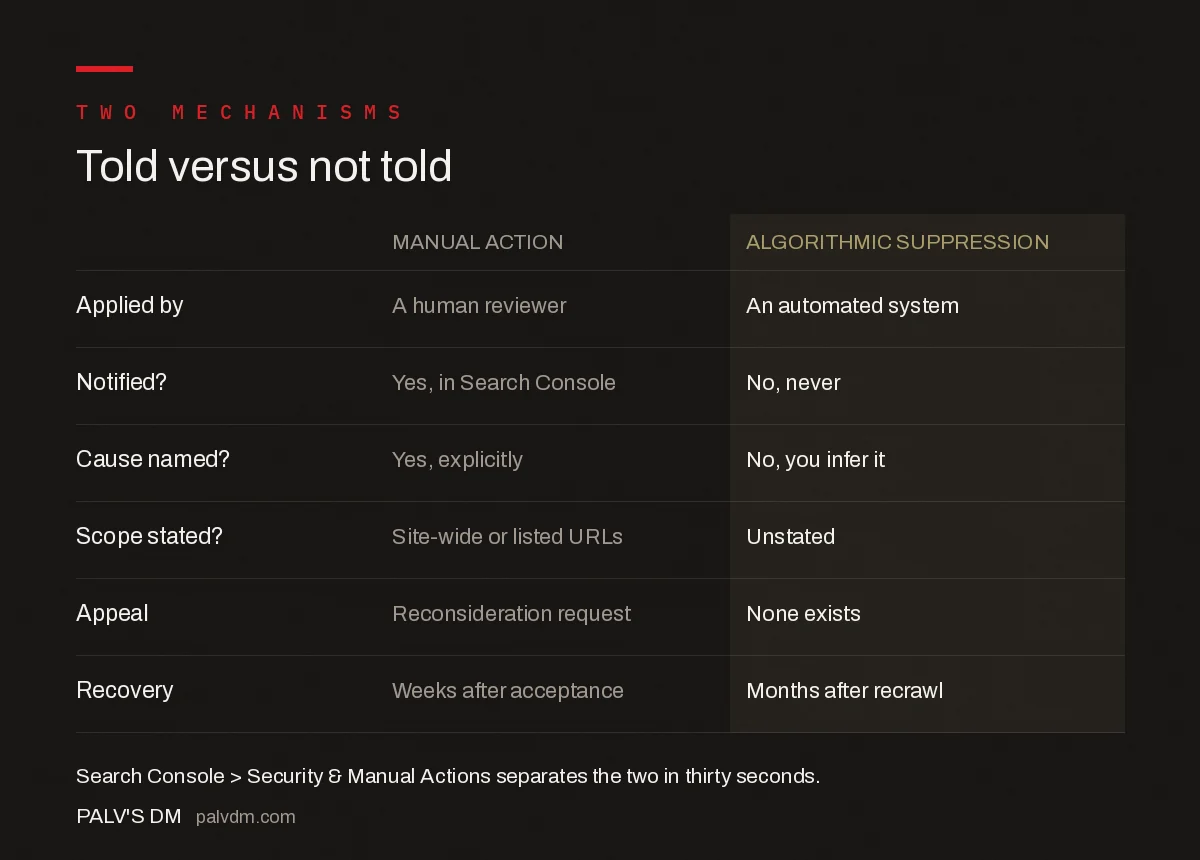
Told versus not told
| Manual action | Algorithmic suppression | |
|---|---|---|
| Applied by | A human reviewer | An automated system |
| Notified? | Yes, in Search Console | No, never |
| Cause named? | Yes, explicitly | No, you infer it |
| Scope stated? | Site-wide or listed URLs | Unstated |
| Appeal | Reconsideration request | None exists |
| Recovery | Weeks after acceptance | Months after recrawl |
Frequently asked questions
What is the difference between a manual action and an algorithmic penalty?
A manual action is applied by a human reviewer at Google and always produces a notice in Search Console that names the violation and its scope. Algorithmic suppression is applied automatically with no notification, no named cause and no appeal. The manual action has a reconsideration process; algorithmic demotion lifts only when Google’s systems recrawl and reassess the site.
How do I check whether I have a manual action?
In Google Search Console, select your property and open Security and Manual Actions, then Manual actions. Any manual action appears there as a notice naming the specific violation and stating whether it applies site-wide or to particular URLs. If the report shows no issues detected, you do not have a manual action. There is no hidden or delayed version of this report.
Can you appeal an algorithmic penalty?
No. Reconsideration requests exist only for manual actions, because only manual actions involve a human decision that a human can reverse. Algorithmic demotions lift when the underlying cause is removed and Google’s systems recrawl and reassess the affected pages. There is no notification when that reassessment happens and no support channel that will confirm it.
How long does a reconsideration request take?
Google reviews reconsideration requests manually and responses typically arrive within a few weeks, though there is no guaranteed timeframe. File only once the named violation is genuinely fixed and you can describe what was wrong, what you changed, and what prevents it recurring. A rejected request costs weeks and the reviewer can see your previous submissions.
Does an algorithmic demotion ever expire on its own?
Not reliably. Algorithmic spam enforcement responds to the state of the site, so it lifts when the violating practice is gone and Google’s systems have recrawled and reassessed the affected pages. Leaving the problem in place and waiting does nothing. Movement caused by a core update is different again: it usually changes with a subsequent core update rather than fading over time.
If Search Console shows no manual action, what caused my drop?
Most commonly your own site. Deployments, robots.txt edits, canonical or noindex changes and migrations account for more traffic drops than algorithm updates do. After that, check the drop date against Google’s Search Status Dashboard for a confirmed update, and check whether anything on the site matches a published spam policy such as link spam or scaled content abuse.
Sources
- Manual Actions report — Search Console Help
- Spam policies for Google web search
- Google core updates and your website — Search Central
- Google Search Status Dashboard
Want this done on your site?
Every PalV’s DM engagement starts with a free audit of your actual website — a 12-point
crawl covering what is blocking indexation, on-page gaps against your primary keywords, speed
findings, and the three to five fixes worth making first. Delivered in two working days. No
payment details, and the findings are yours whether you hire us or not.