March 2026 Spam Update: Who It Hit
The March 2026 spam update ran 19 hours and 30 minutes, two days before the March core update. How to separate the two, and who spam enforcement actually hits.

Google released the March 2026 spam update on 24 March 2026 and marked it complete on 25 March — 19 hours and 30 minutes, the fastest update rollout in Google’s Search Status Dashboard record. Google announced no new spam policies with it and has never said which sites it affected. The honest answer to “who it hit” is: sites matching Google’s already-published spam policies. Google does not name them, and no third party can.
The March 2026 window is also unusually hard to read, which is the part that matters practically. The spam update finished on 25 March. The March 2026 core update launched on 27 March and ran until 8 April. Anyone attributing a late-March ranking change to the spam update rather than the core update is guessing unless their data has a clean boundary between 25 and 27 March.
What did Google confirm about the March 2026 spam update?
| Detail | Confirmed |
|---|---|
| Announced | 24 March 2026, Google Search Status Dashboard |
| Completed | 25 March 2026 |
| Duration | 19 hours, 30 minutes |
| Scope | Applies globally and to all languages |
| New policies | None announced |
| Google’s own estimate | “The rollout may take a few days to complete” |
Google beat its own estimate by a wide margin, and the notice linked to its existing spam updates documentation rather than to any new guidance. That is the tell that nothing about the policy surface changed on 24 March. The Search Status Dashboard is the record of reference, and the June 2026 spam update three months later followed the same pattern.
Why is the March 2026 window so hard to attribute?
Because three confirmed Google updates landed in close succession, and their effects overlap in most reporting windows.
| Update | Started | Completed |
|---|---|---|
| February 2026 Discover core update | 5 Feb 2026 | 27 Feb 2026 |
| March 2026 spam update | 24 Mar 2026 | 25 Mar 2026 |
| March 2026 core update | 27 Mar 2026 | 8 Apr 2026 |
Only two days separate the spam update’s completion from the core update’s launch. Any month-on-month comparison, any 28-day rolling window and most standard client reports blend all three. A site that reports March against February is reporting a period containing a Discover core update, a spam update and the first four days of a Search core update as though it were one thing.
The February 2026 Discover core update adds a further complication for publishers, because it affected a different surface entirely and Google released it to English-language users in the US only.
How do you separate spam update impact from core update impact?
It is possible, but only with daily data and a deliberately narrow window. Work through this before accepting anyone’s diagnosis, including your own.
- Use daily data, not weekly or monthly. A 19-hour rollout is invisible in weekly buckets. Pull Search Console performance by day for the whole of March and early April.
- Isolate 25 and 26 March. Those two days sit after the spam update completed and before the core update launched. A step change visible on 25 to 26 March that then holds is the strongest available evidence for spam attribution.
- Watch what happens from 27 March onwards. Movement that begins on 27 March or later belongs to the core update window, not the spam update.
- Mind the timezone. The dashboard reports in US/Pacific and Search Console’s performance report does too, but most analytics platforms use a local or account timezone. In India, a Pacific-time boundary falls mid-evening IST, so a single “day” in your analytics can straddle two states.
- Check the shape of the loss. Algorithmic spam enforcement tends to be concentrated — specific pages or a whole site at once. Core update movement is usually graded across a content type or query cluster. The three-way comparison sets out the diagnostic differences.
- Check Search Console for a manual action. Security & Manual Actions. A notice there means a human reviewer penalised the site, which is neither of the two updates.
If your data does not support a clean 25 to 26 March boundary, the correct conclusion is that you cannot separate the two. That is a legitimate finding and a far better one to report than a confident guess. Confirming update impact properly covers the comparison method, and choosing the comparison window is where most attempts at this go wrong.
Who does a spam update actually hit?
Sites matching Google’s published spam policies, which on 24 March 2026 were unchanged from the week before. With no new policies announced, nothing became a violation that day which had been acceptable the day before — Google had improved detection, not moved the line.
The policy list covers scaled content abuse, link spam, cloaking, sneaky redirects, doorway abuse, scraping, thin affiliation, keyword stuffing, hidden text and link abuse, hacked content, machine-generated traffic, misleading functionality, user-generated spam, and the two policies introduced in March 2024: site reputation abuse and expired domain abuse.
Google’s instruction to anyone who moved is to review that list: sites that see a change after a spam update should check they comply. If you audit honestly and match nothing, the spam update is probably not your explanation and the March core update, or your own deployments, deserve the attention instead.
Does a 19-hour rollout mean a small update?
There is no evidence for that, and Google has never explained why spam rollout durations vary. The record makes the point better than argument does: the August 2025 spam update ran 26 days and 15 hours, the March 2026 spam update ran 19 hours and 30 minutes, and the June 2026 spam update ran 2 days and 1 hour. Three enforcement updates, durations spanning a factor of thirty.
Rollout length is a measurement, not a signal of scope or severity. The full rollout-duration record shows the same absence of any relationship for core updates, where a 45-day rollout in March 2024 and a 6-day rollout in December 2024 were both broad reassessments of the same type.
Where does the March 2026 spam update sit in the year?
It was the second confirmed Google update of 2026 and the first of two spam updates that year, followed by the June 2026 spam update from 24 to 26 June. Both shared the same three characteristics: a rollout measured in hours or days rather than weeks, an explicit statement that the update applies globally and to all languages, and no new spam policies announced with either.
That last point is the one worth carrying forward. Across 2026 Google shipped enforcement improvements without changing the rules, and issued no new guidance with its core updates either. The consistent message is that the published documentation already contains everything Google intends to tell site owners — a position that is unhelpful if you were hoping for a checklist, and clarifying if you were waiting for one before acting. The wider 2026 update pattern sets out what the year’s five confirmed updates have in common.
What should you do if you think the March 2026 spam update hit you?
Remove the violating practice, and set expectations to Google’s stated timeframe rather than the rollout length. Google says making changes may help a site improve if its automated systems learn over a period of months that the site complies with the spam policies. A 19-hour rollout does not imply a 19-hour recovery, and there is no reconsideration request for algorithmic enforcement — that process exists only for manual actions. Establishing whether you actually have a penalty comes before any remediation work.
For link spam specifically, Google is blunt that remediation may not restore anything: when its systems remove the effect spammy links had, the ranking benefit those links generated is lost and cannot be regained. Removing bought links ends the exposure rather than rebuilding the position.
And if the evidence actually points to the core update that started two days later, the response is entirely different: no violation to undo, and improvement judged at the next core update rather than immediately. What the March 2026 core update actually changed covers that path, what a core update actually is covers why the two are not interchangeable, and the 2026 update timeline carries every confirmed date you need to anchor the analysis.
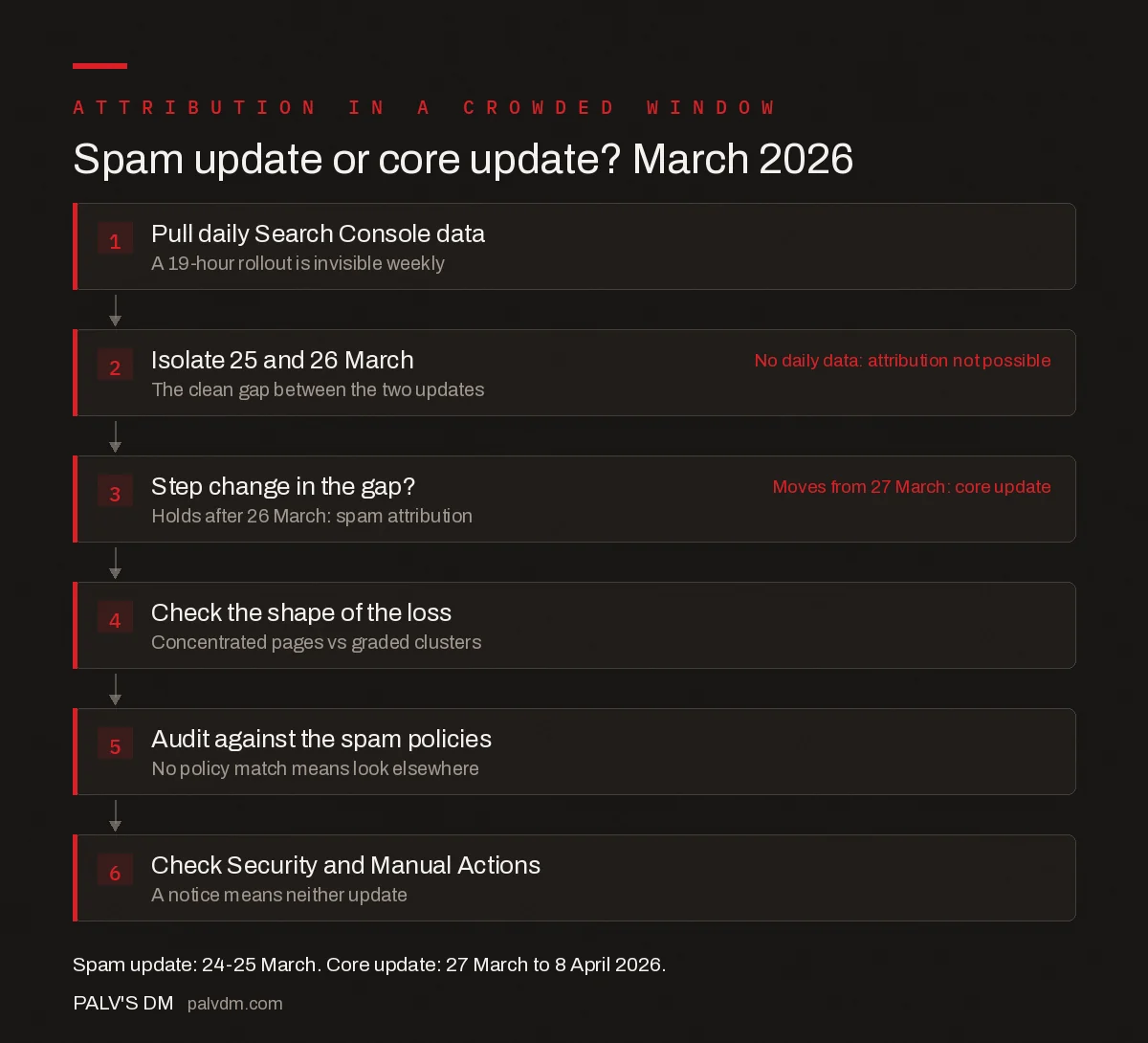
Spam update or core update? March 2026
- Pull daily Search Console data. A 19-hour rollout is invisible weekly.
- Isolate 25 and 26 March. The clean gap between the two updates. No daily data: attribution not possible
- Step change in the gap?. Holds after 26 March: spam attribution. Moves from 27 March: core update
- Check the shape of the loss. Concentrated pages vs graded clusters.
- Audit against the spam policies. No policy match means look elsewhere.
- Check Security and Manual Actions. A notice means neither update.
Frequently asked questions
When was the March 2026 spam update?
Google released the March 2026 spam update on 24 March 2026 and marked the rollout complete on 25 March 2026, a total of 19 hours and 30 minutes. That is the fastest update rollout in Google’s Search Status Dashboard record. Google stated it applies globally and to all languages, and announced no new spam policies with it.
Who did the March 2026 spam update hit?
Google has never said, and no third party can know. What is documented is that no new spam policies were announced, so the update enforced the existing published list: scaled content abuse, link spam, cloaking, doorway abuse, scraping, thin affiliation, site reputation abuse, expired domain abuse and the rest. Sites that moved should audit against that list.
How do I tell the March 2026 spam update from the March 2026 core update?
Use daily data and look at 25 and 26 March 2026. Those two days sit after the spam update completed and before the core update launched on 27 March. A step change visible in that gap that then holds is the strongest available evidence for spam attribution. Movement starting 27 March or later belongs to the core update.
Why was the March 2026 spam update so fast?
Google has never explained why spam rollout durations vary, and it beat its own estimate of a few days by a wide margin. Duration carries no information about scope: the August 2025 spam update ran 26 days and 15 hours, the March 2026 spam update 19 hours and 30 minutes, and the June 2026 spam update 2 days and 1 hour.
How long does recovery from a spam update take?
Google states that making changes may help a site improve if its automated systems learn over a period of months that the site complies with the spam policies. Months, not days. There is no reconsideration request for algorithmic spam enforcement, because reconsideration applies only to manual actions applied by a human reviewer.
Did Google announce new spam policies in March 2026?
No. Google’s dashboard notice linked to its existing spam updates documentation rather than to new guidance, and no new policies accompanied the update. Nothing became a violation on 24 March 2026 that had been acceptable on 23 March. Google improved detection of practices that were already published rules.
Sources
- Google Search Status Dashboard — Ranking incident history
- Google Search spam updates and your site — Search Central
- Google Search spam policies
- Google core updates and your website — Search Central
Want this done on your site?
Every PalV’s DM engagement starts with a free audit of your actual website — a 12-point
crawl covering what is blocking indexation, on-page gaps against your primary keywords, speed
findings, and the three to five fixes worth making first. Delivered in two working days. No
payment details, and the findings are yours whether you hire us or not.