Why Screenshots and Original Images Beat Stock Photos
There is no ranking signal for original images. They win because they prove something stock photos cannot. What to produce, how to ship it, and what to skip.

Original images do not rank better because they are original — Google has never documented a signal that distinguishes your photograph from a licensed stock one. They win because they carry information a stock photo cannot, and because Google’s own guidance asks for them as evidence. Its instructions for writing high-quality reviews ask creators to provide evidence such as visuals, audio or other links of their own experience with a product. A screenshot of the actual error message, an annotated dashboard, a photograph of the thing on your desk: each of those proves something. A smiling team around a laptop proves nothing, and is currently sitting on ten thousand other websites.
The useful reframing is to stop treating images as decoration to be selected and start treating them as evidence to be produced. That changes who makes them, when they are made, and what they are for.
Do original images improve rankings directly?
There is no documented ranking factor for image originality, and several persistent beliefs about image metadata are wrong. EXIF camera and location data is not a documented ranking signal. Google does support IPTC photo metadata, but for image credits and licensing information in Google Images rather than as a quality bonus. Stuffing metadata with keywords is not a tactic; it is the image equivalent of keyword stuffing.
What original images do influence is indirect and real. They are the artefacts that make first-hand experience visible on a page. They give a page something no competitor’s page contains, which is the practical definition of information gain. They can rank in image results, where a distinctive screenshot competes against a saturated field of the same six stock photographs. And they are what a reader uses to decide, in about two seconds, whether the author has actually done this.
What is actually wrong with stock photography?
- It is duplicated at scale. The same image appears on thousands of pages, including your competitors’. Nothing about it is associated with you.
- It contains no information. A generic photograph of a meeting does not explain, illustrate or evidence anything in the article beneath it.
- It costs performance. Large hero images are a frequent cause of poor Largest Contentful Paint scores, and an image that adds no information is pure load time. Image optimisation for SEO covers the weight problem.
- It signals low effort. Readers who know the subject read a stock hero as a sign that the page will be generic, and they are usually right.
The exception worth naming: stock or licensed imagery is fine as pure decoration where no evidence is being claimed — a hero banner, an abstract background. The failure is using it in the place where proof should be.
Which original images are worth producing?
| Type | What it evidences | Time to make |
|---|---|---|
| Annotated tool screenshot | You used the tool and know where the setting lives | 2–5 minutes |
| Error or failure state | You hit the problem and solved it | Seconds, if captured at the time |
| Chart of your own data | You collected something nobody else has | 30 minutes, plus the data |
| Process or workspace photograph | The work physically happened | Minutes |
| Custom diagram of a concept | You understand it well enough to draw it | 1–2 hours |
| Premises and named team photographs | The business and people are real | One session, reusable for years |
The first two rows have the best ratio of value to effort by a wide margin, and both are free if screenshots are captured during the work rather than reconstructed afterwards. Charts of your own data are the most defensible of all — citing your own data covers collecting and publishing it without breaching client confidentiality.
How do you produce original images without it becoming a project?
- Capture during the work, not during the writing. Screenshot errors, settings and results as they happen. Reconstructing a screenshot three months later usually means faking it.
- Standardise the annotation. One highlight colour, one arrow style, one font. Consistency makes a set of screenshots read as a house style rather than as clip art.
- Redact rather than skip. Blur the domain, the client name and any personal data. A redacted real screenshot beats no screenshot every time.
- Crop to the point. A full-window screenshot at 2560px wide, showing mostly empty chrome, communicates less than a tight crop of the setting being discussed.
- Name the file before uploading.
gsc-coverage-report-excluded-pages.png, notScreenshot 2026-08-14 at 11.02.31.png.
How should original images be optimised?
Producing the image is most of the work; shipping it correctly is the rest.
Format and compression. Serve modern formats — WebP or AVIF — and compress. A screenshot of a mostly flat interface compresses extremely well and has no business being a 900KB PNG.
Explicit dimensions. Always set width and height attributes so the browser reserves space, because missing dimensions are one of the most common causes of layout shift. Image dimensions and cumulative layout shift covers the mechanism.
Loading strategy. Lazy-load images below the fold and never lazy-load the one that is your Largest Contentful Paint element; lazy loading and SEO covers the trade-off.
Alt text that describes what is shown. Not a keyword, and not a caption repeat. “Search Console coverage report showing 412 pages excluded by noindex tag” is useful to a screen reader user and to an extraction system; “SEO tips image” is useful to nobody. Writing alt text properly covers the rules.
Captions where the image needs context. Captions are read far more often than body copy and are the right place for the date and source of a screenshot.
Discoverability. Include images in an image sitemap where the site is large or images load via JavaScript — image and video sitemaps — and expect original visuals to have a better chance in image packs than a stock photograph shared with a thousand competitors.
How do images work in AI answers?
Generative engines cannot read an image the way a person does. What they can read is the text around it: the alt attribute, the caption, the file name, the heading above it and the sentence introducing it. An original chart carrying a finding that appears nowhere in the body text is invisible to exactly the systems most likely to cite you.
The rule that follows is simple and widely ignored: every figure shown in an image must also exist in the HTML. If a chart says 62% of the sites in a sample had a particular problem, write that sentence in the paragraph above or below it, with the sample size and date. The image persuades the human; the sentence is what gets quoted.
The same applies to diagrams and infographics. A well-made infographic that summarises eight steps is useful to a reader and useless to a retrieval system unless those eight steps also appear as a numbered list in the markup. Treating the image as a visual mirror of text that already exists — rather than as a container for information available nowhere else — costs nothing at production time and removes the problem entirely.
Captions are the underused half of this. They are read more often than body copy, they are plain text, and they are the natural place to record what a screenshot shows, when it was taken and where the data came from.
Do AI-generated images count as original?
They are original in the narrow sense that they did not previously exist, and they are useless as evidence. An AI-generated illustration of a dashboard is not proof that you opened the dashboard, and if it contains plausible-looking but invented interface elements it actively misleads.
The sensible division: AI imagery is acceptable for abstract decoration and conceptual illustration, where nothing is being evidenced. It is not acceptable anywhere a reader would reasonably assume they are looking at a real thing — a product, an interface, a place, a person. Where AI images are used prominently, saying so in an editorial policy costs nothing, which is part of the case for publishing your methodology.
A ten-minute image audit
- Open your five most important pages and count the images you actually made. If the answer is zero, that is the finding.
- Check whether any image is doing evidential work — showing a result, an interface, a place, a person.
- Check the file names. Anything still called
image-1orshutterstock-482910needs renaming on next upload. - Check alt text describes the content of the image rather than repeating the target keyword.
- Check the hero image is not lazy-loaded and has explicit dimensions.
- Check total image weight on the page, and convert anything oversized to a modern format.
- Pick one page and replace its stock hero with a real screenshot or photograph this week. Then repeat, one page at a time.
The reason this is worth doing at all is that images are the fastest signal a reader processes. Before a word of your argument has been read, a stock photograph has told them the page is generic, or a real annotated screenshot has told them somebody actually did this. That judgement happens first, and everything else on the page is read in its light — which is why showing genuine first-hand experience starts with what you photographed, not what you wrote.
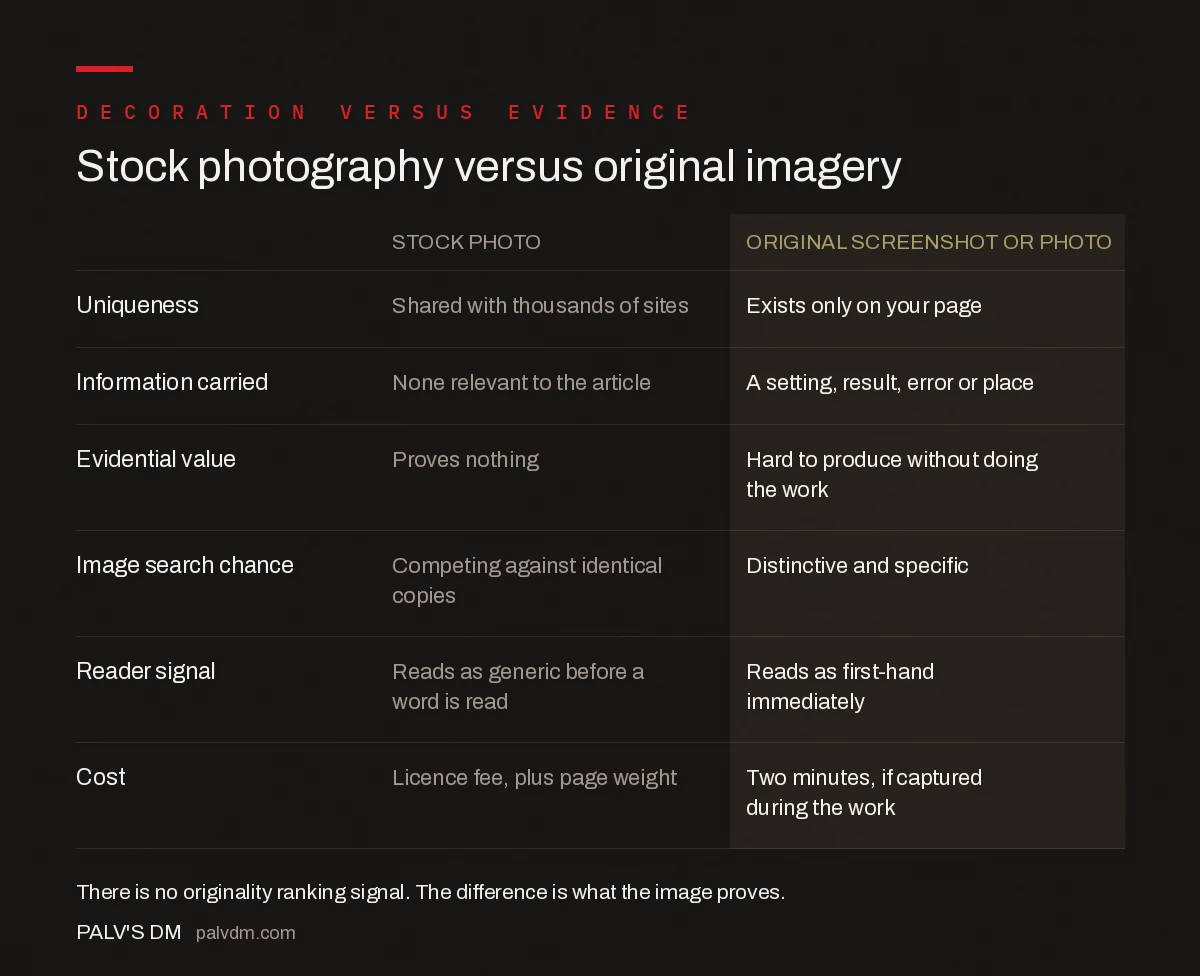
Stock photography versus original imagery
| Stock photo | Original screenshot or photo | |
|---|---|---|
| Uniqueness | Shared with thousands of sites | Exists only on your page |
| Information carried | None relevant to the article | A setting, result, error or place |
| Evidential value | Proves nothing | Hard to produce without doing the work |
| Image search chance | Competing against identical copies | Distinctive and specific |
| Reader signal | Reads as generic before a word is read | Reads as first-hand immediately |
| Cost | Licence fee, plus page weight | Two minutes, if captured during the work |
Frequently asked questions
Do original images help SEO?
Not through a documented ranking signal — Google has never published one that distinguishes original photography from licensed stock. The benefits are indirect: original images evidence first-hand experience, give a page content no competitor has, compete better in image results than a widely reused stock photo, and change how quickly a knowledgeable reader decides the page is credible.
Does EXIF data affect image rankings?
EXIF camera and location data is not a documented ranking signal. Google does support IPTC photo metadata, but for showing image credit and licensing information in Google Images rather than as a quality bonus. Filling metadata fields with keywords is the image equivalent of keyword stuffing and achieves nothing useful.
Are stock photos bad for SEO?
They are not penalised, but they are wasted space. The same stock image appears on thousands of pages including competitors’, it evidences nothing, and a large hero image is a common cause of poor Largest Contentful Paint scores. Stock imagery is acceptable as pure decoration; the failure is using it where proof should be.
Do AI-generated images count as original content?
They are new images, and they are useless as evidence. An AI-generated illustration of a dashboard does not prove you opened the dashboard, and invented interface elements actively mislead. Use AI imagery for abstract decoration only, never where a reader would reasonably assume they are seeing a real product, interface, place or person, and disclose prominent use.
How should screenshots be optimised for SEO?
Serve them as WebP or AVIF and compress them, since flat interface screenshots compress extremely well. Set explicit width and height attributes to prevent layout shift, avoid lazy-loading the largest above-the-fold image, give the file a descriptive name before upload, and write alt text describing what the screenshot actually shows rather than repeating a keyword.
What should image alt text say?
What is actually in the image, specifically enough that someone who cannot see it understands why it is there. For a screenshot, name the tool, the screen and the notable value — for example, a coverage report showing a number of pages excluded by a noindex tag. Alt text is not a place for keyword repetition or for restating the caption.
Sources
- Google Images best practices — Google Search Central
- Image license metadata — Google Search Central — IPTC metadata is used for credits and licensing, not ranking
- Write high quality reviews — Google Search Central — asks for visuals evidencing first-hand use
- Creating helpful, reliable, people-first content — Google Search Central
Want this done on your site?
Every PalV’s DM engagement starts with a free audit of your actual website — a 12-point
crawl covering what is blocking indexation, on-page gaps against your primary keywords, speed
findings, and the three to five fixes worth making first. Delivered in two working days. No
payment details, and the findings are yours whether you hire us or not.