Service Support — AI Visibility
Do You Need GEO Yet? A Straight Answer by Business Type
Do I need GEO? It depends on whether your buyers research before they buy. Here's a straight, business-type-by-business-type answer, not industry hype.
Short answer: if buyers already research your category before they buy, and you haven’t checked whether ChatGPT, Perplexity or Google’s AI Overviews mention you by name, you need to check today — not necessarily hire an agency today. Whether you actually need GEO (Generative Engine Optimisation, i.e. optimising for AI-generated answers) depends less on your industry and more on how your specific buyers research before they contact you. A local plumber and a B2B SaaS company answer “do I need GEO” very differently, and this guide walks through both.
Key takeaway
- GEO matters most where buyers do comparison research before contacting you — B2B SaaS, considered purchases, high-ticket local services — and matters least where the sale is driven by proximity, price, or an existing relationship.
- The fastest way to answer “do I need GEO” is to run the actual questions your buyers would ask through two or three AI engines and see who gets named — not to guess based on industry.
- If your site has very little published content, GEO isn’t the first move — you need source material an AI engine can actually cite before you optimise how it’s cited.
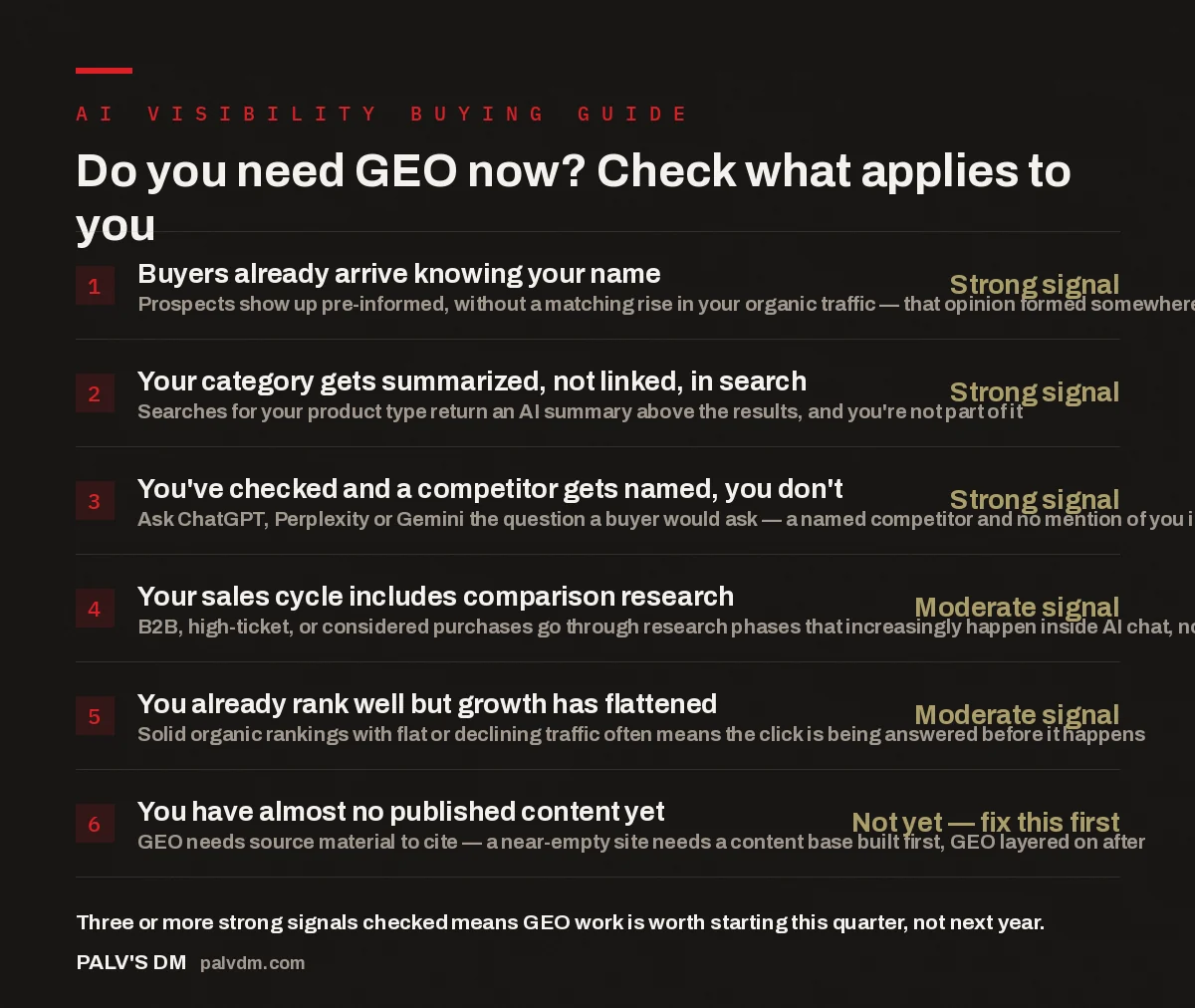
Do you need GEO now? Check what applies to you
- Buyers already arrive knowing your name — Strong signal. Prospects show up pre-informed, without a matching rise in your organic traffic — that opinion formed somewhere else.
- Your category gets summarized, not linked, in search — Strong signal. Searches for your product type return an AI summary above the results, and you’re not part of it.
- You’ve checked and a competitor gets named, you don’t — Strong signal. Ask ChatGPT, Perplexity or Gemini the question a buyer would ask — a named competitor and no mention of you is a direct loss.
- Your sales cycle includes comparison research — Moderate signal. B2B, high-ticket, or considered purchases go through research phases that increasingly happen inside AI chat, not just Google.
- You already rank well but growth has flattened — Moderate signal. Solid organic rankings with flat or declining traffic often means the click is being answered before it happens.
- You have almost no published content yet — Not yet — fix this first. GEO needs source material to cite — a near-empty site needs a content base built first, GEO layered on after.
What does “GEO” actually mean, and why is everyone suddenly asking about it?
GEO stands for Generative Engine Optimisation — the practice of structuring content so AI systems like ChatGPT, Perplexity, Google’s AI Overviews and Gemini can find it, understand it, and cite it in a generated answer. It sits next to SEO rather than replacing it: SEO gets you found in a list of links, GEO gets you mentioned inside an answer that a buyer never scrolls past. The reason it’s suddenly a question people ask is straightforward — a meaningful share of research-stage queries now resolve as a direct AI answer instead of a results page, and a business absent from that answer is invisible for that entire moment of research, regardless of where it ranks organically.
That doesn’t make GEO universally urgent. It makes it a question worth answering deliberately, by business type and by buyer behaviour, rather than by industry hype.
Which businesses need GEO right now?
The businesses where GEO earns its cost quickly share one trait: the buyer does research before they ever talk to a human. That’s a longer list than “tech companies.”
- B2B SaaS and considered software purchases. Buyers compare tools by asking AI engines “best X for Y use case” before they ever hit a vendor’s site. If you’re not in that answer, you’re not on the shortlist. We cover what this work looks like in practice in GEO for a B2B SaaS: what the work looks like.
- Ecommerce brands with a real catalogue. Product research — “best X under budget Y,” “X vs Z for use case” — increasingly happens as an AI conversation before a shopper opens a marketplace tab. See GEO for an ecommerce catalogue for how that plays out with product pages specifically.
- High-ticket local services. A homeowner comparing solar installers, a family choosing a dental implant clinic, a couple picking a wedding venue — these are considered, researched decisions even though the buyer is local. Proximity still matters, but so does being the name an AI answer surfaces first. GEO for a local service business goes into where this actually pays off versus where it doesn’t.
- Anyone competing on expertise rather than price. If your pitch is “we know this space better,” and a buyer can get a competent-sounding answer to that exact question from an AI engine without your name in it, you’re losing ground you’d otherwise win on merit.
Which businesses can reasonably wait on GEO?
Not every business is losing anything by waiting, and it’s worth saying plainly where that’s true rather than selling urgency that isn’t there.
- Businesses driven by low-consideration, transactional demand. A convenience store, a same-day repair callout, a walk-in service — decisions made in minutes with no real comparison phase aren’t decided inside an AI chat window.
- Businesses with almost no site to begin with. GEO optimises citability of existing content. If there’s little to cite, the honest first move is building a content base — see what GEO cannot do for you for the full list of situations GEO isn’t the fix for.
- Businesses running almost entirely on referral or repeat business. If new demand mostly arrives through existing relationships and word of mouth, an AI engine mentioning your name is a nice-to-have, not the growth lever.
- Very early-stage businesses still finding product-market fit. Optimising for AI citation before you know your positioning is optimising a message that’s about to change.
The question we get most often isn’t “does GEO work,” it’s “do I need it yet.” Nine times out of ten the honest answer is in the client’s own search behaviour, not in an industry trend piece — go ask the AI engine the question your buyer would ask, and look at who it names.
Palash, Founder, PalV’s DM
How do you actually check if your buyers are using AI to research you?
Skip the industry-wide statistics and run a small, direct test instead. It takes about twenty minutes and tells you more than any general benchmark.
- Write down the three to five questions a prospect would type into a search bar or ask ChatGPT right before they contact you — not your brand name, the actual problem-framed question (“best CRM for a 10-person agency,” “reliable AC repair near me open weekends,” “GEO agency in India”).
- Run each question through ChatGPT, Perplexity, and Google (checking whether an AI Overview appears). Note whether you’re mentioned, whether a competitor is named instead, and whether a source is cited at all.
- Check your own analytics for referral traffic from chat.openai.com, perplexity.ai, or similar sources — even a small, steady trickle indicates this channel is already active for your category, not hypothetical.
- Compare your organic search rankings to your AI-answer presence for the same queries. Ranking well but absent from the AI answer is the single clearest signal that GEO is the gap, not general SEO.
If you want a structured version of this instead of doing it manually, this is close to what we run for new clients before recommending anything — see the AI visibility audit we run before anything else for the fuller process.
What happens if you wait too long to start?
Nothing catastrophic happens overnight, which is exactly why this is easy to keep deprioritising. The pattern we see repeatedly in accounts that delayed is slower and quieter than a ranking drop: organic traffic holds roughly steady while inbound leads from research-stage buyers soften, because the research step that used to lead to a click now sometimes ends inside the AI answer instead. It shows up in the numbers as a conversion problem long before anyone thinks to check AI citation, because nothing on the SEO dashboard looks broken.
The other real cost of waiting is competitive, not technical. Citation in AI answers tends to be sticky once an engine settles on trusted sources for a category — being the first name it learns to associate with your niche is a different position than being the fifth business trying to displace an incumbent citation a year later. Directionally, businesses that started early in their category tend to hold that position with less ongoing effort than latecomers need to catch up.
What does starting with GEO actually involve, once you decide you need it?
If the checklist above pointed toward “yes, now,” the starting work isn’t exotic. It’s an audit of where you currently stand across engines, a look at whether your existing content is structured in a way AI systems can parse and trust, and then targeted work on the pages most likely to earn citation for the specific questions your buyers ask. For a plain-language walkthrough of what’s actually in that engagement, read what an AI visibility engagement actually involves. And if you’re unsure whether it should be a separate line item or folded into existing SEO work, standalone AI visibility vs bundled with SEO lays out the tradeoff.
One caution: GEO isn’t a substitute for having something worth citing. If your website is thin or largely marketing copy with no substantive answers to buyer questions, the honest sequence is content first, citation optimisation second. Skipping that step is the most common reason GEO work underperforms.
Next step
If you ran the checklist above and landed on three or more strong signals, the fastest way to get a straight answer for your specific business is to have someone actually run the audit rather than guess from a blog post.
Do I need GEO if I already rank well on Google?
Ranking well and being cited in an AI answer are separate outcomes, and one doesn’t guarantee the other. Good rankings mean Google trusts your page for a query; AI citation depends on whether the content is structured clearly enough for an AI system to extract a direct answer from it. It’s common for a well-ranking page to be skipped over for citation in favour of a less-ranked but more clearly structured competitor page.
Is GEO only relevant for B2B or tech companies?
No. It applies to any business where the buyer does research before deciding, which includes many local services, ecommerce categories, and considered purchases outside of tech. It’s less relevant for low-consideration, transactional, or purely referral-driven businesses, regardless of industry.
How long does it take to see whether GEO is working?
It varies by engine and by how much existing content you have to work with — some citations shift within weeks of a page update, others take longer as an engine’s index refreshes. We track this month over month rather than promising a fixed timeline, because the honest answer depends on your starting content base.
Can I do the check-if-I-need-GEO test myself before hiring anyone?
Yes, and you should — running your own buyer questions through ChatGPT, Perplexity, and Google’s AI Overview takes about twenty minutes and gives you a real read on whether you’re currently visible. It won’t tell you why you’re missing or how to fix it, but it will tell you whether the problem exists at all.
What if I have almost no content published yet — should I still start with GEO?
Not as the first move. GEO optimises how existing content gets cited; it can’t manufacture citation-worthy material out of a thin site. Build a real content base that answers the questions your buyers actually ask, then layer citation-focused optimisation on top of it.
Short version: you need GEO now if your buyers research before they buy and you haven’t checked whether AI engines name you in that research — that’s true across far more business types than “tech company,” including local services, ecommerce, and considered purchases of any kind. You can reasonably wait if your sales are transactional, referral-driven, or your site doesn’t have enough content yet to be worth citing. Either way, the twenty-minute check above beats guessing from industry averages.