Service Support — Content Writing
Why Every Article Goes Through a Humanising Pass
What a humanizing AI content process actually checks before an article ships at PalV's DM, and why every single piece runs through it before it publishes.
A humanising pass is the edit every article at PalV’s DM goes through after the first draft exists — whether that draft started with a writer typing from scratch or with AI assistance for research and structure — where an editor rewrites for rhythm, cuts vague claims, verifies every fact, and matches the piece to one consistent voice before it is ever scheduled. We run it because a first draft, AI-assisted or not, is a starting point, not a finished piece. The pass exists so that what we publish reads like someone who actually knows the subject wrote it. In the end, someone did.
Key takeaway
- A humanising pass is a dedicated editorial step — not a synonym swap — that rewrites for rhythm, specificity, and flow after the first draft and fact-checking are done.
- Every article runs through it regardless of how the draft was produced, because the goal isn’t hiding AI use, it’s removing the generic patterns that make text forgettable.
- Content that reads specific and consistent tends to hold reader attention and gets pulled into AI answer engines more reliably than generic-sounding text.
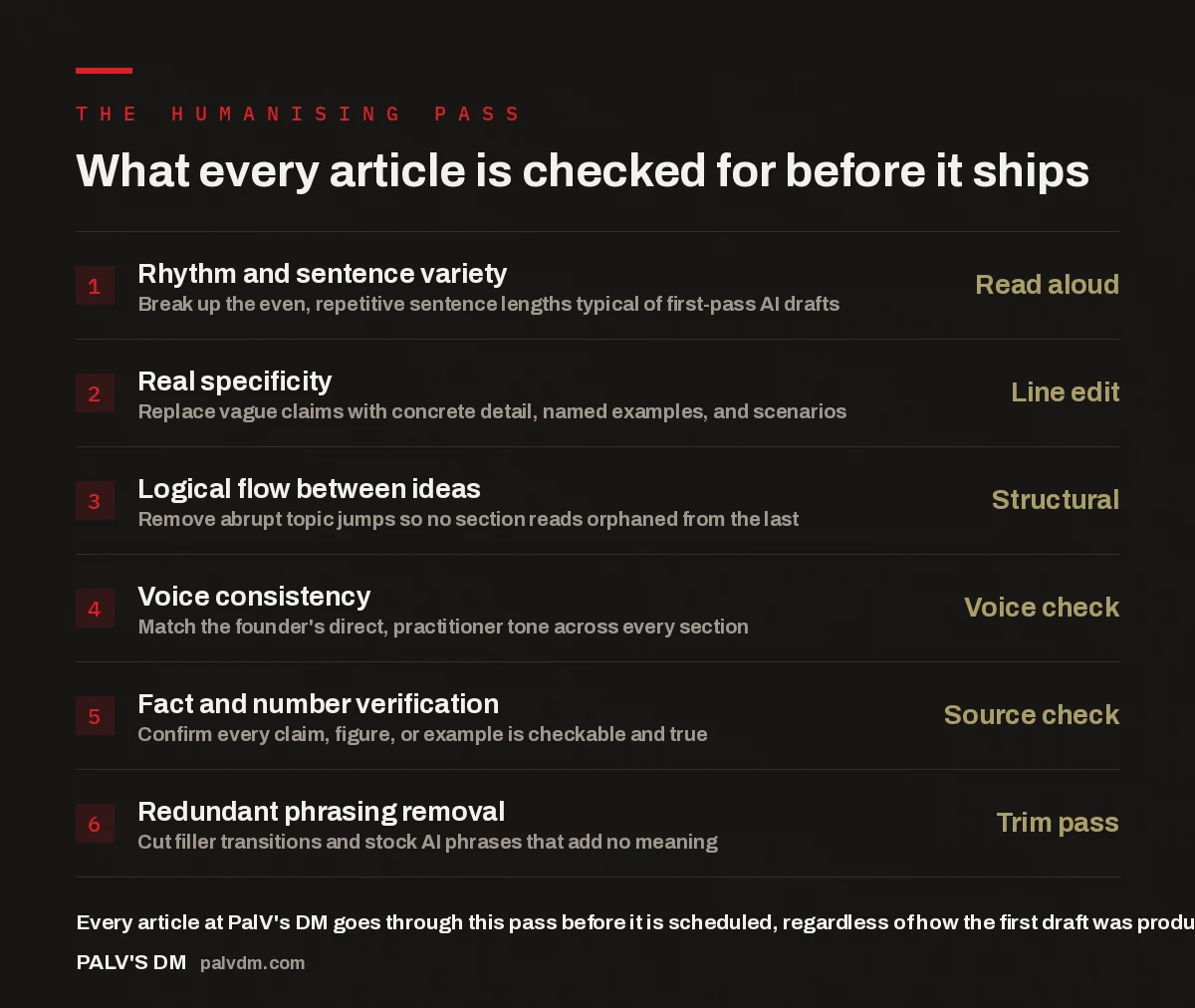
What every article is checked for before it ships
- Rhythm and sentence variety — Read aloud. Break up the even, repetitive sentence lengths typical of first-pass AI drafts.
- Real specificity — Line edit. Replace vague claims with concrete detail, named examples, and scenarios.
- Logical flow between ideas — Structural. Remove abrupt topic jumps so no section reads orphaned from the last.
- Voice consistency — Voice check. Match the founder’s direct, practitioner tone across every section.
- Fact and number verification — Source check. Confirm every claim, figure, or example is checkable and true.
- Redundant phrasing removal — Trim pass. Cut filler transitions and stock AI phrases that add no meaning.
What actually happens during a humanising pass?
A humanising pass is not a find-and-replace job where an editor swaps a few words for synonyms and calls it done. It’s a full re-read of the draft, sentence by sentence, with three questions running in parallel: does this sentence sound like it was written by someone with an opinion, does this claim actually mean something specific, and does this paragraph follow logically from the one before it. Anything that fails any of the three gets rewritten, not tweaked.
In practice this means an editor is reading the whole draft twice — once for structure and once for line-level rhythm — after the research and fact-checking stage in our content pipeline is already complete. The humanising pass isn’t checking whether the facts are right; that’s a separate step. It’s checking whether the piece reads like a person who understands the subject wrote it in one sitting, with one point of view, rather than like a document assembled from several disconnected sources.
Why does AI-assisted drafting still need a human pass?
AI drafting tools are genuinely useful for the parts of writing that are mechanical: pulling together a first-pass structure, summarising source material, drafting a rough outline to react to. What they’re not good at is the part that actually makes writing worth reading — committing to a specific claim, varying sentence rhythm the way a person naturally does when they care about a point, and connecting ideas the way someone who has actually thought about the topic would connect them. Left unedited, AI-drafted text tends to hedge everything, use the same sentence length over and over, and lean on stock transitional phrases that carry no real information.
Search engines have been public about the fact that they don’t penalise content for being AI-assisted — they penalise content that’s unhelpful, generic, or written to game rankings rather than answer a question. The problem is that unedited AI drafts often land squarely in that unhelpful-and-generic category by default, not because a machine wrote part of them, but because nobody went back and made the piece specific. That’s the gap the humanising pass closes. It’s also part of a broader shift covered in our look at where search is heading in 2026: both search rankings and AI answer engines are converging on rewarding content that demonstrates real, checkable understanding of a topic, and punishing content that reads like it was produced to fill a content calendar.
How is a humanising pass different from ordinary proofreading?
Proofreading catches typos, grammar errors, and formatting inconsistencies. A humanising pass operates one level up from that — it’s concerned with whether the writing itself is doing its job, not whether it’s technically correct. An article can be grammatically flawless and still fail a humanising pass if every sentence is roughly the same length, every claim is hedged with “can” and “may,” and every section reads like it was written by a different person with no shared voice.
The two steps also happen in a different order for a reason. Fact verification, covered in why we refuse to publish without verifying numbers, has to come before the humanising pass, because rewriting a sentence for rhythm is pointless if the claim inside it turns out to be wrong and needs to be cut anyway. Proofreading, by contrast, comes last, after the content is locked, because there’s no point polishing spelling on a paragraph that might still get rewritten.
Does every article get a humanising pass, even ones a human wrote entirely from scratch?
Yes, without exception. This surprises some clients, because they assume the humanising pass is only there to fix AI-generated drafts. It isn’t. Human writers produce first drafts with the same underlying problems — sentences that all run the same length, claims left vague because the specific detail wasn’t at hand when the section was written, transitions inserted just to move from one idea to the next rather than because the ideas actually connect. A tired writer on a deadline produces exactly the same flat, generic patterns an unedited AI draft does.
The humanising pass isn’t about hiding how a draft was made. It’s about refusing to publish anything that reads like nobody in particular wrote it — because that’s what actually loses readers and gets ignored by AI answer engines, not the tool used to get the first version onto the page.
Palash, Founder, PalV’s DM
Running every article through the same pass, regardless of origin, is also what keeps the humanising pass honest as a quality gate rather than a label. If it only applied to AI-assisted drafts, it would function as a disclosure exercise. Applied universally, it’s a genuine editorial standard — the article either reads specific, consistent, and well-structured, or it goes back for another round, and how the first draft was produced is irrelevant to that decision.
How does this affect whether an article ranks and gets cited by AI tools?
Two audiences read every article we publish: the human who lands on the page, and the AI systems that summarise or cite it in answers. Both respond to the same underlying quality, for related reasons. A reader stays on a page longer and trusts it more when the writing is specific and has a clear point of view — that’s a pattern well established in how people engage with content, and it shows up in engagement signals search engines already weigh. AI answer engines lean the same direction, because when an AI system is deciding what to pull into a generated answer, content with concrete, well-structured, checkable claims is easier to extract and cite accurately than a paragraph full of hedged generalities. Vague writing doesn’t just read worse, it’s genuinely harder for either kind of reader to use.
This is the connection covered in more depth in writing content that both ranks and gets cited: the two goals aren’t in tension, and the same editorial habits that make an article more citable also make it more readable. Specificity, clear structure, and a consistent voice aren’t stylistic preferences layered on top of good SEO — they’re a large part of what good SEO and good AI visibility actually consist of in 2026.
What happens to an article that fails the humanising pass?
It doesn’t get published on a lower bar because of a deadline. It goes back to the writer or editor with specific notes attached to the sections that failed — this paragraph reads generic, this claim needs a concrete example, this transition is doing no work — and it’s rewritten and re-read before it can move forward. This is one of the two approval gates in our writing process: nothing reaches a client for sign-off, and nothing gets scheduled, until it clears the humanising pass. There’s no partial credit for an article that’s factually accurate but reads flat; flat writing that happens to be accurate still doesn’t get read, shared, or cited the way specific writing does, so publishing it anyway would just be shipping a weaker asset on purpose.
In practice this adds a defined step to the pipeline every article goes through, not an occasional extra check applied when something looks off. Treating it as a standing step rather than a spot-check is what keeps quality consistent across a large batch of articles and across the several writers who might touch a client’s content over a year.
Want content that reads like it, not a template?
FAQ: humanising AI content and the editing process
What is a humanising pass in content writing?
A humanising pass is an editorial step, run after fact-checking, where an editor rewrites a draft for sentence rhythm, specificity, and logical flow, and checks it against a consistent voice. It’s not a cosmetic edit — sentences and paragraphs that read generic get rewritten, not lightly adjusted.
Does using AI in the drafting process hurt SEO?
Not directly. Search engines have said they evaluate content on whether it’s helpful and demonstrates real understanding, not on which tools produced the first draft. The risk is publishing unedited AI output, which tends to be generic by default — that’s an editing problem, and a humanising pass is how it gets fixed before publication.
How is a humanising pass different from proofreading?
Proofreading fixes spelling, grammar, and formatting after content is finalised. A humanising pass happens earlier and goes deeper — it’s concerned with whether the writing itself reads specific and coherent, which can mean rewriting whole sentences or paragraphs, not just correcting errors in the ones that already exist.
Does every article get a humanising pass, even ones written entirely by a human?
Yes. Human first drafts show the same generic patterns AI drafts do — flat sentence rhythm, vague claims, transitions that don’t actually connect ideas — especially under deadline pressure. The pass is applied to every article regardless of how the draft originated.
Why does this matter for AI visibility, not just search rankings?
AI answer engines pull specific, well-structured, checkable claims into generated answers more readily than hedged, generic statements, because specific claims are easier to extract and cite accurately. A humanising pass that makes writing more specific tends to make it more useful to both a human reader and an AI system summarising the page.
Short version: a humanising pass is the standing editorial step every article at PalV’s DM goes through after fact-checking — rewriting for rhythm, specificity, logical flow, and one consistent voice, regardless of how the first draft was produced. It’s not there to disguise AI use; it’s there because generic writing loses readers and gets skipped by AI answer engines looking for content worth citing, and that’s true whether the flat first draft came from a machine or a rushed afternoon.