Nine SEO Myths That Quietly Waste Your Budget
Keyword density, LSI keywords, duplicate content penalties, Domain Authority. Nine SEO myths, what Google actually documents, and what to do instead.

Most SEO myths are not harmless folklore. They are budget lines. Chasing a keyword density target, buying links to lift a vendor authority score, or paying for a guaranteed number-one ranking all consume money that could have gone to work that Google has actually documented as mattering. The nine below are the ones that survive longest in briefs, proposals and internal SEO checklists, and each one is contradicted by something Google has published — in most cases years ago.
A note on how to read this. “Google has not said this” is not proof that something has no effect. But when an agency proposal rests on a mechanism Google explicitly denies, or on a metric Google does not have access to, the burden of proof sits with the proposal.
Myth 1: There is an optimal keyword density
There is no target percentage, and there never was one. Google has never published a keyword density figure, and no system has been described that counts occurrences against a threshold. What Google does publish is a spam policy against keyword stuffing — filling a page with repeated words to manipulate rankings — which is the opposite problem.
The practical replacement is simple: write the page so a reader who knows the topic would recognise it as competent. That naturally uses the vocabulary of the subject. Where the keyword density myth came from traces why the number persists in tools that still report it.
Myth 2: LSI keywords improve rankings
“LSI keywords” borrows the name of latent semantic indexing, a 1980s information-retrieval technique, and applies it to a practice Google has never described using. Google has not documented an LSI system, and search engines at web scale do not use the original technique.
The kernel of truth is that Google understands topics rather than matching strings, so a page about home loans that never mentions interest rates, tenure or eligibility looks thin. That is a completeness argument, not a keyword-insertion tactic. Buying a list of “LSI terms” to sprinkle in is solving a problem that does not exist.
Myth 3: Duplicate content earns a penalty
Google does not apply a penalty for duplicate content in the ordinary sense. During indexing, Google groups pages with similar content and selects one as canonical — the version it shows in results. The other versions are not punished; they are consolidated.
The real cost of duplication is dilution and unpredictability. If Google picks a canonical you did not intend, the wrong URL ranks and your internal links and signals point at a page that is no longer the one being served. There is a genuine spam policy covering scraped content taken from other sites, which is a different thing entirely. How duplicate content actually behaves covers the distinction.
Myth 4: Domain Authority is a Google ranking factor
Domain Authority, Domain Rating and similar scores are proprietary metrics produced by SEO tool vendors. They are estimates built on those vendors’ own link indexes. Google does not receive them, does not use them, and has never described an equivalent published score.
They are still useful as a rough comparative signal when prospecting for links or sizing up competitors. They are not useful as a target. A campaign whose stated goal is “raise DA from 28 to 40” is optimising a vendor’s estimate rather than anything a search engine sees — and the cheapest way to move that number is usually to buy links, which is a spam policy violation. What Domain Authority does and does not tell you sets out the sensible use.
Myth 5: The meta keywords tag still matters
Google announced in September 2009, on its official Search blog, that it does not use the keywords meta tag in web ranking. That position has never been reversed.
The tag survives because content management systems still expose the field and some SEO plugins still populate it. Filling it in is not harmful, but it is not work — and where it is completed by hand across hundreds of pages, it is a line item that has produced nothing since 2009.
Myth 6: Running Google Ads improves your organic rankings
Google’s documentation on how Search works states directly that “Google doesn’t accept payment to crawl a site more frequently, or rank it higher”, and that ranking is done programmatically. Paid and organic results are produced by separate systems, and ad spend is not an input to the organic one.
The inverse myth is equally common and equally wrong: that pausing ads causes an organic drop. What ads genuinely do is provide fast, reliable query-level data on what converts, which is legitimately useful for prioritising organic work. Google Ads versus SEO compares them on their actual merits rather than an imagined interaction.
Myth 7: Longer content ranks better
Google has never published a word count target, and the systems do not reward length as such. The correlation people cite runs the other way: thorough treatments of complex topics tend to be longer, so long pages appear disproportionately among top results for complex queries.
Padding a 700-word answer to 2,500 words to hit a competitor’s average makes it worse, not better, because it buries the answer the reader came for. Google’s own self-assessment questions ask whether content provides substantial value compared with other pages in the results — a question about added information, not volume. Word count targets and where they come from covers how to set a sensible length.
Myth 8: Bounce rate is a ranking factor
Bounce rate is a Google Analytics metric. Google Search does not have access to your analytics data, and Google representatives have consistently said analytics metrics are not used as ranking signals. In any case the metric is unreliable on its own terms: a visitor who reads a full article, gets their answer and leaves is recorded identically to one who arrives and bounces in disgust.
Google Analytics 4 has largely replaced bounce rate with engagement rate for that reason. Optimising to reduce a number that search engines cannot see is a common way to waste a quarter. Engagement rate versus bounce rate explains what each actually measures.
Myth 9: Someone can guarantee you a number one ranking
Google’s own documentation for site owners choosing an SEO says it plainly: “No one can guarantee a #1 ranking on Google.” Google goes further and advises treating guarantees of first place as a warning sign when evaluating providers.
The reason is structural rather than modest. Results vary by location, language, device and personalisation, they change with every core update, and the systems are not deterministic from the outside. What a competent provider can commit to is scope, method and reporting — the deliverables — not the position. Why ranking guarantees are a warning sign covers what to ask instead.
Why do these myths survive?
Three reasons, and understanding them is a defence against the next batch.
- Tools report them. If a piece of software shows a keyword density score or an authority number with a coloured dial, people optimise it. The metric exists because it can be calculated, not because it drives anything.
- They are actionable. “Raise density to 2%” is a task. “Add genuine information the top ten does not contain” is a project. Myths persist partly because they are easier to put in a sprint.
- Correlation is easy to sell. Top-ranking pages do tend to be longer and do tend to have more links. Presenting that as causation produces a tidy strategy deck and a wasted budget.
What deserves the budget instead?
- Fix what blocks indexing. Pages that are not in the index cannot rank regardless of how well written they are. This is cheap, binary work with the highest certainty of return.
- Answer questions the current results answer badly. Google’s self-assessment asks whether your page adds substantial value against what already ranks. That is a content brief, not a keyword target.
- Make expertise verifiable. Named authors with real credentials, stated methodology, and evidence a reader can check. What E-E-A-T actually asks for is the concrete version of this.
- Set the timeline honestly. Most of the pressure to chase shortcuts comes from an unrealistic expectation of speed. How long SEO actually takes is worth agreeing before the first invoice.
- Measure outcomes, not proxies. Clicks, enquiries and revenue. Vendor authority scores and impressions are diagnostics at best — and impressions in particular have been discontinuous since Google withdrew a URL parameter in September 2025.
The pattern across all nine myths is the same: a measurable proxy substituted for an unmeasurable outcome. That substitution is comforting and it is what most wasted SEO budget is spent on. If a tactic cannot be traced to something Google has documented, or to a mechanism you can explain without hand-waving, it belongs in a test rather than a plan — a point that applies just as much to the newer claims about AI search as to the old ones, which is where the “SEO is dead” argument and what we actually know about ranking factors are worth reading next.
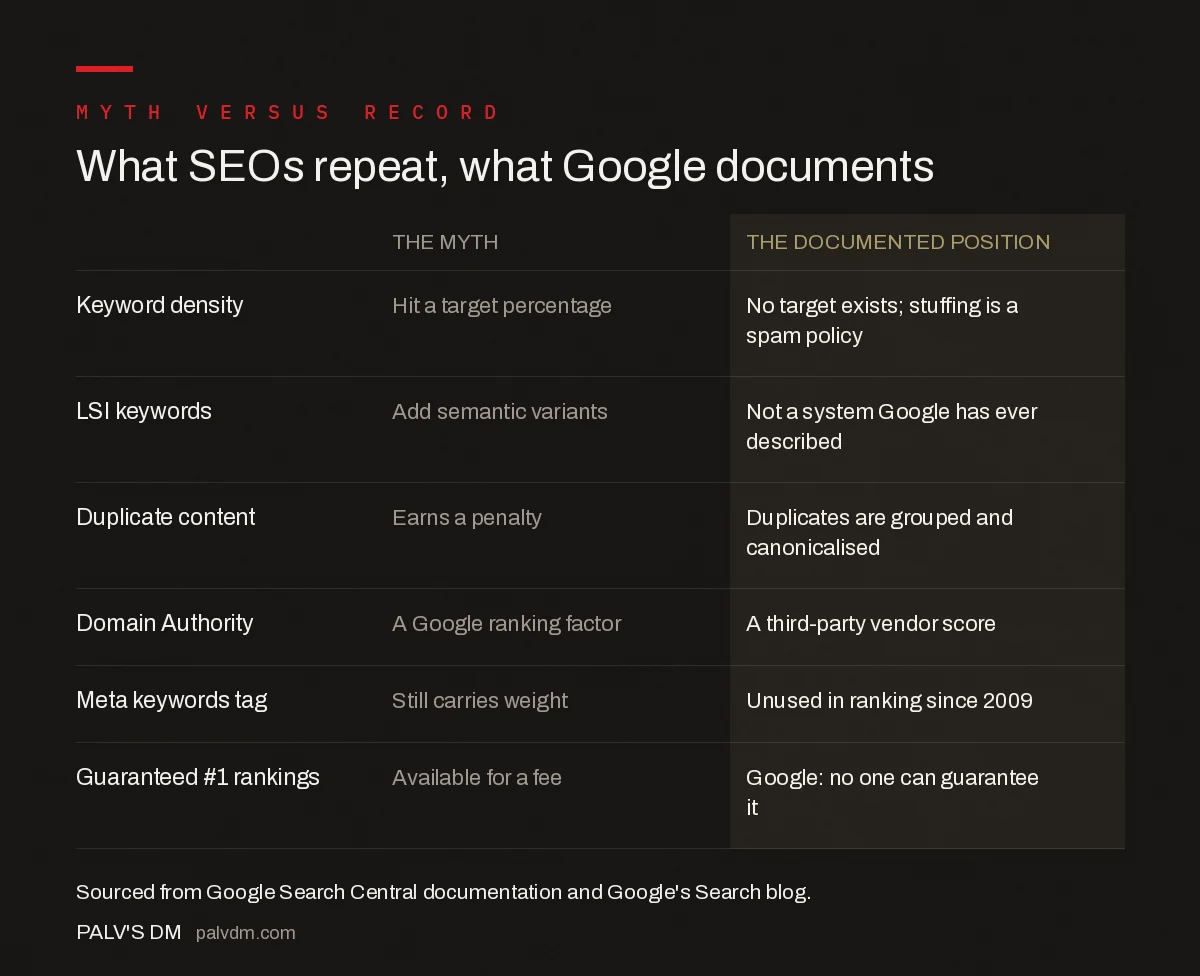
What SEOs repeat, what Google documents
| The myth | The documented position | |
|---|---|---|
| Keyword density | Hit a target percentage | No target exists; stuffing is a spam policy |
| LSI keywords | Add semantic variants | Not a system Google has ever described |
| Duplicate content | Earns a penalty | Duplicates are grouped and canonicalised |
| Domain Authority | A Google ranking factor | A third-party vendor score |
| Meta keywords tag | Still carries weight | Unused in ranking since 2009 |
| Guaranteed #1 rankings | Available for a fee | Google: no one can guarantee it |
Frequently asked questions
Is there an ideal keyword density for SEO?
No. Google has never published a keyword density target and has never described a system that counts keyword occurrences against a threshold. Google does publish a spam policy against keyword stuffing, which is filling a page with repeated terms to manipulate rankings. Writing the page so a knowledgeable reader would find it competent covers the vocabulary naturally.
Does Google penalise duplicate content?
Not in the ordinary sense. During indexing Google groups pages with similar content and picks one as the canonical version to show in results; the others are consolidated rather than punished. The real cost is that Google may choose a canonical you did not intend. Scraped content taken from other sites is a separate matter covered by Google’s spam policies.
Is Domain Authority a Google ranking factor?
No. Domain Authority and Domain Rating are proprietary scores produced by SEO tool vendors from their own link indexes. Google does not receive or use them and has never described an equivalent published metric. They can be useful for comparing sites when prospecting for links, but they are not a target worth optimising directly.
Does buying Google Ads improve organic rankings?
No. Google’s documentation states that it does not accept payment to crawl a site more frequently or rank it higher, and that ranking is done programmatically. Paid and organic results come from separate systems. Ads are still useful to SEO indirectly, because they produce fast query-level data on what actually converts.
Does longer content rank better on Google?
Google has never published a word count target and does not reward length in itself. Thorough treatments of complex subjects tend to be longer, which creates the correlation people cite, but padding a page to match a competitor’s word count makes it worse by burying the answer. Google’s guidance asks whether a page adds substantial value, not how long it is.
Can an agency guarantee a number one ranking on Google?
No, and Google’s own documentation says so: no one can guarantee a #1 ranking on Google, and Google advises treating such guarantees as a warning sign when choosing a provider. Results vary by location, language, device and personalisation and change with every core update. A provider can commit to scope, method and reporting, not to a position.
Sources
- Google does not use the keywords meta tag in web ranking — Google Search blog, September 2009
- Do you need an SEO? — Search Central
- In-depth guide to how Google Search works — Search Central
- Google Search spam policies — Search Central
Want this done on your site?
Every PalV’s DM engagement starts with a free audit of your actual website — a 12-point
crawl covering what is blocking indexation, on-page gaps against your primary keywords, speed
findings, and the three to five fixes worth making first. Delivered in two working days. No
payment details, and the findings are yours whether you hire us or not.