Publishing Your Methodology as an Authority Move
A published method turns a claim of competence into something buyers can inspect. What belongs on a methodology page, how specific to be, and where to link it.
Publishing how you do the work converts an unverifiable claim of competence into something a buyer can inspect before spending anything. A methodology page — how you run an audit, how you test a product, how you fact-check an article, how a dataset was collected — answers the middle question in Google’s own Who, How and Why framework for assessing content. Google’s core update documentation asks site owners to consider how content was created, and states that where readers might reasonably wonder how something was made, explaining the process is the appropriate response. Almost nobody does it, which is precisely why it works.
The counter-argument arrives immediately: does publishing the method not just hand it to competitors? In practice, no. Process is rarely the moat. Anyone can read a documented method; almost nobody executes it consistently for two years. What publishing does is remove the buyer’s need to take your competence on faith, and that is worth more than the secrecy it costs.
What counts as a methodology page?
Several different documents fall under the same idea, and most businesses need two or three rather than one.
| Type | What it documents | Who reads it |
|---|---|---|
| Service delivery method | What happens in week one, what you check, in what order, what triggers escalation | Prospects comparing suppliers |
| Editorial policy | Who writes, who reviews, how facts are checked, correction policy, use of AI | Readers, raters, journalists |
| Testing method | How products or tools were tested, over what period, on what hardware | Readers of reviews and comparisons |
| Data method | Sample, date range, collection tool, definitions, limitations | Anyone considering citing your figures |
| Pricing method | What determines the price, what is included, what changes it | Buyers at the quote stage |
A consultancy typically needs the delivery method and the editorial policy. A publisher needs the editorial policy and the testing method. Anyone publishing figures needs the data method, which is the half of citing your own data that makes the numbers usable to somebody else.
Why does Google’s guidance care how content was produced?
Google’s documentation on core updates sets out three self-assessment prompts — Who created the content, How was it created, and Why does it exist. The How question is the one most sites cannot answer, and it is the one a methodology page exists to answer.
The guidance is specific about automation. Google has stated that appropriate use of AI is not against its guidelines, and that the issue is content produced primarily to manipulate rankings rather than to help people. It also suggests that where automation was used in a way readers would want to know about, explaining why it was considered useful is the right approach. A one-paragraph statement of where AI is and is not used in your process is therefore not a confession — it is the documented answer to a question Google published. Whether AI content breaks Google’s guidelines covers the policy position in full.
What none of this creates is a ranking factor. There is no methodology page signal, and E-E-A-T is not something Google measures directly. The value is that the page answers a question that readers, raters and retrieval systems all ask, and answers it in a form that can be quoted.
What actually goes on the page?
Six elements separate a real methodology page from a process diagram in a brochure.
- Named steps in order, with what happens at each one. Not “discovery, strategy, execution” — the actual checks, in sequence.
- Thresholds and definitions. If step three flags thin pages, state the threshold you use. Numbers are what make a method reproducible rather than aspirational.
- Tools named. Which crawler, which analytics source, which version. Naming tools is also the most common thing agencies avoid, which tells you something.
- Who does what. Roles, and where a human review sits. An editorial policy with no named reviewer is a promise rather than a process.
- Exceptions and limitations. When the method does not apply, and what you do instead. Stating the limits is the single strongest credibility move on the page.
- A last-reviewed date. A method described in 2024 terms and never updated undermines the claim it exists to support.
What does a usable editorial policy look like?
An editorial policy is the methodology page for a publisher, and it is the version most sites need first because it applies to every article rather than one service. Seven things belong in it: who writes, what qualifies them, who reviews before publication and under what criteria, how factual claims are sourced, how and when pages get updated, what happens when something is found to be wrong, and where automation is used.
The correction policy is the part that carries disproportionate weight. A site that publishes what it does when it gets something wrong — annotate the page, date the change, state what was corrected — is making a claim about accountability that almost no competitor makes. It is also the part that costs nothing until it is needed.
Keep it operational rather than aspirational. “Every article is reviewed by a named subject reviewer before publication, and the reviewer is credited on the page” is a policy. “We are committed to accuracy” is a sentiment. The distinction is the same one running through a working content quality checklist, and it maps directly onto Google’s own self-assessment questions, which are written as things to check rather than values to hold.
How specific should it be?
Specific enough that a competent person could follow it, vague enough that you are not publishing client-identifying detail or licensed material. The line is easier than it sounds: publish the sequence, the checks and the thresholds; keep the templates, the scripts and the accumulated judgement.
The genuine risk is not imitation but obsolescence — a published method locks in a description of how you work, and if you change how you work you have to update the page. That is a maintenance cost, and it is the actual reason most firms avoid publishing one. Treat it as an annual review item alongside what gets reported and how and the workbooks the delivery runs on.
Where should it live and what should link to it?
One permanent URL, linked from the places where the question naturally arises rather than buried in a footer.
- From the service page, at the point where the buyer is deciding whether you know what you are doing.
- From every article that uses the method — an audit guide should link to how you actually run audits.
- From the data pages. Every statistic you publish should link to the method behind it.
- From the about page. An about page built for verification is where a reader goes looking for evidence, and the method is the strongest thing you can put in front of them there.
- From author bios, where the person named is the one who executes the method described.
The same logic applies to prices. Publishing a rate card is a methodology statement about commercial terms, which is the argument in why we publish prices — the buyer learns something checkable before contacting you, and the ones who make contact are better qualified.
How does a methodology page perform in AI answers?
Well, for a structural reason. Methodology pages are naturally composed of self-contained, procedural statements — the format retrieval systems handle best. A numbered step that names its tool, its threshold and its output is quotable on its own, without the paragraph before it.
Peer-reviewed research on generative engine optimisation (Aggarwal et al., KDD 2024) found that adding statistics, quotations from named sources and citations to authoritative sources lifted a source’s visibility in generative answers by up to around 40%, and that keyword stuffing performed worse than making no change at all. A well-written method page carries the first set of properties almost automatically: it is full of specific numbers and named things, and it has no reason to contain promotional padding. A research-backed GEO method is itself an example of the genre.
What makes a methodology page fake?
Five tells, all common on agency sites.
- Four abstract stages — discover, define, deliver, optimise — with an icon each and no content.
- No numbers anywhere. No thresholds, no durations, no sample sizes, no frequencies.
- No named tools. “Industry-leading tools” is a way of avoiding the question.
- No failure path. A method that never encounters an exception has never been run.
- No date and no owner. Nobody is accountable for it and nothing says when it was last true.
The fix for all five is the same: replace each abstraction with the thing you actually do. If a step cannot be described concretely, it probably is not a step.
Where to start
Write down what you did on your last engagement, in order, with the tools and thresholds included, then remove anything client-identifying. That draft is closer to a publishable methodology than anything a brochure template will produce. Add the exceptions, add a review date, put a named person’s byline on it, and link it from your service pages.
It is a half-day of work that answers the How question permanently, supports every claim on your author page, and gives every article on the site something concrete to reference. Judged against the effort, it is one of the highest-yield trust assets available — and it stays useful long after the current helpful content guidance has been rewritten again.
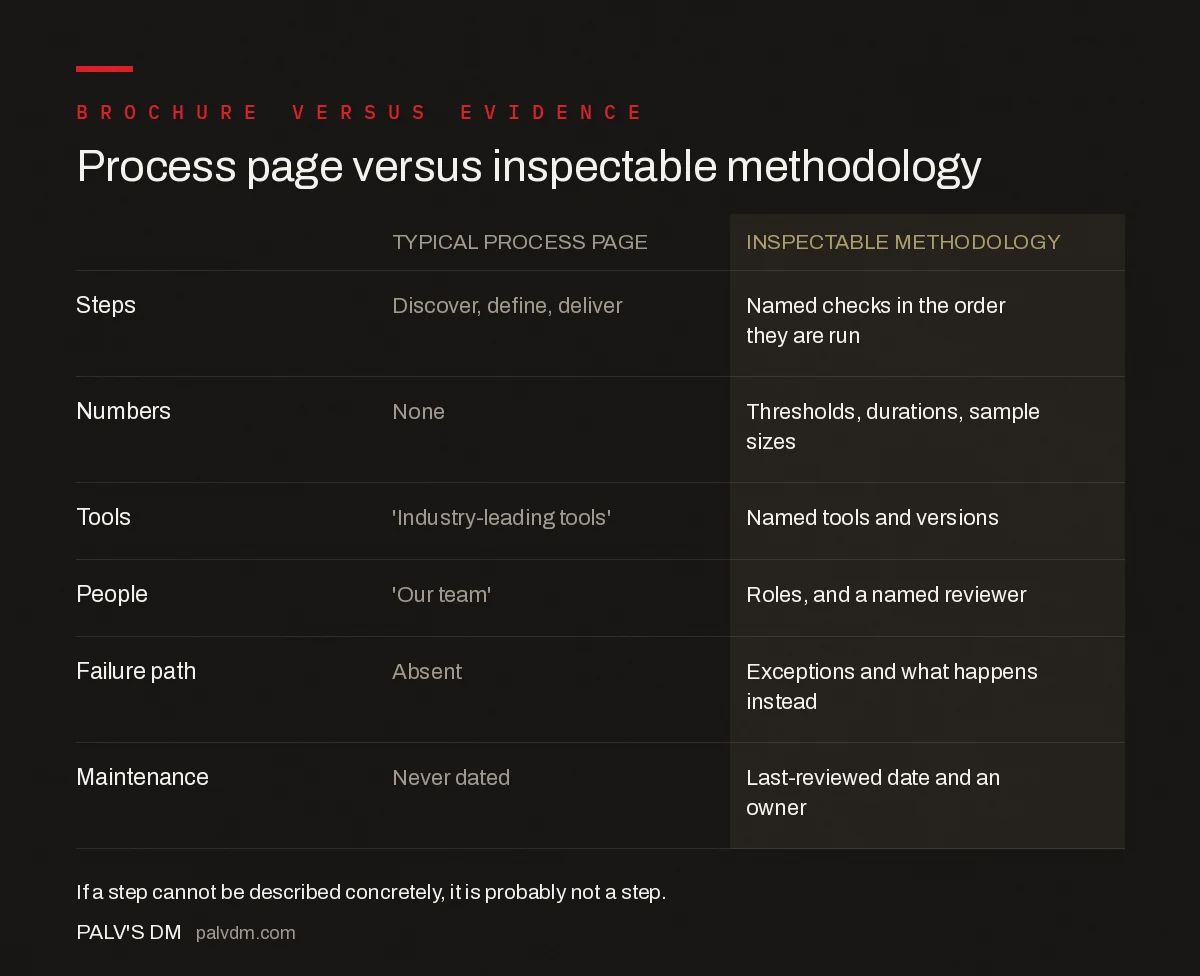
Process page versus inspectable methodology
| Typical process page | Inspectable methodology | |
|---|---|---|
| Steps | Discover, define, deliver | Named checks in the order they are run |
| Numbers | None | Thresholds, durations, sample sizes |
| Tools | ‘Industry-leading tools’ | Named tools and versions |
| People | ‘Our team’ | Roles, and a named reviewer |
| Failure path | Absent | Exceptions and what happens instead |
| Maintenance | Never dated | Last-reviewed date and an owner |
Frequently asked questions
What is a methodology page?
A page documenting how work is actually done — the steps of a service, an editorial and fact-checking policy, how products were tested, or how a dataset was collected. It states the sequence, the tools, the thresholds, who is responsible and where the method does not apply. Its purpose is to let a reader inspect competence rather than take it on trust.
Does publishing your methodology help SEO?
Not as a ranking factor, and none exists. Google’s core update documentation asks site owners to consider how their content was created, and states that where readers might reasonably wonder how something was made, explaining the process is appropriate. A methodology page is the direct answer to that question, and it gives every other page on the site something concrete to reference.
Will competitors copy my method if I publish it?
They can read it, and most will not execute it. Process is rarely the durable advantage; consistent execution over years is. The practical rule is to publish the sequence, the checks and the thresholds while keeping templates, scripts and accumulated judgement. The real cost of publishing is maintenance, because changing how you work means updating the page.
Should I disclose whether I use AI in content production?
Where readers would reasonably want to know, yes. Google has stated that appropriate use of AI is not against its guidelines and that the problem is content produced primarily to manipulate rankings. Its guidance suggests explaining why automation was considered useful in cases where readers would wonder. A short paragraph in an editorial policy covers it.
What makes a methodology page unconvincing?
Five tells: four abstract stages with an icon each, no numbers or thresholds anywhere, no named tools, no description of what happens when the method fails, and no owner or last-reviewed date. Each abstraction should be replaced with the concrete thing that actually happens. If a step cannot be described concretely, it is probably not a step.
What should an editorial policy contain?
Who writes the content and what qualifies them, who reviews it before publication, how factual claims are sourced and checked, how and when pages are updated, what your corrections process is, whether and where automation or AI is used, and how sponsored or affiliate content is disclosed. Name the reviewer rather than referring to an anonymous editorial team.
Sources
- Google core updates and your website — the Who, How and Why self-assessment questions
- Creating helpful, reliable, people-first content — Google Search Central
- Google Search's guidance about AI-generated content
- GEO: Generative Engine Optimization (Aggarwal et al., KDD 2024)
Want this done on your site?
Every PalV’s DM engagement starts with a free audit of your actual website — a 12-point
crawl covering what is blocking indexation, on-page gaps against your primary keywords, speed
findings, and the three to five fixes worth making first. Delivered in two working days. No
payment details, and the findings are yours whether you hire us or not.