The Page Experience Update: What Survived
Google's page experience update promised a lot and delivered narrowly. What Google still confirms, the current Core Web Vitals thresholds, and what to ignore.
The page experience update rolled out for mobile between mid-June and the end of August 2021, and for desktop from 22 February 2022 over nine days. What survived from it is narrow: Google’s current documentation states that “Core Web Vitals are used by our ranking systems” and that beyond Core Web Vitals, other page experience aspects “don’t directly help your website rank higher in search results”. There is also no combined page experience signal. Google answers that question directly in its own FAQ: “There is no single signal.”
That is a considerable retreat from how the update was received in 2021, when a great deal of budget moved into performance work on the assumption that a page experience score would decide rankings. The useful version of this story is working out which parts Google still stands behind, and which parts were always the industry talking to itself.
What was the page experience update?
Google introduced Core Web Vitals in May 2020 and announced shortly afterwards that page experience signals would become part of ranking. The rollout was deliberately slow and heavily trailed — unusual for Google, and closer to how it handled the 2015 mobile-friendly update than to how it handles a core update.
Two rollouts happened:
- Mobile: rolled out gradually from mid-June 2021, completing at the end of August 2021.
- Desktop: listed on Google’s Search Status Dashboard as beginning on 22 February 2022 and running nine days.
The components Google described at the time were Core Web Vitals, mobile-friendliness, secure serving over HTTPS, and the absence of intrusive interstitials. Those four are still recognisable in Google’s documentation, but their status has changed substantially.
What does Google say about page experience now?
Google’s current page experience documentation replaced the update-era framing with a set of self-assessment questions. Answering yes to all of them, Google says, means you are “probably on track”. The questions are:
- Do your pages have good Core Web Vitals?
- Are your pages served in a secure fashion?
- Does your content display well on mobile devices?
- Does your content avoid using an excessive amount of ads that distract from or interfere with the main content?
- Do your pages avoid using intrusive interstitials?
- Is your page designed so visitors can easily distinguish the main content from other content on your page?
The critical detail is what Google says about how these feed ranking. Core Web Vitals are confirmed as used by its ranking systems. The rest are described as things that “can make your website more satisfying to use, which is generally aligned with what our ranking systems seek to reward” — which is a careful way of saying they are worth doing and are not a direct ranking lift.
| 2021 component | Status in Google’s current documentation |
|---|---|
| Core Web Vitals | Explicitly used by Google’s ranking systems |
| Mobile-friendliness | A self-assessment question; no standalone ranking system |
| HTTPS | A self-assessment question; checked via Search Console’s HTTPS report |
| Intrusive interstitials | Still a named concern with its own documentation page |
| A combined page experience signal | Does not exist — “there is no single signal” |
What are the Core Web Vitals in 2026?
Three metrics, each with published thresholds, each assessed at the 75th percentile of real page loads rather than on a lab test of your laptop.
| Metric | What it measures | Good | Poor |
|---|---|---|---|
| Largest Contentful Paint (LCP) | How long until the main content renders | 2.5 seconds or less | Over 4.0 seconds |
| Interaction to Next Paint (INP) | How responsive the page is to user input | 200 ms or less | Over 500 ms |
| Cumulative Layout Shift (CLS) | How much the layout moves unexpectedly | 0.1 or less | Over 0.25 |
The set changed on 12 March 2024, when Interaction to Next Paint replaced First Input Delay. That swap mattered more than it sounds: FID measured only the delay before the first interaction was processed, which most sites passed easily. INP measures responsiveness across the whole visit, and a great deal of JavaScript-heavy work that passed FID comfortably fails INP. If your Core Web Vitals report got worse in 2024 without anything changing on your site, that is why, and fixing INP is usually the highest-value performance work available.
The other two have well-understood causes. LCP problems are usually server response time, render-blocking resources or an unoptimised hero image — identifying the LCP element takes minutes and eliminates most guesswork. CLS is nearly always missing dimensions on images and embeds, which makes setting explicit width and height one of the cheapest fixes in technical SEO. The full Core Web Vitals guide covers the diagnostic path for each.
Is page experience judged per page or per site?
Google’s documentation answers this one directly, and the answer is both, with the emphasis on pages. Its core ranking systems “generally evaluate content on a page-specific basis, including when understanding aspects related to page experience”, while Google adds that it does have “some site-wide assessments”.
That has two practical consequences that change how you plan the work. First, a single slow template does not condemn the whole domain, so triaging by traffic value is legitimate: fix the templates that carry commercial pages before the ones that carry an abandoned blog archive. Second, a site where nearly every template is slow is a different case, because at that point poor performance is the site rather than a property of a few pages.
It also settles a common argument about whether to fix Core Web Vitals sitewide before publishing anything new. You do not have to. Performance work and content work run in parallel, on different templates, with different owners, and neither blocks the other. The only genuine sequencing rule is the one above: content that Google cannot see is worth nothing however fast it renders, so parity and indexability come before milliseconds. Beyond that, the ordering is a resourcing decision rather than an SEO constraint.
What quietly went away?
Three things from the 2021 framing no longer hold, and each still shows up in proposals.
- The idea of a page experience score. There is no combined signal, no score, and no report that produces one. Tools that present a “page experience score” have invented it.
- The idea that speed alone lifts rankings. Google states that a perfect score does not guarantee top rankings and that “trying to get a perfect score just for SEO reasons may not be the best use of your time”. The answer to whether page speed affects SEO is yes, narrowly, through Core Web Vitals — not as a general performance bonus.
- The idea that page experience outranks relevance. Google is explicit: “Google Search always seeks to show the most relevant content, even if the page experience is sub-par.” Page experience contributes when there is a lot of helpful content competing, which is a tiebreaker role.
A fourth idea deserves the same treatment: that page experience explains ranking losses. It rarely does. When a site drops sharply, the mechanism is usually a broad core update reassessing whether the content deserves to rank, not a performance metric moving a few milliseconds. Checking the announced update record before commissioning a performance sprint saves a great deal of misdirected budget.
How much should you invest in page experience?
Enough to clear the thresholds, then stop optimising for search and start optimising for revenue. The sequence that works:
- Fix indexing before performance. A fast page Google cannot fully see is worth nothing. Content parity under mobile-first indexing comes first, always.
- Work from field data, not lab scores. Search Console’s Core Web Vitals report uses real user data. A Lighthouse run on a fast desktop connection does not reflect what your visitors experience.
- Fix by template, not by URL. One product template fix repairs thousands of URLs. Chasing individual pages is the most common wasted effort in this work.
- Clear the “good” threshold and move on. There is no documented benefit to 2.0 seconds over 2.4 seconds for ranking. There is a documented benefit to being under 2.5.
- Treat interruption as a conversion problem too. Intrusive interstitials are a named page experience concern, and aggressive entry and exit popups cost more in abandonment than they earn in signups on mobile.
- Serve everything securely. HTTPS is a self-assessment question and a basic expectation; mixed content warnings are a solved problem that still breaks sites, so resolving mixed content belongs on the checklist.
Beyond the thresholds, the argument for performance work stops being an SEO argument and becomes a commercial one. The relationship between page speed and conversion rate is far more direct than the relationship between page speed and rankings, and it is measurable on your own analytics rather than inferred from Google’s documentation.
None of this makes performance optional. It makes it honest: you are buying a threshold pass, a faster site for your visitors, and a better conversion rate, rather than a ranking boost that Google has never described.
The one-sentence version: page experience never became the ranking factor it was sold as, Core Web Vitals are the only part Google confirms its ranking systems use, and everything else on the list is worth doing because it makes the site better — which a technical SEO programme should be doing anyway.
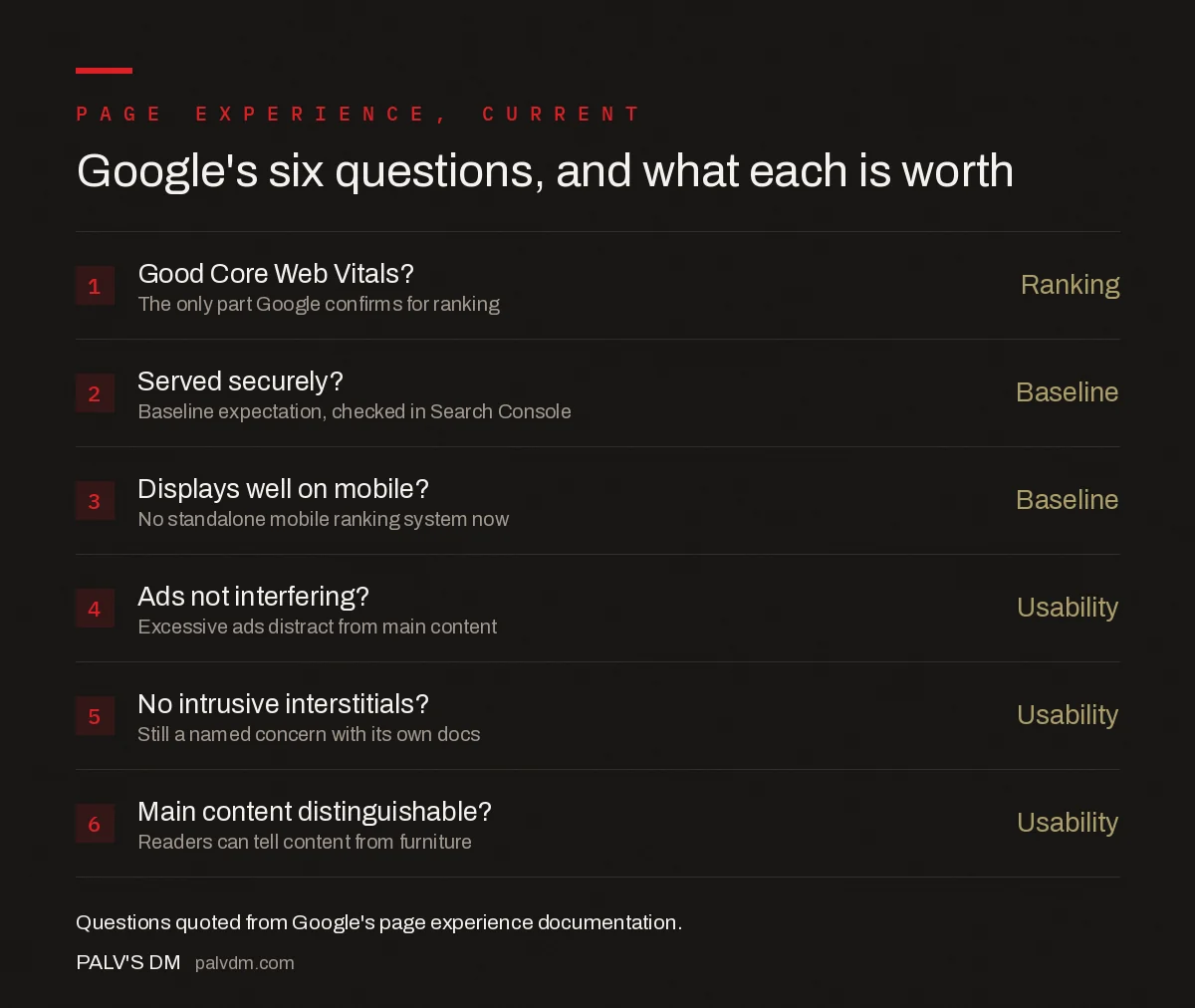
Google’s six questions, and what each is worth
- Good Core Web Vitals? — Ranking. The only part Google confirms for ranking.
- Served securely? — Baseline. Baseline expectation, checked in Search Console.
- Displays well on mobile? — Baseline. No standalone mobile ranking system now.
- Ads not interfering? — Usability. Excessive ads distract from main content.
- No intrusive interstitials? — Usability. Still a named concern with its own docs.
- Main content distinguishable? — Usability. Readers can tell content from furniture.
Frequently asked questions
What was the Google page experience update?
The page experience update introduced Core Web Vitals and related signals into ranking. It rolled out for mobile gradually from mid-June 2021 to the end of August 2021, and for desktop from 22 February 2022 over nine days according to Google’s Search Status Dashboard. Its original components were Core Web Vitals, mobile-friendliness, HTTPS and the absence of intrusive interstitials.
Is page experience a ranking factor?
There is no single page experience signal. Google’s documentation states this directly and says its core ranking systems look at a variety of signals that align with overall page experience. Of those, Google confirms that Core Web Vitals are used by its ranking systems, and says other page experience aspects do not directly help a page rank higher.
What are the Core Web Vitals thresholds?
Largest Contentful Paint should be 2.5 seconds or less, with over 4.0 seconds considered poor. Interaction to Next Paint should be 200 milliseconds or less, with over 500 milliseconds poor. Cumulative Layout Shift should be 0.1 or less, with over 0.25 poor. Each is assessed at the 75th percentile of real page loads, not on a single lab test.
When did INP replace FID?
Interaction to Next Paint replaced First Input Delay as a Core Web Vital on 12 March 2024. FID measured only the delay before the first interaction was processed, which most sites passed easily. INP measures responsiveness across the whole visit, so many JavaScript-heavy sites that comfortably passed FID now fail INP without having changed anything.
Will faster pages rank higher?
Only up to the published Core Web Vitals thresholds, and only as a contributing factor. Google states that good results in the Core Web Vitals report do not guarantee top rankings, and that trying to get a perfect score purely for SEO reasons may not be the best use of your time. Relevance still comes first, even when page experience is sub-par.
Does HTTPS still help rankings?
Secure serving is one of the six page experience self-assessment questions in Google’s documentation, and Search Console provides an HTTPS report to check it. Google does not describe it as a direct ranking lift today. It is best treated as a baseline requirement rather than an optimisation, since mixed content and certificate problems break trust and functionality regardless of ranking.
Sources
- Understanding page experience in Google Search results — Source of the six self-assessment questions and the no-single-signal statement
- Understanding Core Web Vitals and Google Search results
- Avoid intrusive interstitials and dialogs — Search Central
- Google Search Status Dashboard — ranking update history — Lists the desktop page experience rollout, 22 February 2022
Want this done on your site?
Every PalV’s DM engagement starts with a free audit of your actual website — a 12-point
crawl covering what is blocking indexation, on-page gaps against your primary keywords, speed
findings, and the three to five fixes worth making first. Delivered in two working days. No
payment details, and the findings are yours whether you hire us or not.