Service Support — Content Writing
How We Keep One Voice Across Multiple Writers
How we keep consistent brand voice content across every writer on an account: a one-page voice sheet, live examples, and a separate voice-only edit pass.
Consistent brand voice content across multiple writers comes down to one thing: writers work from a shared written reference, not from memory of how the brand “usually sounds.” At PalV’s DM, every writer — first article or fiftieth — drafts against a one-page voice sheet, studies the same live examples before typing a word, and passes through a voice-only edit pass before anything ships. No one is trusted to intuit tone from a client call they sat in once. The system is built so it doesn’t matter who’s writing.
Key takeaway
- A one-page voice sheet with banned words and real example paragraphs does more than any style guide document that lists adjectives.
- New writers study live examples before drafting; they are never asked to guess the tone from a brief alone.
- A separate voice-only edit pass — distinct from the fact-check and grammar pass — is what actually catches drift before publish.
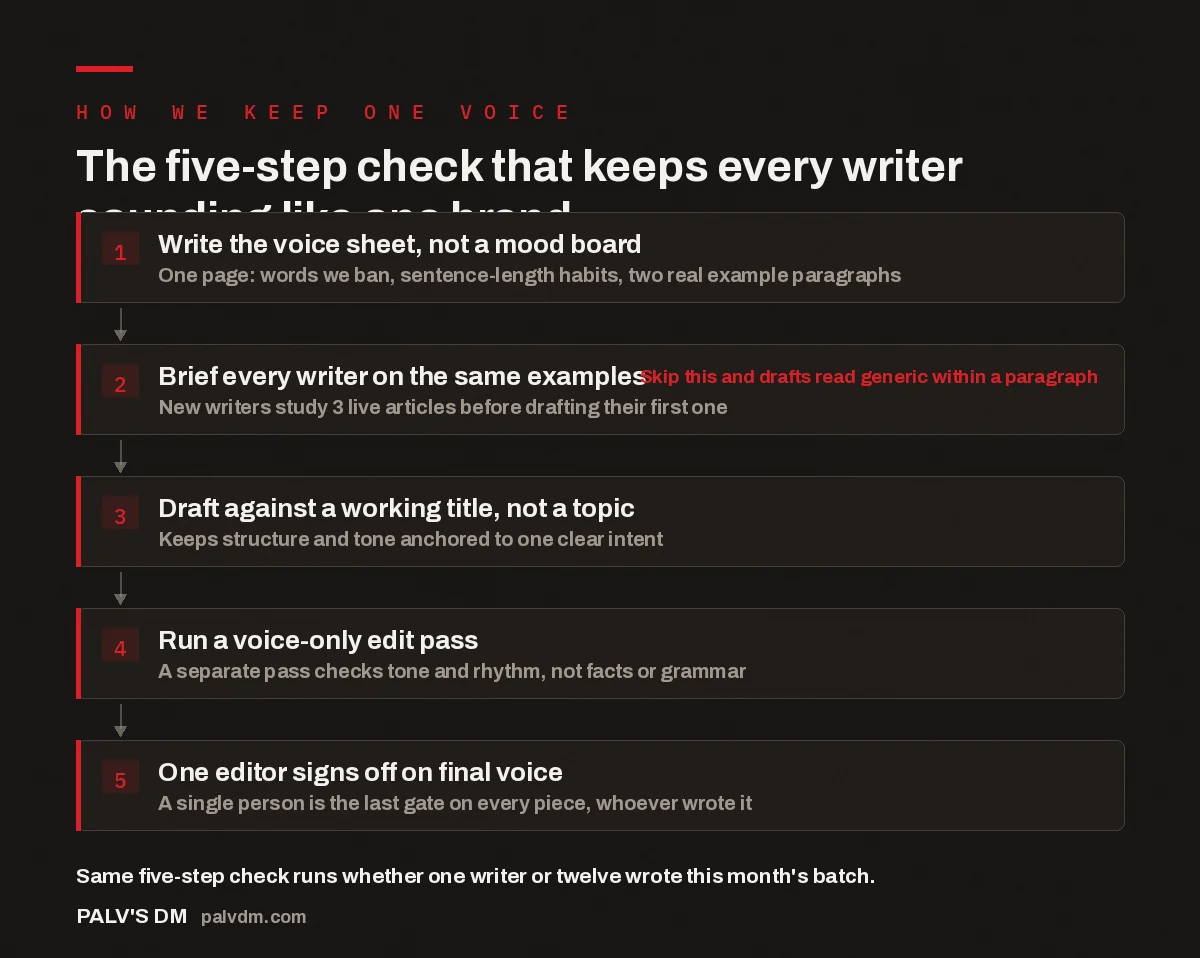
The five-step check that keeps every writer sounding like one brand
- Write the voice sheet, not a mood board. One page: words we ban, sentence-length habits, two real example paragraphs.
- Brief every writer on the same examples. New writers study 3 live articles before drafting their first one. Skip this and drafts read generic within a paragraph
- Draft against a working title, not a topic. Keeps structure and tone anchored to one clear intent.
- Run a voice-only edit pass. A separate pass checks tone and rhythm, not facts or grammar.
- One editor signs off on final voice. A single person is the last gate on every piece, whoever wrote it.
Why does brand voice break down with more than one writer?
Voice breaks down the moment a second writer is briefed on the topic instead of the tone. One writer produces short, blunt sentences; the next defaults to whatever their own natural style is — longer clauses, softer hedging, more adjectives. Neither is wrong on their own. Read side by side, though, the two articles don’t sound like they came from the same company, and a reader who lands on both within a week notices, even if they can’t say exactly why.
The usual fix — a style guide that lists brand adjectives like “friendly, expert, approachable” — doesn’t work, because adjectives don’t constrain sentences. Two writers can both aim for “approachable” and land in completely different places. What constrains a sentence is a rule about sentence length, a banned word list, or an actual paragraph the writer can pattern-match against. That’s the difference between a voice sheet and a mood board, and it’s the reason we build the former and skip the latter.
What actually goes in a voice sheet?
A working voice sheet fits on one page and contains four things, in this order:
- A banned-words list. Specific to the brand — words a founder has flagged as “not us,” not a generic list of clichés.
- Sentence-length habits. Whether the brand favours short, declarative sentences or allows longer, more layered ones — stated as a rule, not a vibe.
- Two real example paragraphs. Pulled from published, approved work — not written specifically as “examples,” because those tend to sound like guideline copy rather than the brand’s actual writing.
- A short list of things the brand never does. Never opens with a rhetorical question, never uses an exclamation mark in body copy, never claims a statistic without a source — whatever applies.
Everything past that first page is optional. A voice sheet that runs to five pages tends not to get read past page one before a deadline, which defeats the purpose. The goal is a document a writer can reread in ninety seconds before every draft, not a reference manual they consult once and forget.
How do we brief a new writer before their first draft?
A new writer joining an account never starts by writing. They start by reading. The onboarding step is simple and non-negotiable: read three live, published articles from that account before drafting anything, alongside the one-page voice sheet. This isn’t a formality — it’s the fastest way we’ve found to transfer tone that can’t fully be written down as a rule. A writer who has read three real examples of the brand’s rhythm produces a first draft that’s already close. A writer who’s only read the voice sheet produces something technically compliant and recognisably off.
The same applies whenever the brand itself has never had a blog before, and there are no live examples yet — a situation covered in more detail in our piece on writing content for a brand with no existing blog. In that case, the first few articles function as the reference set for everything after them, so we spend disproportionate editing effort on getting those right before scaling to more writers.
What happens in the voice-only edit pass?
Most editing processes bundle everything into one pass: check the facts, fix the grammar, tidy the structure, and — somewhere in there — hope the tone is right. We split voice out into its own dedicated pass, run separately from fact-checking and line editing. An editor reads the draft purely for rhythm, word choice, and whether it sounds like the brand rather than like a generic version of the topic. Nothing else gets marked in that pass. That separation matters because voice problems are easy to miss when an editor is also hunting for a wrong statistic or a dangling clause — the brain is doing a different kind of reading, and something has to give.
The voice-only pass sits alongside — not instead of — the fact-checking work we describe in why we refuse to publish without verifying numbers, and it’s one of the two checkpoints in the two approval gates in our writing process. It’s also distinct from the pass covered in why every article goes through a humanising pass, which focuses on removing AI-flat phrasing rather than checking brand-specific tone. A draft can pass the humanising pass and still fail the voice pass if it reads like generically good writing rather than this specific brand’s writing.
A style guide full of adjectives tells a writer what to feel. A voice sheet with real example paragraphs tells them what to type. Only one of those actually changes the sentence.
Palash, Founder, PalV’s DM
How do we handle disagreements about tone?
Tone disagreements are settled by one person, not by committee. Every account has a single editor who is the final voice gatekeeper — usually the same person across that client’s whole content run, so the judgment call stays consistent over months, not just within one article. If a writer and editor disagree on a phrase, the editor’s read of the voice sheet wins, and the disagreement itself becomes a note added to the voice sheet so it doesn’t recur. Over a few months, the sheet accumulates these edge cases and gets more precise, which is why a voice sheet six months into an account is a better document than the one we started with.
This is also where the distinction between a writer and a strategist matters. A writer executes against the voice sheet and the brief; deciding what the voice sheet should say in the first place, and resolving ambiguity when the brief and the brand’s usual tone pull in different directions, is a strategist-level judgment call. We go into that split in more detail in do you need a writer or a content strategist, and it’s the reason we don’t hand new accounts straight to whichever writer has capacity that week — someone has to own the voice decisions before the writing starts.
What tools don’t replace a voice sheet?
AI writing assistants and grammar tools can flag passive voice, long sentences, or reading-level mismatches, and we use that kind of tooling as one input among several. What they can’t do is know that this brand never uses exclamation marks, or that this founder specifically dislikes the word “leverage.” That’s brand-specific institutional knowledge, and it only exists if someone wrote it down and put it in front of every writer before the draft, not after. Treating a generic AI tone-checker as a substitute for a voice sheet is a common shortcut, and it’s the fastest way to end up with content that’s grammatically fine and recognisably not the brand’s.
The same logic runs through the rest of our production process, which we map end to end in our content pipeline from brief to published — voice is one checkpoint among several, but it’s the one that’s easiest to skip when a team is moving fast, and the one readers notice fastest when it’s missing.
Want writing that sounds like your brand, not like a generic AI draft?
What’s the fastest way to check if two writers on the same account sound consistent?
Read the opening paragraph of each article back to back, aloud, with the titles hidden. If you can guess which writer wrote which purely from word choice and sentence rhythm, the voice sheet isn’t specific enough yet — usually because it’s still full of adjectives instead of concrete rules and example paragraphs.
Do we need a written voice sheet if we only have one regular writer right now?
Yes, and earlier than most brands think. A single writer internalises tone without writing it down, which works until that writer is unavailable, replaced, or joined by a second person — at which point there’s no record to hand over. Writing the voice sheet while one writer is still active is far easier than reverse-engineering it from old articles later.
How often should a voice sheet be updated?
Whenever an edge case comes up that the current sheet doesn’t cover — not on a fixed calendar. In practice that means small updates every few articles early in an account, tapering off as the sheet accumulates enough real examples and edge-case notes to cover most situations a writer will hit.
Can AI detection or grammar tools keep brand voice consistent across writers?
Not on their own. Those tools catch generic problems — passive voice, reading level, repeated phrasing — but they don’t know a specific brand’s banned words, sentence-length habits, or the founder’s personal dislikes. They’re a useful secondary check, not a substitute for a written, brand-specific voice sheet and a human voice-only edit pass.
Who should have final say when writers disagree about tone?
One named editor per account, kept consistent over time rather than rotated. Splitting that call across multiple editors reintroduces the exact inconsistency a voice sheet is meant to prevent, since each editor tends to have their own read of what counts as “on voice.”
Short version: consistent brand voice content across multiple writers isn’t a talent problem, it’s a documentation problem. Write a one-page voice sheet with banned words, sentence-length rules, and real example paragraphs. Brief every new writer on live examples before their first draft. Run a voice-only edit pass, separate from fact-checking and grammar. Give one editor final say, and feed every disagreement back into the sheet. Do those four things consistently and it stops mattering how many people are writing.