The Helpful Content Update: From System to Core Signal
The helpful content update ran from August 2022 until March 2024, when Google folded it into core ranking. Full timeline and what it means now.
The helpful content update began in August 2022 as a standalone, site-wide classifier and no longer exists as a separate system. In March 2024 Google folded its signals into the core ranking systems and retired the standalone entry, which means there is no longer such a thing as an isolated helpful content update to recover from. Whatever the classifier used to do on its own is now assessed by multiple systems inside every core update. Sites that were suppressed by it wait for core updates now, not for a dedicated rerun.
That change is the single most important thing to understand about the history, because a large amount of advice written between 2022 and early 2024 assumed a separate switch that could be flipped back. There is no switch.
What was the original helpful content update?
Google announced the helpful content update in August 2022 and rolled it out between 25 August and 9 September 2022. It launched for English-language searches and introduced something unusual: an automated, site-wide classifier that ran continuously rather than a per-page assessment applied at a moment in time.
Two design choices caused most of the confusion that followed. First, it was site-wide — a large volume of unhelpful material could weigh on a site’s other pages, including pages that were perfectly good. Second, because the classifier ran continuously but its effect was reassessed periodically, sites that cleaned up saw nothing for months and concluded the cleanup had failed.
Google extended the update to all languages in a rollout that ran from 5 December 2022 to 12 January 2023, and ran a further helpful content update from 14 to 28 September 2023.
What did the March 2024 core update change?
The March 2024 core update, which ran from 5 March to 19 April 2024 — roughly 45 days, the longest core rollout of the modern series — was where the helpful content system stopped being a system.
Google explained that rather than relying on one signal, it had integrated the helpful content work into its core ranking systems, using multiple signals and approaches to identify unhelpful content. The standalone helpful content system entry was removed from Google’s ranking systems documentation, and the guidance page was reframed around creating helpful, reliable, people-first content instead.
Google also stated an expectation for the combined effect: a 40% reduction in low-quality, unoriginal content in search results, a figure it later revised upward to 45%. It is worth being precise about what that number is. It is Google’s own stated expectation of its own systems, not a measured outcome published afterwards, and no independent verification of it exists.
The same announcement introduced three new spam policies — scaled content abuse, site reputation abuse and expired domain abuse — which is why March 2024 is remembered as a single large event rather than four separate ones.
How does the timeline read end to end?
| Event | Dates | What changed |
|---|---|---|
| Helpful content update | 25 Aug – 9 Sep 2022 | Site-wide classifier launched, English only |
| December 2022 helpful content update | 5 Dec 2022 – 12 Jan 2023 | Extended to all languages |
| September 2023 helpful content update | 14 – 28 Sep 2023 | Further rollout of the same system |
| March 2024 core update | 5 Mar – 19 Apr 2024 | Signals folded into core ranking; standalone system retired |
| Core updates since | 2025 – 2026 | Helpfulness assessed inside every core update |
Why does the history still matter in 2026?
Because the practical implication changed and much of the surviving advice did not.
Before March 2024, a site hit by the helpful content classifier waited for the next helpful content update. After March 2024, there is nothing to wait for except core updates, and Google’s standing guidance on those is unambiguous: no specific actions guarantee recovery, a drop does not necessarily mean something is wrong, and the largest changes tend to arrive with a subsequent core update rather than between them. Both 2026 core updates ran twelve days each, which sets the realistic rhythm. The 30-day recovery plan works from that constraint, and what a core update actually is covers the mechanics.
The second reason is that the underlying idea survived intact. Google’s guidance still asks whether content is created for people rather than to attract search traffic, and still points site owners at the same self-assessment questions. What the helpful content guidance rewards today covers the current version, which is the one worth working from.
How does it relate to Panda?
The comparison comes up constantly and it is broadly fair. The Panda update, launched in 2011, was also a site-level quality assessment that ran on a periodic refresh, also punished sites for the aggregate of their weak pages, and was eventually absorbed into Google’s core ranking systems rather than remaining a separate filter.
The lifecycle repeats: Google names a system, the industry organises around the name, and Google eventually stops treating it as separate. The Panda update set the pattern and the wider history of Google’s algorithm updates shows how often it recurs. The practical lesson is to optimise against the documented guidance rather than against a system name, because the names have a short half-life.
What does this mean for AI-assisted content?
A common misreading is that the helpful content work was aimed at AI writing. It was not. Google’s published position, set out in February 2023, is that it rewards high-quality content however it is produced, and that using automation to generate content primarily to manipulate rankings is a spam policy violation. Production method is not the test; purpose and quality are.
What the March 2024 work did target, explicitly, was scaled content abuse: producing many pages at volume primarily for ranking rather than for readers, whether written by people, generated by a model, or a mixture. Whether AI content breaks Google’s guidelines deals with the distinction in detail, and thin content describes what the pages usually look like in practice.
The durable version of the whole history is short. Google spent 2022 and 2023 running a separate helpfulness classifier, decided in 2024 that helpfulness belonged in core ranking, and has assessed it there ever since. The questions it asks have barely changed. What changed is that there is no longer a specific update to blame or a specific one to wait for. Every confirmed date since sits in the 2026 update timeline.
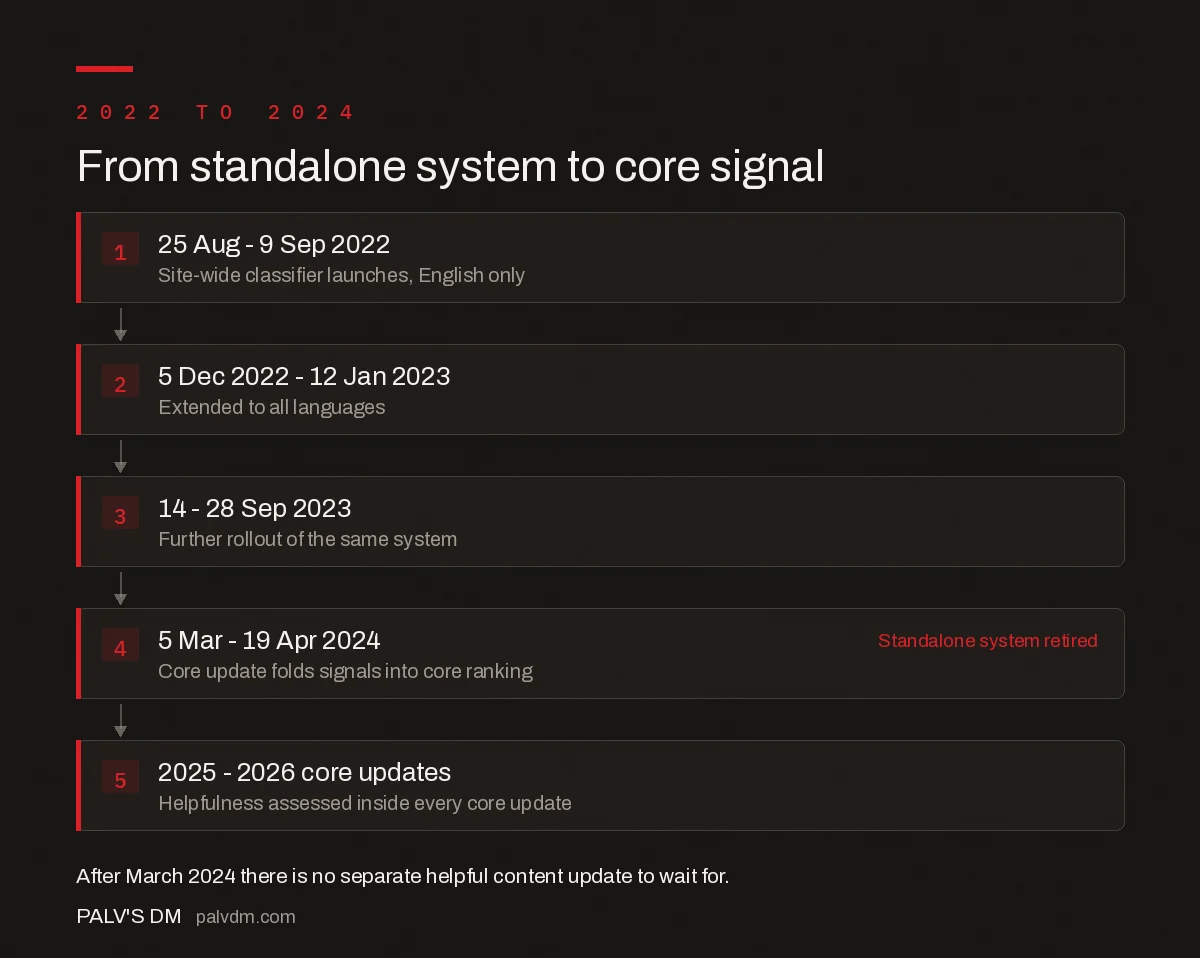
From standalone system to core signal
- 25 Aug – 9 Sep 2022. Site-wide classifier launches, English only.
- 5 Dec 2022 – 12 Jan 2023. Extended to all languages.
- 14 – 28 Sep 2023. Further rollout of the same system.
- 5 Mar – 19 Apr 2024. Core update folds signals into core ranking. Standalone system retired
- 2025 – 2026 core updates. Helpfulness assessed inside every core update.
Frequently asked questions
Does the helpful content update still exist?
No, not as a standalone system. Google folded the helpful content signals into its core ranking systems with the March 2024 core update and removed the standalone helpful content system from its ranking systems documentation. Helpfulness is now assessed by multiple signals inside every core update rather than by one separate classifier running on its own schedule.
When did the helpful content update launch?
Google announced the helpful content update in August 2022 and rolled it out between 25 August and 9 September 2022, initially for English-language searches. It was extended to all languages in a rollout running from 5 December 2022 to 12 January 2023, and a further helpful content update ran from 14 to 28 September 2023.
How do you recover from the helpful content update now?
Through core updates, because there is no separate helpful content update left to wait for. Google states that no specific actions guarantee recovery, that a drop does not necessarily mean something is wrong, and that the largest changes tend to arrive with a subsequent core update. Both 2026 core updates ran twelve days each, which sets the realistic rhythm for reassessment.
Was the helpful content update aimed at AI content?
No. Google’s published position, set out in February 2023, is that it rewards high-quality content however it is produced, and that using automation primarily to manipulate rankings is a spam policy violation. The March 2024 work targeted scaled content abuse, meaning pages produced at volume primarily for ranking rather than for readers, regardless of whether people or models wrote them.
What did Google mean by a 45% reduction in low-quality content?
With the March 2024 core update Google said it expected the combined changes to reduce low-quality, unoriginal content in search results by 40%, a figure it later revised upward to 45%. That is Google’s own stated expectation for its own systems rather than a measured result published afterwards, and no independent verification of the figure exists.
Is the helpful content update the same as Panda?
They are different updates with a similar lifecycle. Panda, launched in 2011, was also a site-level quality assessment that ran on a periodic refresh and was eventually absorbed into Google’s core ranking systems. The helpful content system followed the same arc between 2022 and 2024. The lesson both share is to work from Google’s documented guidance rather than from a system name.
Sources
- What web creators should know about our March 2024 core update and new spam policies
- What creators should know about Google's helpful content update
- Creating helpful, reliable, people-first content — Search Central
- A guide to Google Search ranking systems
Want this done on your site?
Every PalV’s DM engagement starts with a free audit of your actual website — a 12-point
crawl covering what is blocking indexation, on-page gaps against your primary keywords, speed
findings, and the three to five fixes worth making first. Delivered in two working days. No
payment details, and the findings are yours whether you hire us or not.